Théodore Géricault · PD
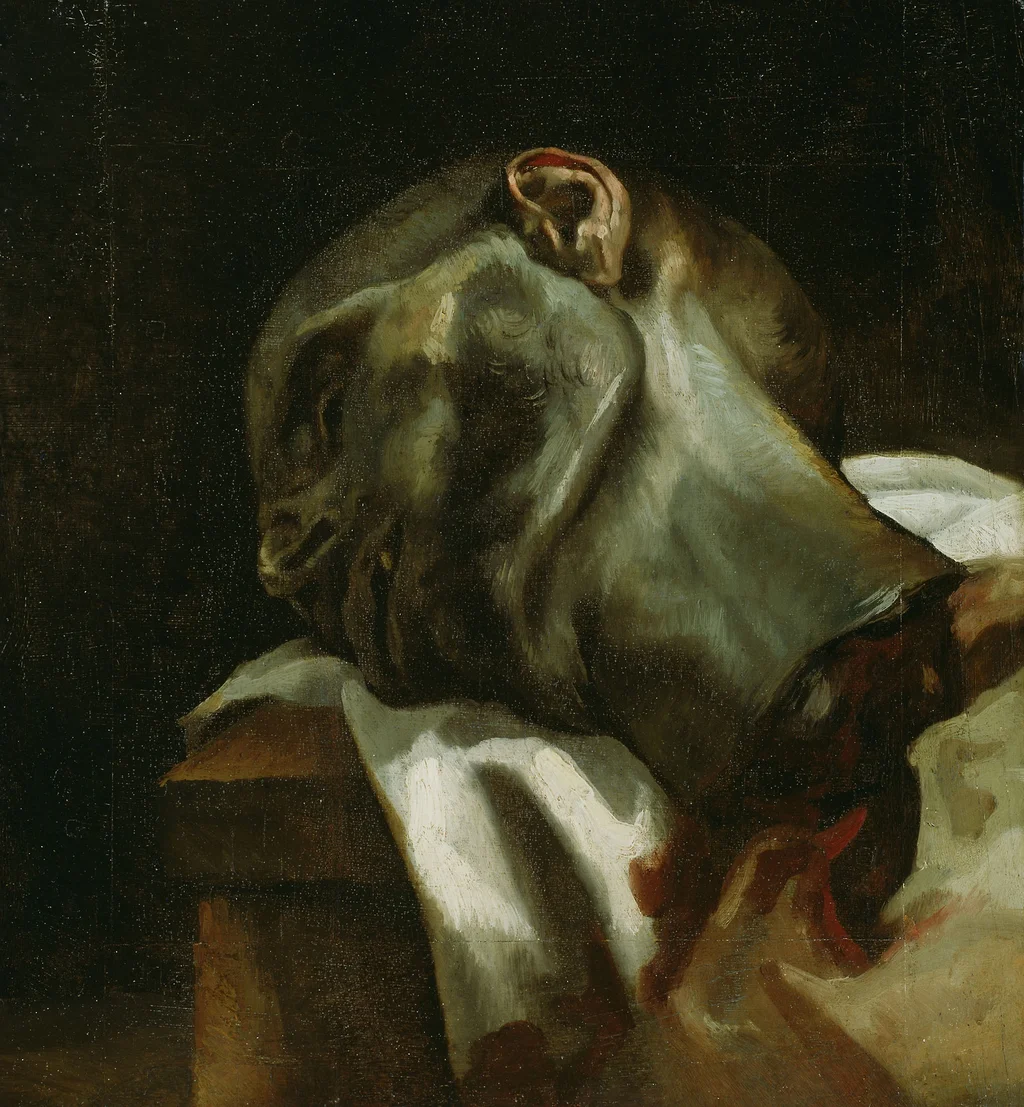
Head of a Guillotined Man
Details
The story
Ten months after Géricault died in January 1824, aged 32, the contents of his studio were auctioned in Paris. In one copy of the sale catalogue, now in the British Museum, someone added by hand “three heads of guillotined men”, sold for 270 francs, and this panel may be one of them. It shows just that: the grey head of an executed man, probably a convicted criminal, laid on a blood-stained cloth over a wooden table. In 1818, under the restored Bourbon monarchy, executions in Paris were still carried out in public, and in 1992 the art historian Nina Athanassoglou-Kallmyer connected Géricault's severed heads to the politics of the scaffold. The Art Institute, which bought the panel that same year, points to the table, the white cloth and the dark ground, the ordinary props of a still life. Before Chicago it belonged to the painter Auguste Boulard and later to the Duc de Trévise, a collector who lent it to the Paris exhibition marking the centenary of Géricault's death in 1924.