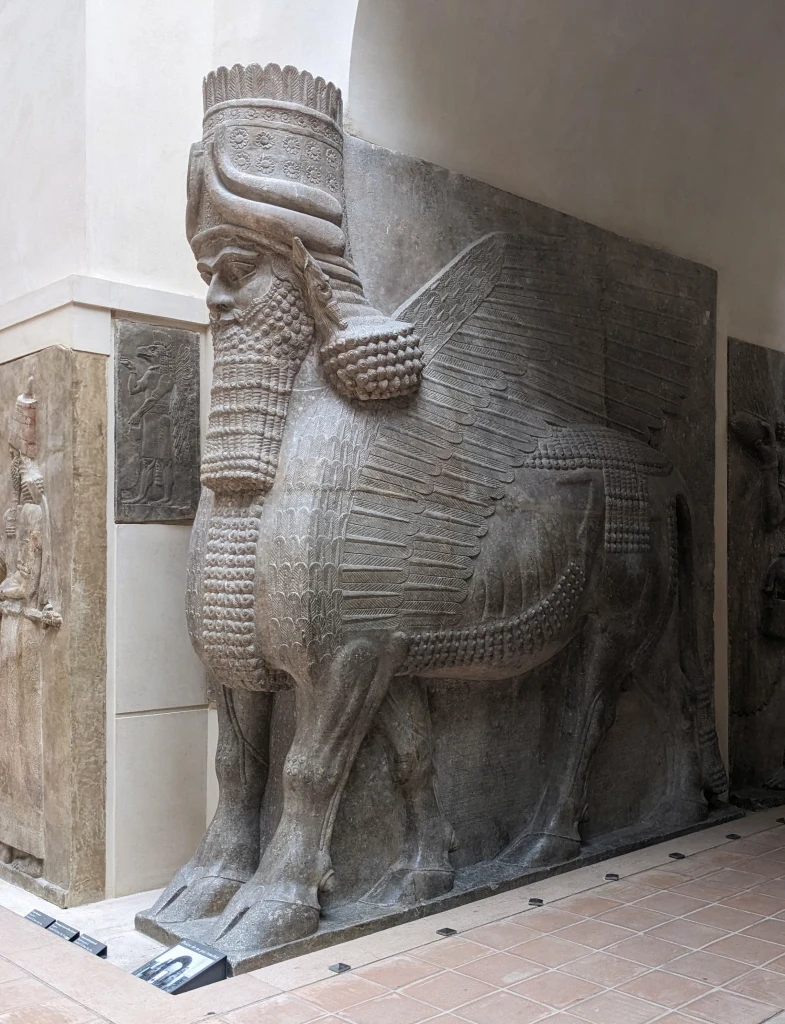
Human-headed winged bull (lamassu) from the palace of Sargon II at Khorsabad
Details
The story
In 717 BC the Assyrian king Sargon II began building a new capital on open ground north-east of Nineveh and named it Dur-Sharrukin, the Fortress of Sargon. It was barely finished when he was killed in battle in 705, and his son Sennacherib moved the court to Nineveh, leaving the new city largely empty. This bull with a man's head and an eagle's wings stood at one of the palace gateways as a guardian. Count its legs and you get five. From the front it stands still on two, and from the side it strides on four, so the carvers gave it both views at once. The French consul at Mosul, Paul-Émile Botta, uncovered it in 1843 and 1844 near the village of Khorsabad, which sits on the ruins. Too heavy to move whole, it was sawn into six pieces for the journey and shipped to France in 1846.
