The Louvre became a public museum on August 10, 1793, the first anniversary of the fall of the monarchy. The date was chosen with intent: the palace of the French kings was opened to the public on the very day the overthrow of the king was being celebrated, and the collection that had belonged to the crown was declared the property of the nation. In those first years, though, “public” meant something different from what it means now. Half of the ten-day republican week belonged to artists and copyists, the public was let in on three days, and the remaining two went to cleaning.
Today the Louvre holds around half a million objects, with some 30,000 of them on display. Nobody can see it all in one visit, so we have picked twenty-five works and will take them in order of time, from an Egyptian statue four and a half thousand years old to a barricade of 1830.
01. What the French Dug Up in the Nineteenth Century
Talk about the Louvre usually begins with the Mona Lisa, although the palace was filling up long before she became its star. A large part of the collection arrived through nineteenth-century excavations. French consuls and diplomats in Egypt, Mesopotamia and the lands of the Ottoman Empire organized and paid for the digs, hired local laborers, chose the finds themselves and shipped them to Paris. We begin with five of those finds, because they are older than anything else on our list.
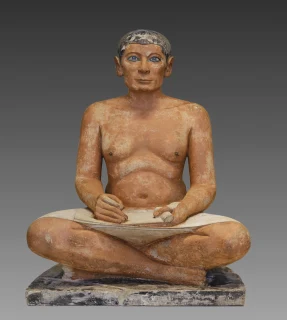
1. The Seated Scribe
The eyes of this statue are made of four materials. The whites are white magnesite and the irises polished rock crystal, with a dark backing behind the crystal standing in for the pupil, and a copper rim runs around the edge in place of an eyelid.
All this was done for people who would look at the statue from close by. From a distance the eyes look like ordinary stone, but close up the crystal catches the light and the statue’s gaze follows you. That was the intention, although we do not know exactly where the statue stood: it was found in the necropolis of Saqqara near Memphis, the journals of that excavation are lost, and little is known about how it was found. Most likely it was part of the furnishings of a tomb and was meant for the people who came to visit it.
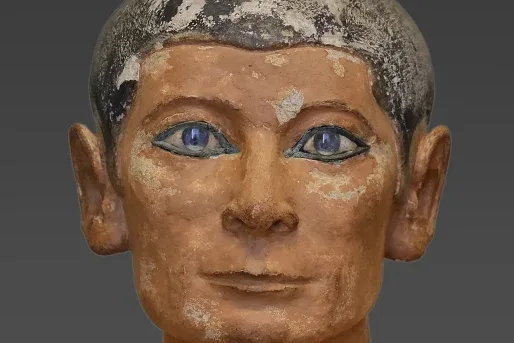
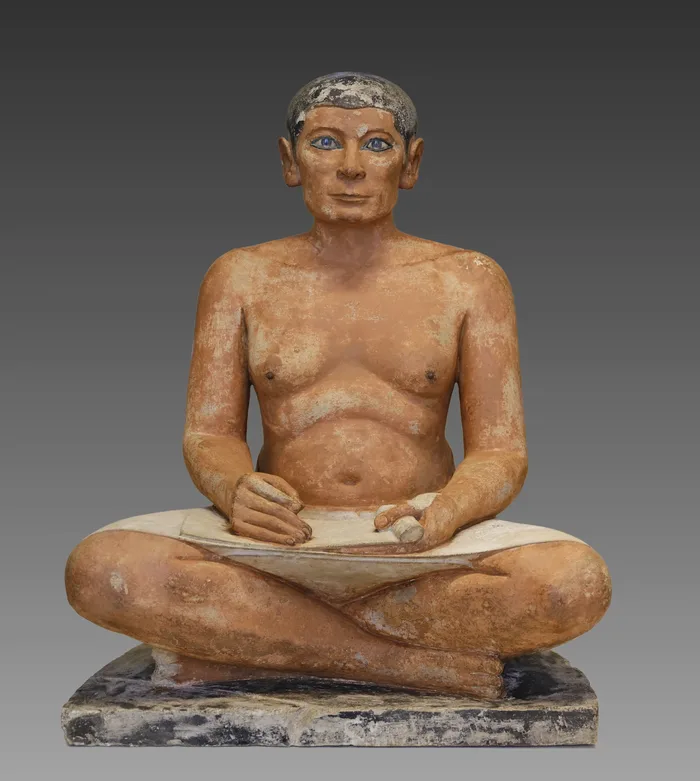
The figure itself is painted limestone, just under 54 centimeters tall. A man sits cross-legged with a papyrus unrolled across his lap, his back straight and his face raised. Egyptian sculptors knew how to make a body ideal, yet here, for some reason, they did not, and he has a slight paunch, a heavy jaw and the face of a man no longer young. The right hand is shaped to hold a reed pen, but there is no pen in it.
Nobody knows who he was. “Scribe” is a label of convenience. No name or title was found with the statue, and in Egypt the ability to write was a sign of high standing and did not necessarily mean it was a man’s profession.
The statue was found in 1850 by Auguste Mariette, a French Egyptologist who had come to Egypt to collect Coptic manuscripts and stayed on to excavate, and four years later the Louvre bought it. In 1858 Mariette became head of Egypt’s Antiquities Service and secured a ban on taking finds out of the country.
2. The Stele of Hammurabi
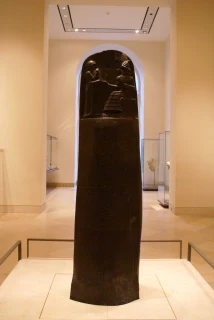
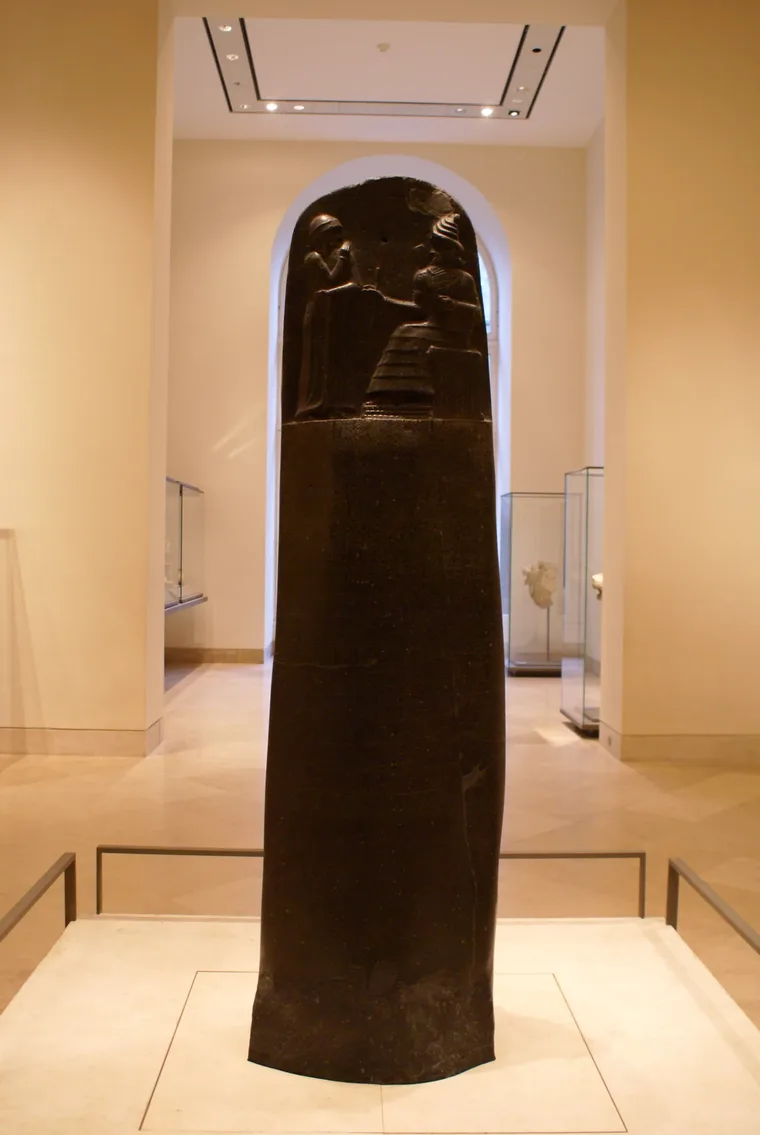
A pillar of dark stone just over two and a quarter meters tall is covered in cuneiform from top to bottom, so evenly and densely that from a few steps away the inscription looks like a woven pattern. Above the text is a relief. The king stands with his hand raised in greeting before the seated sun god Shamash, who holds out a rod and a ring to him while flames rise from the god’s shoulders. Their faces are at the same height, although one is seated and the other standing.
Below come the laws, for the few who could read: hundreds of clauses on debts, injuries, marriage, hired oxen, collapsed houses and what to pay a boatman. The relief at the top was for everyone else, and a Babylonian of the time needed no one to explain it, because it meant one thing only, that the laws had been laid down by a king who received his power from the hand of a god.
Law codes had been drawn up in Mesopotamia before Hammurabi, some of them three centuries earlier, but they were written on clay tablets and kept in palace archives. Hammurabi’s laws were carved in stone and set up for everyone to see.
Around 1155 BCE, six hundred years after the stele was carved, the Elamite king Shutruk-Nakhunte defeated the Babylonians, took Babylon and carried off everything he thought worth having, this stele included. In his capital, Susa, in what is now southwestern Iran, he had seven columns of the laws below the relief scraped away to make room for an inscription about his own victories. That inscription was never carved, and at the bottom of the front face there is still a blank patch with the text running on around it.
In the winter of 1901–1902 Jacques de Morgan’s French archaeological mission found the stele at Susa, broken into three pieces. The pieces were sent to Paris and joined together, and the stele has been on display in the Louvre since 1904.
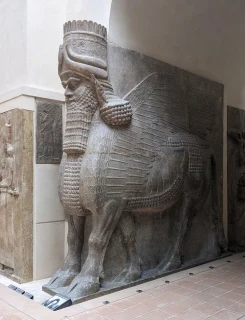
3. The Lamassu from Khorsabad
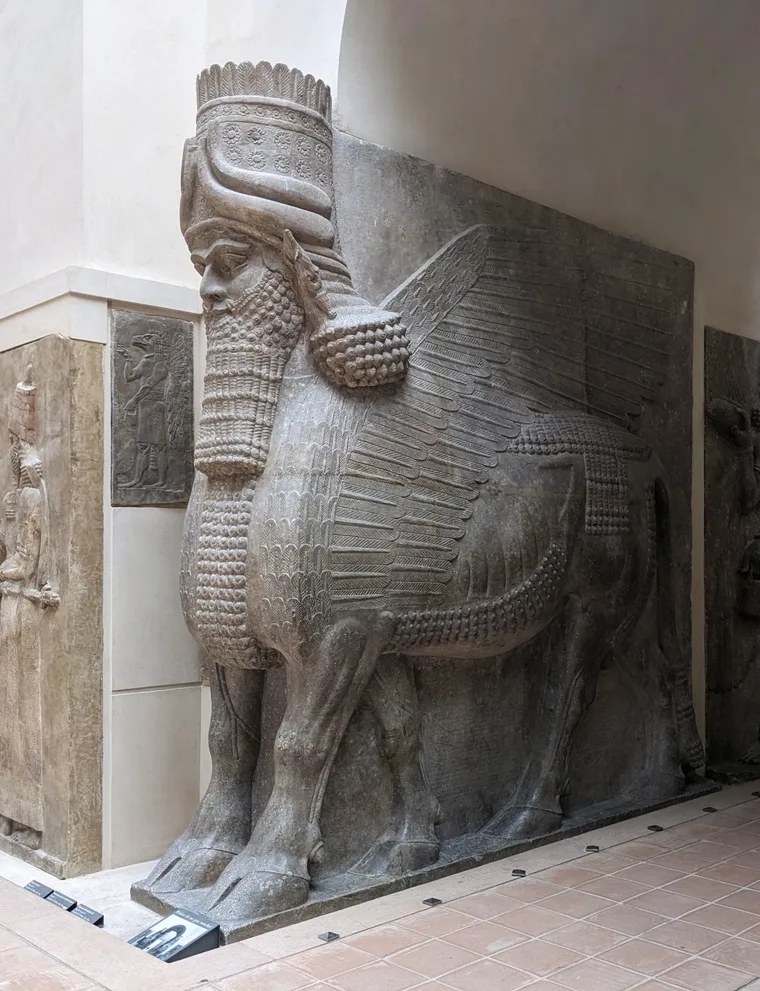
This bull has five legs, and the carver added the fifth on purpose.
The winged bull with a human head was carved for Sargon II, king of Assyria from 721 to 705 BCE, for the palace in the new capital he was building and had named after himself, Dur-Sharrukin. It has a bearded human head, a bull’s body, wings folded along its flanks and a horned cap.
It stood in a gateway, and people saw it from two positions. From the front there are two forelegs set side by side, and the animal stands still, blocking the way. From the side there are four legs in motion, and the bull strides along the passage. So everyone who entered Sargon’s palace to petition, to negotiate or to surrender first came face to face with a standing animal, and once through the gate saw it walking.
It reached the Louvre through Paul-Émile Botta, the French consul in Mosul, who began digging at Khorsabad in 1843, chose for himself what would be taken away, and in 1846 shipped his selection to Paris.
The next consignment had worse luck. In May 1855 rafts loaded with Assyrian sculpture were going down the Tigris, and near Qurna they were attacked by local tribesmen. Most of the cargo sank and lies there still, and nobody knows exactly what went to the bottom, or how much of it.
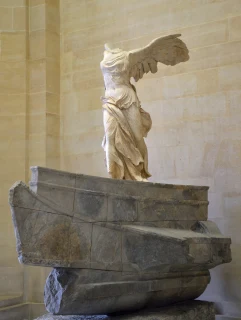
4. Winged Victory of Samothrace
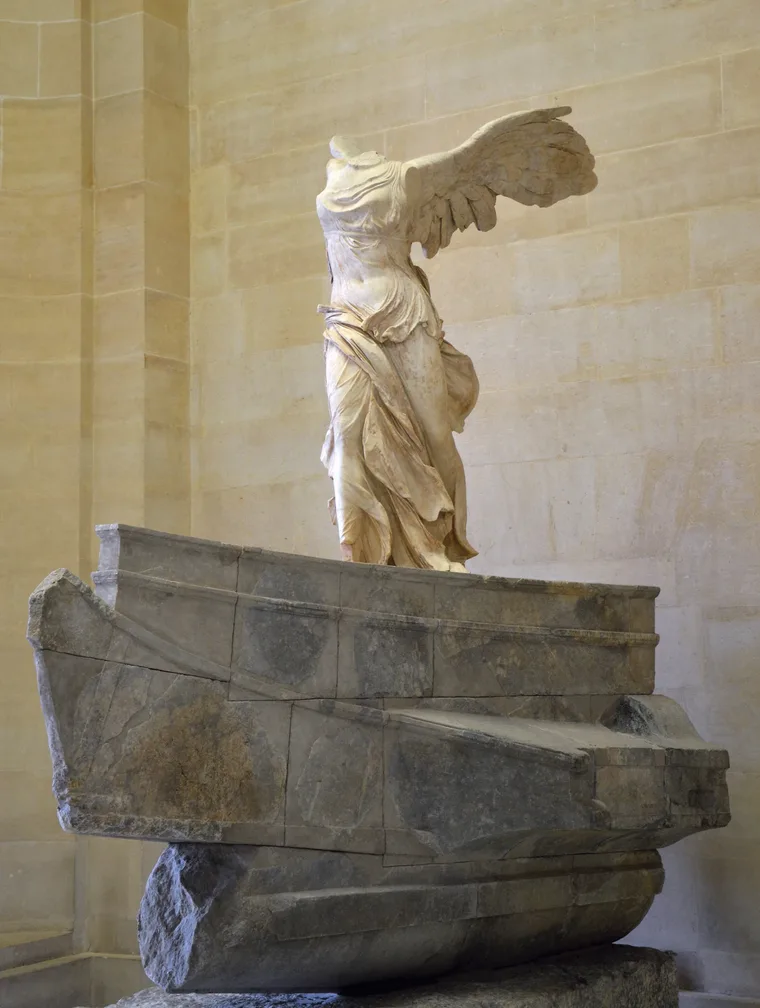
In this sculpture you can see the wind. The right leg is thrust forward and braced, the wet cloth clings to the thigh and follows its shape, and on the other side the same cloth is torn away from the body and flung back in a long train between the wings. The torso turns against the wings, the chest pushed forward. She is still in the air, alighting on the ship’s prow out of the sky.
She was carved around 190 BCE from Parian marble and set up in the Sanctuary of the Great Gods on the island of Samothrace. The head and arms were broken off, and nobody knows when. The head has never been found, but the right hand was found on Samothrace in 1950 and is displayed beside the statue. The sense of movement has hardly suffered, because it comes from the pose and the drapery.
In the sanctuary she was set up high, above the heads of the people who came to be initiated into the local mysteries, of which little record survives. They saw her from below and from a distance, against the sky.
She came to Paris as a heap of fragments. Charles Champoiseau, the French vice-consul at Adrianople and a keen amateur excavator, dug the figure up on Samothrace in 1863 and sent it to the Louvre. He took the gray marble blocks of the ship’s prow she had stood on for building rubble and left them on the island, and he went back for them only in 1879. Everything was put together in the 1880s and raised to the top landing of the great staircase, so that once again she has to be seen from below and at a distance, as she was in the sanctuary.
The left wing survives from antiquity. The right one was made in the museum, as a plaster cast mirroring the left.
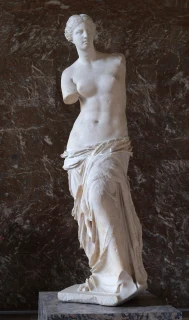
5. Venus de Milo
In 1820 a peasant on the island of Melos found a marble woman in the ground. A French naval officer heard about the find, the Marquis de Rivière bought the statue and presented it to Louis XVIII, and in 1821 the king gave it to the Louvre. The timing was lucky: five years earlier, when the Napoleonic collections were being broken up and sent back across Europe, the Medici Venus had left Paris for Tuscany. It had once been carried off from Florence, and in those days it was held to be the most famous ancient Venus on the continent. The Louvre had lost its great ancient beauty, and the new statue was brought in to take her place.
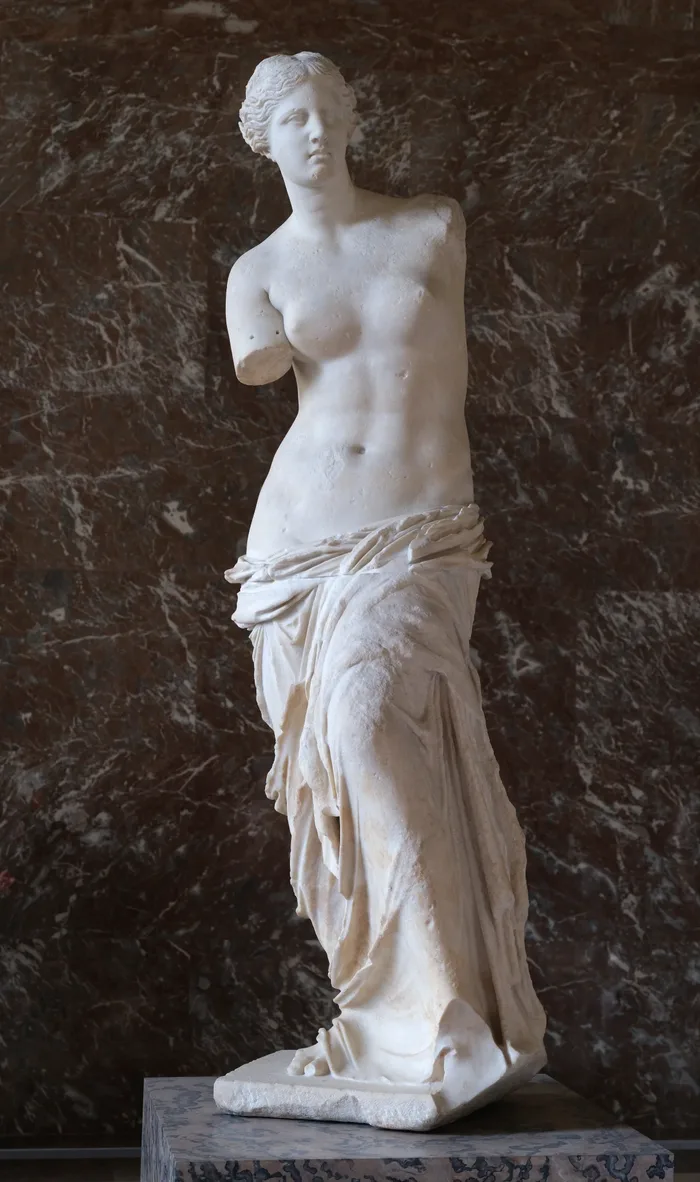
Then the promotion began. The statue was reproduced in engravings and examined at length in specialist publications, and one well-known archaeologist and critic after another declared it among the summits of ancient sculpture. About a year after she entered the museum, she had already been painted on the ceiling of one of the Louvre’s rooms.
She stands a little over two meters tall. The woman turns at the waist, and the drapery slides down her hips and is caught a moment before it falls. The arms are gone, and we do not know what she held. Nor do we know whether she is Venus at all, where on Melos she stood, or what she was for. Reconstructions have put an apple in her hand, or a mirror, a shield, a spear, the edge of her own drapery, and each time the result was a different statue.
How she was made, on the other hand, is known. Marble for figures like this was rarely available as a single block of the right size, so the statue was assembled from several blocks, and the join runs across the hip, hidden under the folds of the drapery.
02. The First Paintings, and a Man Named Denon
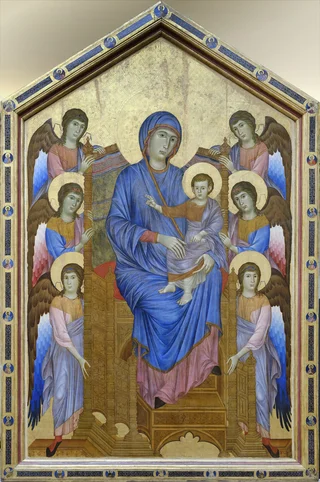
6. Cimabue. Maestà
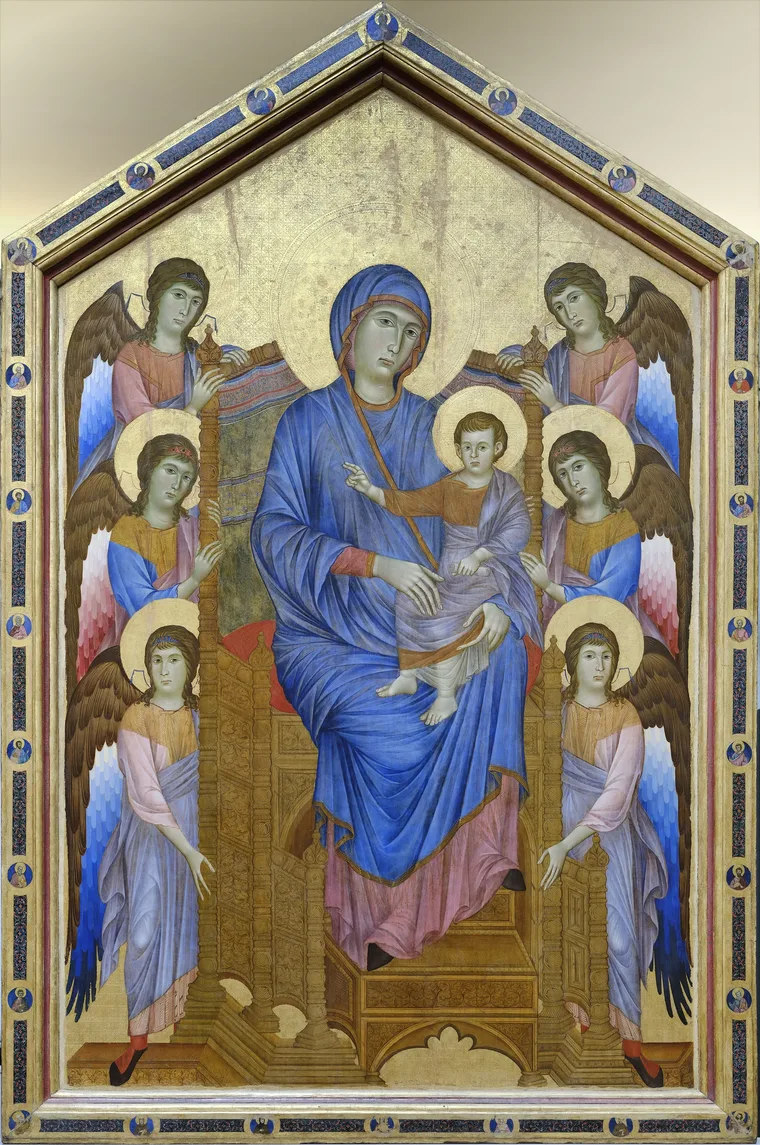
The Virgin sits on a throne with the Child on her knees, and the throne is held aloft by six angels, three on each side, set one above another in tiers. The background is solid gold, the faces are long, and the folds of the robes are traced in gold lines over the paint. The panel is more than four meters high, and it was painted around 1280 for the church of San Francesco in Pisa.
Cimabue worked in the Byzantine manner, which had held on in Italy for several centuries: gold in place of space, rigid poses, no depth. Even so, his angels stand one behind another, stepping back, and the throne recedes into the picture. A generation later his pupil Giotto would start painting differently, giving his figures weight and volume, placing them in space and having them act the way people act. Giotto kept the gold ground all the same, and the Louvre has his Saint Francis Receiving the Stigmata, painted against gold.
The Maestà came to Paris in 1812. Napoleon’s armies had occupied Italy, and behind them came commissioners choosing works for the museum at the Louvre. The operation was run by Dominique-Vivant Denon, the museum’s director, an engraver and diplomat with a fine eye for painting. Besides the famous Venetians and Romans, he took the Italian primitives, painters of the thirteenth and fourteenth centuries whom Europe at the time regarded as clumsy forerunners of real art and hardly bothered to collect.
After Waterloo the Allies made France hand back most of what had been taken. The Maestà stayed: Pisa never came for it, and the French did not remind anyone. On the whole Denon returned noticeably less than was demanded of him, and we will see further on how he managed it.
7. Jan van Eyck. Madonna of Chancellor Rolin
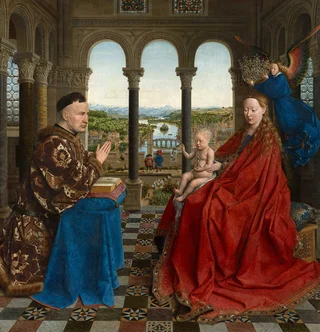
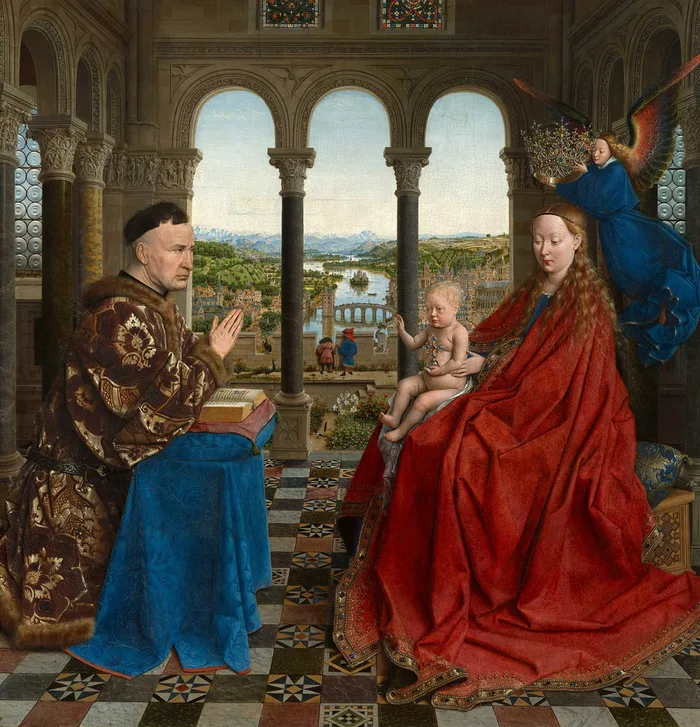
In the left half of the picture an older man in a brocade robe kneels with an open book in front of him. In the right half sits the Virgin with the Child, and an angel holds a crown over her head. Each of them takes up exactly half the panel, and they are painted at the same scale, facing each other, on the same floor, in the same loggia.
The man is Nicolas Rolin, chancellor of Burgundy, which made him the chief minister of Duke Philip the Good and one of the richest men of his time. Donors had been painted into pictures before, but they were placed in a corner and made noticeably smaller than the saints, so that the difference in rank could be read at once. Rolin had himself painted level with the Virgin and got what he wanted. He commissioned the picture around 1435 for a church in Autun, his home town, where it stayed until the Revolution, and in 1800 it was taken to the Louvre.
Van Eyck worked in oil, in thin transparent layers, and achieved astonishing precision. On a panel only 66 by 62 centimeters he painted the separate hairs of the fur trim, the letters in the book, the pattern of the tiled floor and the stones in the crown.
Beyond the columns of the loggia a city opens out: a river with an island, a bridge with people crossing it, roofs, towers, fields, and mountains on the horizon. The city is put together from different places and appears on no map, although some of its buildings have been identified. The figures on the bridge are the size of a grain of rice, and yet you can tell which way each of them is walking.
8. Giorgione or Titian. Pastoral Concert
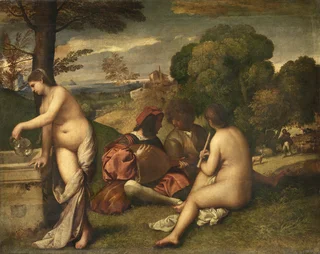
Two young men sit on the grass, one with a lute, talking to each other. Beside them are two naked women. One pours water from a glass jug into a well, and the other sits with her back to us, holding a flute. The men do not look at the women and, by every sign, do not see them.
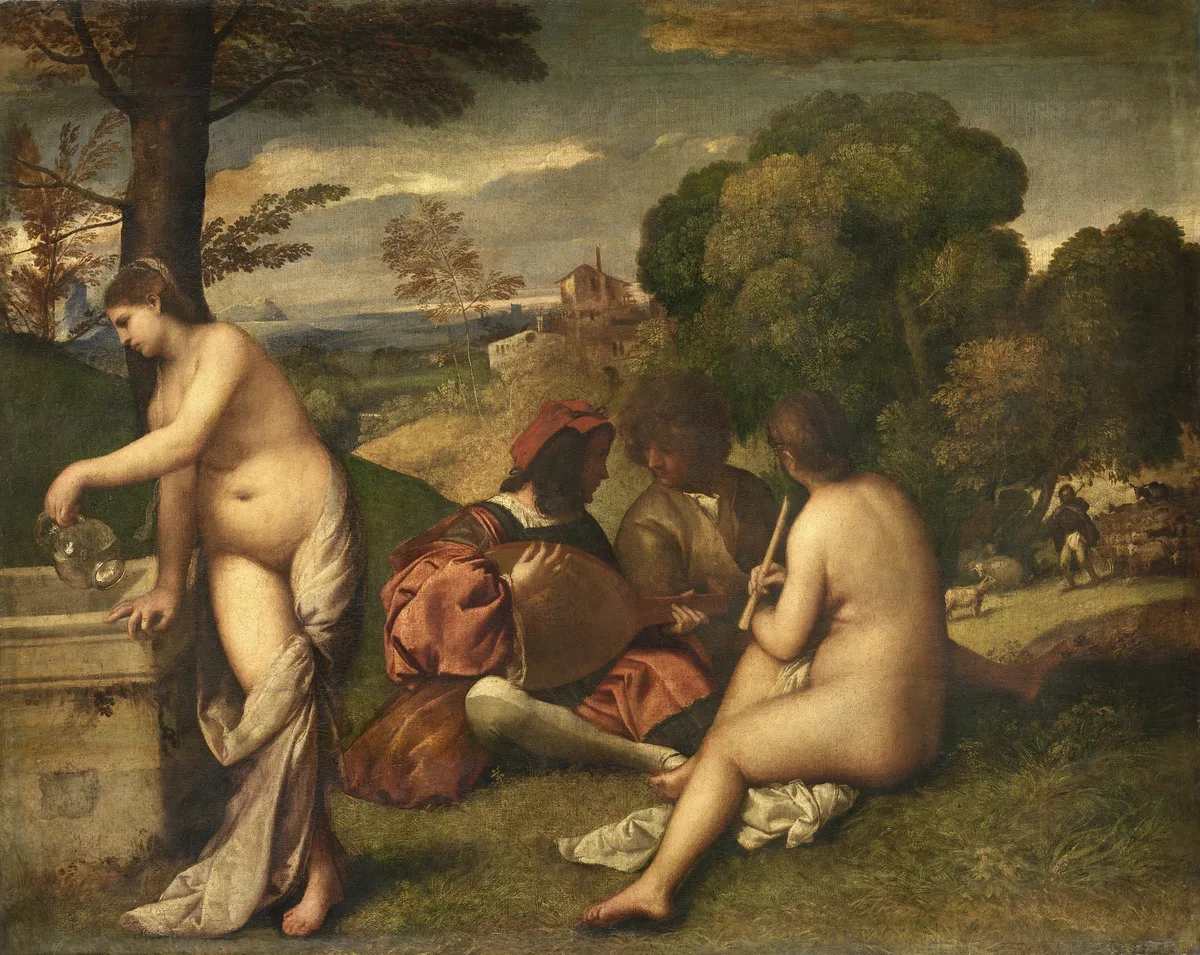
Most likely the women are Muses, or personifications of music itself, visible only to the viewer, and the picture was painted for a small circle of Venetian connoisseurs who liked such puzzles and knew how to solve them. Nobody has yet offered an explanation that settles it.
The argument over who painted it has gone on for more than two hundred years. For a long time the picture was given to Giorgione, a Venetian who died of plague in 1510 at about 33 and left fewer than ten works, none of them signed. Then close study of the brushwork led many scholars to give the Concert to the young Titian, Giorgione’s pupil and companion, who after his death finished the pictures he had left incomplete. Today the Louvre lists it under Titian, but there is no consensus, and some specialists hold to Giorgione or suggest the two worked on it together.
The picture entered the French royal collection in 1671, when Louis XIV bought the collection of Eberhard Jabach, a banker from Cologne who had run into money trouble. We will meet his name again.
03. Leonardo, Who Never Let Go
9. Leonardo da Vinci. Virgin of the Rocks
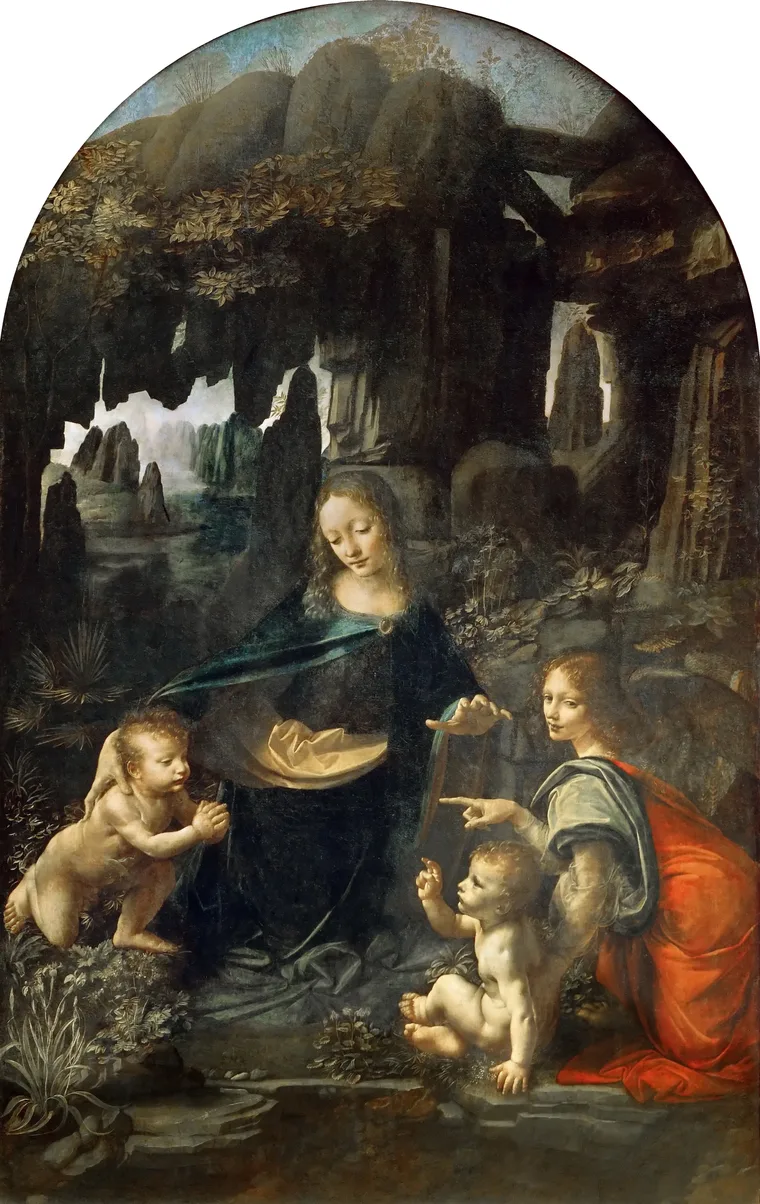
In 1483 the Confraternity of the Immaculate Conception in Milan commissioned Leonardo and the de Predis brothers to paint a large altarpiece for its chapel in the church of San Francesco Grande. The contract set out deadlines, payments and even the gilding of the frames. What followed was a dispute over money that dragged on for more than twenty years and went as far as the courts and petitions to the king of France.
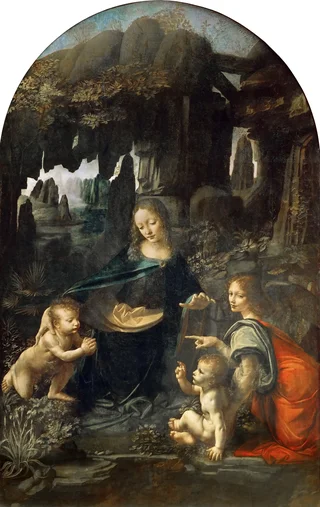
The picture at the center of it all looks like this. In a dim grotto the Madonna kneels, one arm around the infant John the Baptist, her other hand held above the head of the infant Christ. Christ sits on the ground and raises his hand, blessing John. Beside him an angel supports his back and points at John. Behind the figures are rocks hollowed out by water, and between them an opening onto water and misty light.
Leonardo’s grottoes came from study. For many years he kept notes on geology, on the movement of water and on how rock wears away, and the stone in this picture is layered the way real stone layers.
Historians are not sure what exactly the lawsuit was about. There are several theories: the confraternity thought the painter was asking for more than had been agreed, or that the work was delivered late, or that the picture did not match the commission, since the figures have no haloes and the saints can be told apart only by their gestures.
In the end a second, different version of the same composition was hung in the chapel, with haloes and with a cross in John’s hands. That version is in London today. No document explains what became of the first. It left Milan before the lawsuit was over, and by the seventeenth century it was already listed in the French royal collection at Fontainebleau. How it got there is unknown.
10. Leonardo da Vinci. Mona Lisa
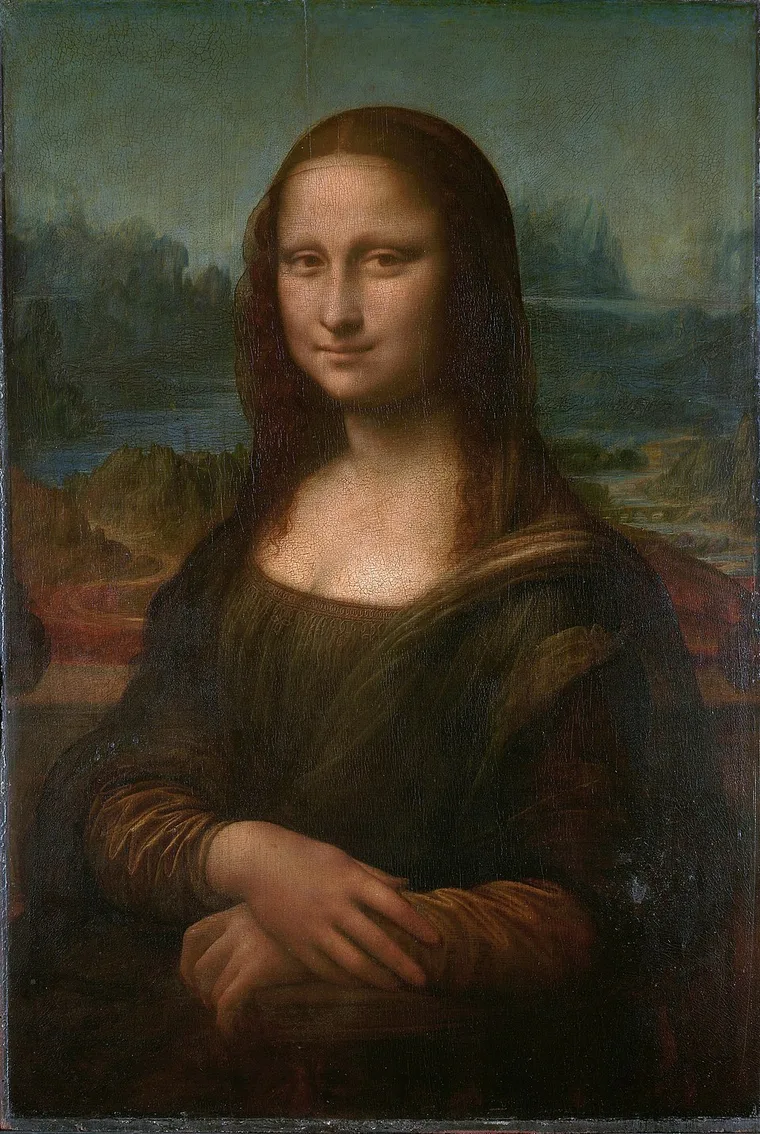
Leonardo did the same thing with the Mona Lisa: the man who commissioned it never received it.
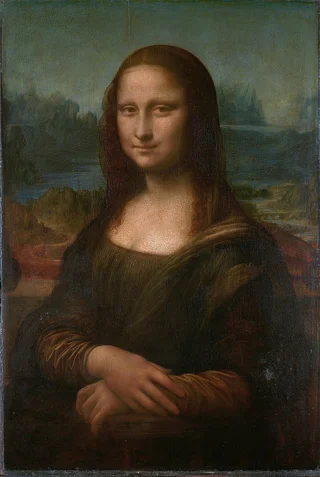
The woman in the portrait is almost certainly Lisa Gherardini, wife of the Florentine silk merchant Francesco del Giocondo, and Leonardo seems to have begun the painting for her husband around 1503. He kept the finished picture, took it with him whenever he moved, and went on reworking it for many years. He did this more than once, and it drove his clients to despair. In 1516 he moved to France at the invitation of Francis I, and the portrait went with him. The king acquired it, most likely in 1518. From then on the picture belonged to the royal collection and later the national one, hanging among other pictures, known to connoisseurs, artists and collectors, and for nearly four hundred years it drew no crowd at all.
More nonsense has been written about the smile than about anything else in European painting, so it is worth looking at the picture another way. Leonardo laid the paint on in dozens of semi-transparent layers, each thinner than the one before, and softened the edges until no brushstroke shows and the outlines of the lips and eyes melt away. The landscape comes out of the same way of working. The rocks, the water and the misty distance behind her correspond to no place on any map, there is no road from the parapet into the distance, and the horizon to the left of her head sits noticeably lower than on the right. Leonardo painted the picture over years, adding layer upon layer, and he had no reason to make the landscape add up to a single place.
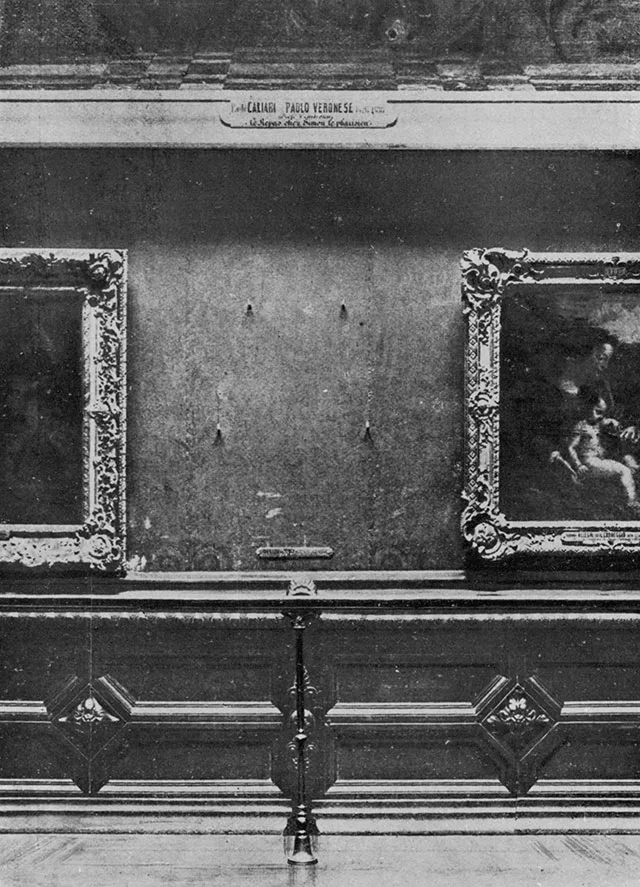
Then, on Monday, August 21, 1911, Vincenzo Peruggia carried the panel out of the museum. He was an Italian house painter who worked in the Louvre as a contractor, fitting protective glass over paintings, and he had handled this very picture before. The museum was closed on Mondays. Peruggia took the panel off the wall in the Salon Carré, removed the frame on a service staircase, hid the painting under his clothes and walked out. More than a day went by before anyone at the museum realized the picture had not been taken away to be photographed.
When the rooms reopened, the public came to look at the place where it had hung. The wall was bare, with four iron pegs sticking out of it. In the autumn of 1911 the visitors included Franz Kafka and Max Brod, who came specifically to look at the empty space and later wrote about it. It is often said that more people came to see the empty wall than had come to see the picture the year before, as if someone had been counting. Nobody counted. The documented part is enough: the most famous period in the history of the most famous painting in the world turned out to be the two years when it was not there.
It turned up in Florence in 1913, when Peruggia tried to sell it to an antiques dealer. At his trial he said he had wanted to bring an Italian painting home. That was his own account of his motives, and it has been retold in different ways ever since. One thing is certain: the Mona Lisa was never Napoleonic loot, since it entered the French royal collection two and a half centuries before Napoleon was born.
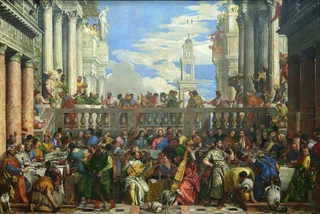
11. Paolo Veronese. The Wedding at Cana
This painting belongs right after the Mona Lisa for a simple reason: several thousand people a day stand with their backs to it. The canvas, almost ten meters wide, hangs on the opposite wall of the same room, and hardly anyone looks at it.
From 1563 it covered the end wall of the refectory of the monastery of San Giorgio Maggiore in Venice. Under the Benedictine rule one brother read aloud while the others ate in silence.
The feast in the picture is a noisy one. Musicians play in the middle of the hall, servants lean over the balustrade with dishes, a dog stands on the table, someone holds a glass up to the light, a carcass is being butchered on the terrace above, and all the guests are talking at once. Christ sits at the center of the table, facing the viewer. The water in the jars has just turned into wine at his word, and almost no one at the feast has noticed.
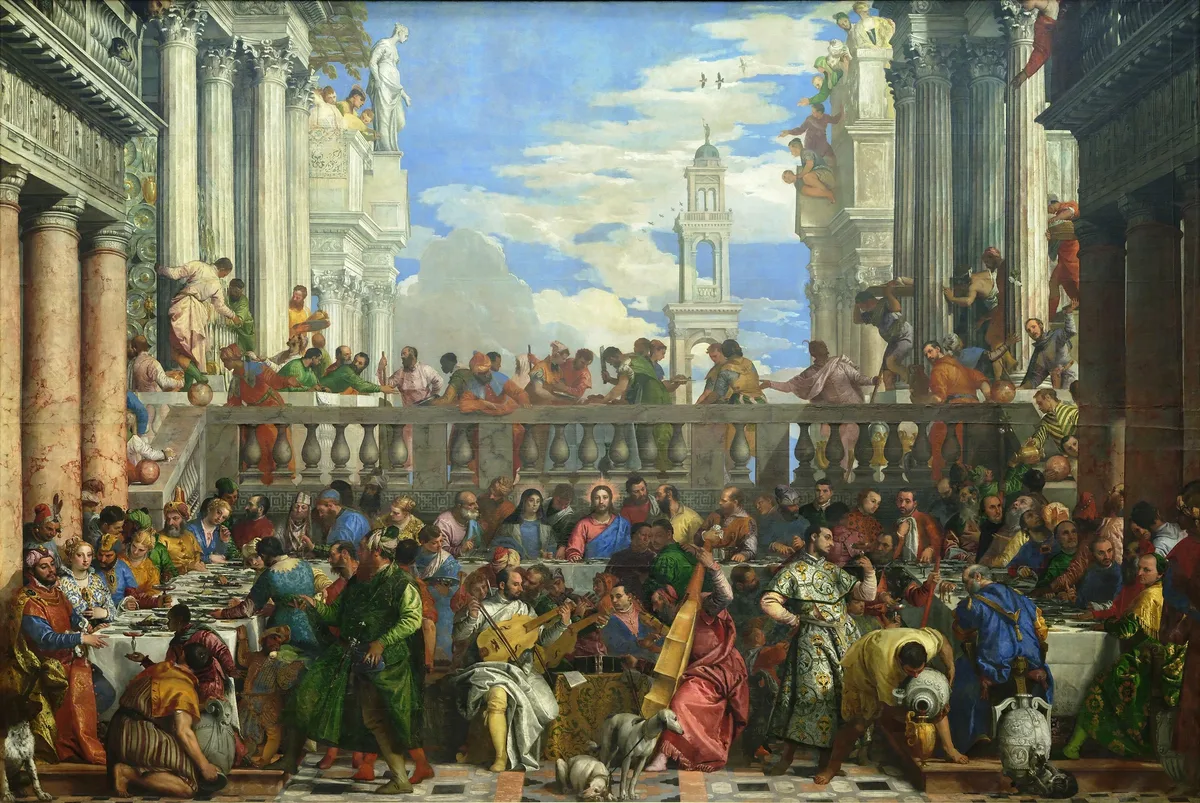
Among the musicians in the foreground stands an hourglass. The detail was meant for the monks who ate beneath this picture every day, with wine enough for everyone, merry guests, and the sand running. At every meal these men sat listening to reminders of how short life is.
In 1797 the French commissioners attached to the Army of Italy took the canvas down from the wall. It could not be moved in one piece, so it was cut into sections, rolled up, carried to Paris and sewn back together there. The Louvre makes no secret of it: the museum’s own catalogue record gives the mode of acquisition as military conquest.
After Waterloo the picture was due to go back. The Allies were returning plunder across Europe and Venice demanded what was its own, and at that point Denon explained that the canvas, which had already been cut up once, would not survive another crossing of the Alps, and offered a large painting by Charles Le Brun instead. Venice took the Le Brun.
Nobody recorded whether Denon believed his own argument.
04. Patrons in Rome
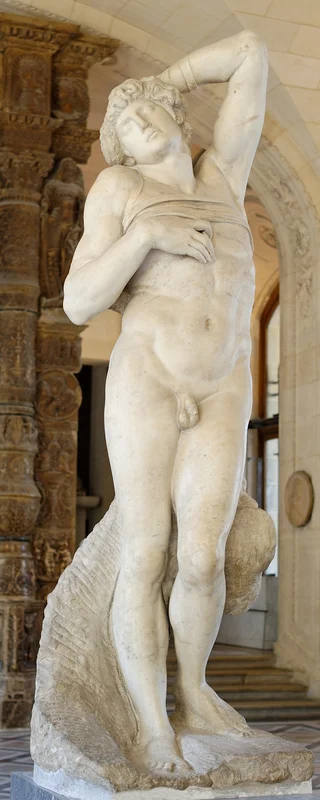
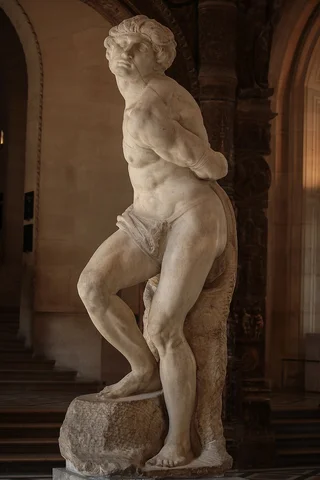
12. Michelangelo. The Dying Slave and the Rebellious Slave
In 1505 Pope Julius II summoned Michelangelo to Rome and commissioned a tomb for himself: a free-standing structure in three tiers with more than forty figures, set in the middle of St. Peter’s. Michelangelo spent eight months in the quarries at Carrara choosing marble, and then the pope lost interest and turned to rebuilding the basilica itself.
After that the affair dragged on for forty years. Julius II died in 1513, his heirs demanded the work the contract promised, the contract was rewritten six times, each time shrinking the design, and Michelangelo called the whole business the tragedy of the tomb. In 1513 the heirs signed a new contract with him for a smaller monument, and it was for this design that he carved the two slaves. The contract was rewritten several more times after that, the tomb kept shrinking, and under the last contract, in 1542, there was no longer room for either figure. It all ended as a modest wall monument in the church of San Pietro in Vincoli, where the Moses is all that remains of the original plan.
The Dying Slave has thrown his head back and lifts one arm behind it, the way a person stretches on waking. The Rebellious Slave has his hands bound behind his back, twisting his torso and straining against the bonds, and in places the surface of his body is left unfinished, still marked by the chisel.
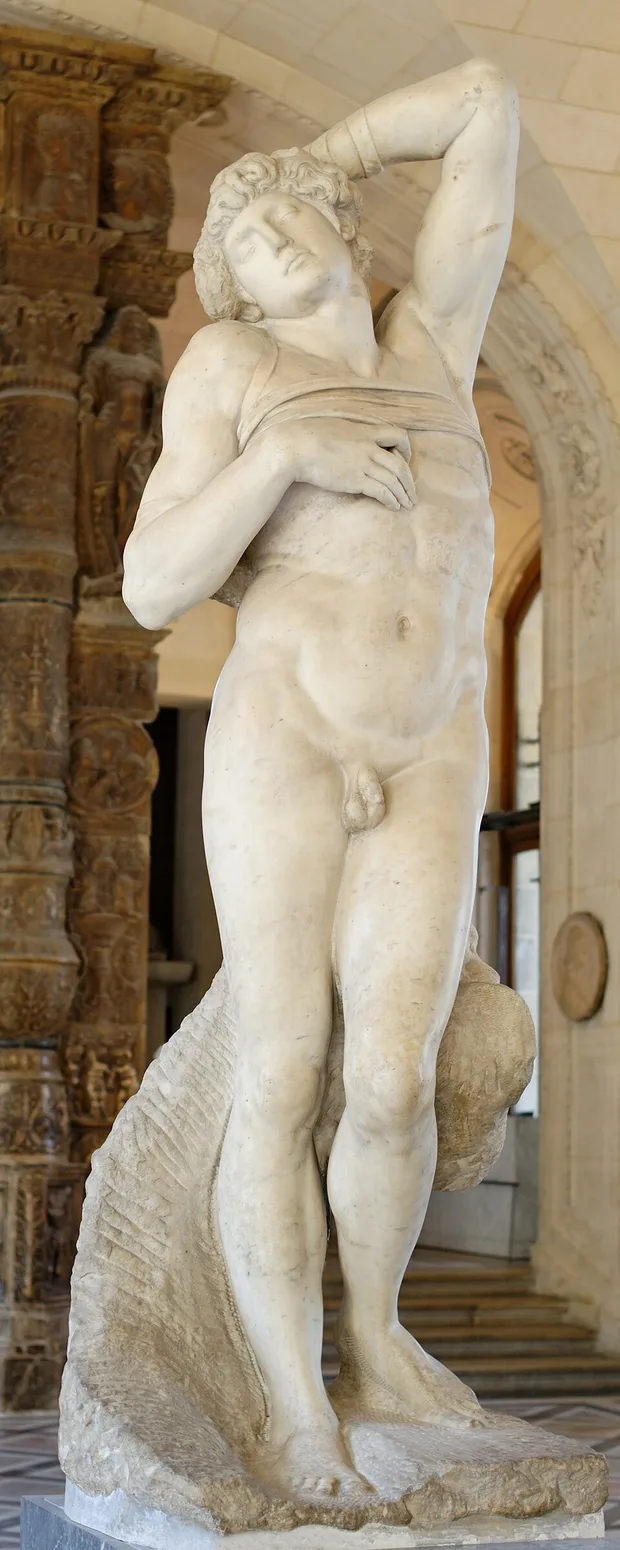
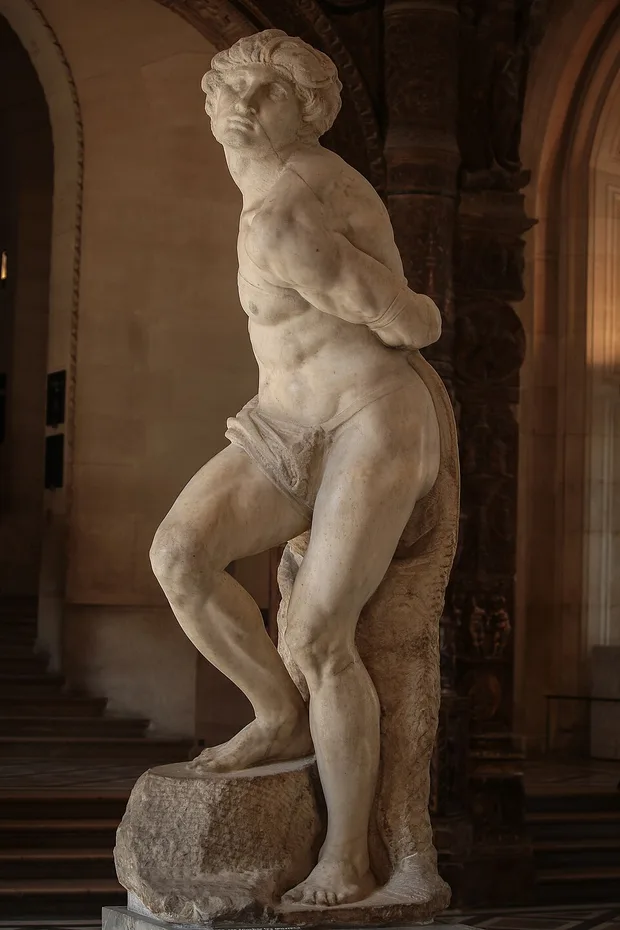
Nobody knows whom they represent, and the proposals have ranged from the provinces conquered by Julius II, to the liberal arts left without a patron after the pope’s death, to the soul held captive by the body.
In 1546 Michelangelo gave both figures to Roberto Strozzi, a Florentine exile in Rome in whose house he had twice lain ill. Strozzi sent them on to Francis I, from the king they passed to Anne de Montmorency, Constable of France, and after Montmorency’s grandson was executed for rebellion in 1632 the crown seized the estate and gave the sculptures to Cardinal Richelieu. They stayed with his descendants until the Revolution, when the head of the family emigrated. An émigré’s property was confiscated, and in 1794 the slaves came to the Louvre.
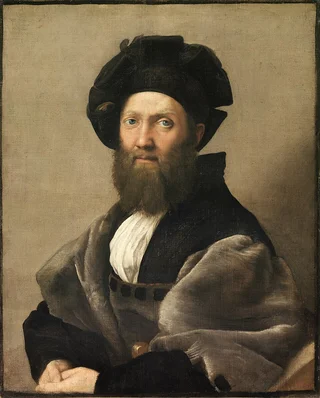
13. Raphael. Portrait of Baldassare Castiglione
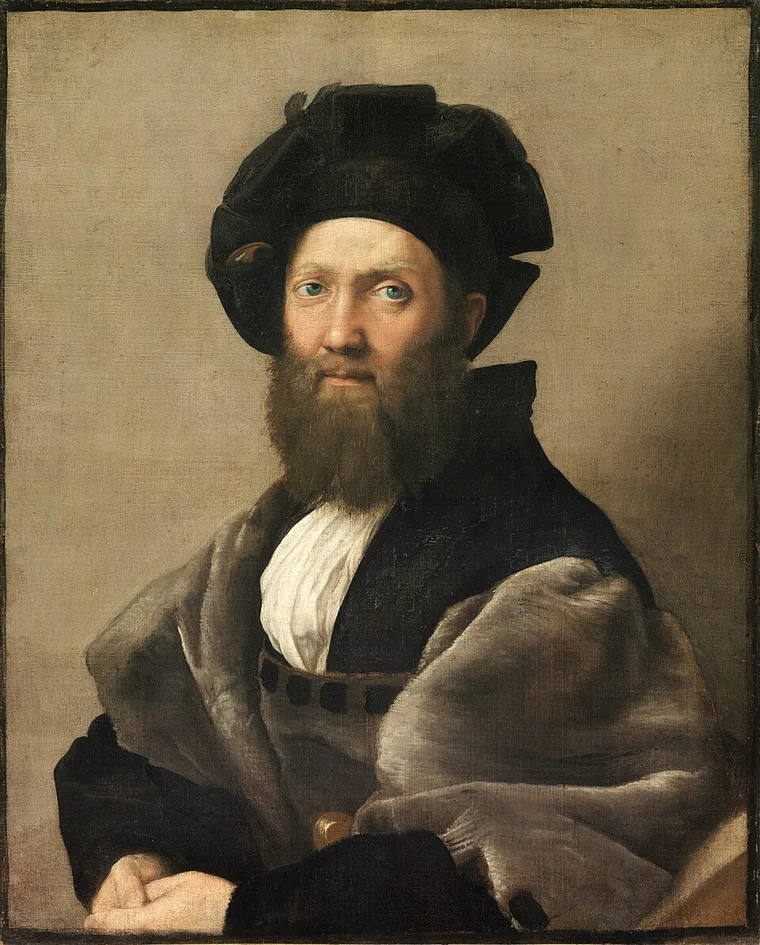
Castiglione wrote a book on how to conduct yourself at court, and its main rule was that everything should look easy and effortless. Castiglione himself called this sprezzatura. The Book of the Courtier came out in 1528 and spread across Europe, teaching noblemen from London to Kraków how to talk, joke, dress and lose.
The portrait was painted around 1515 in Rome, where Castiglione was the Duke of Urbino’s ambassador to the papal court and a friend of Raphael. He sits half-turned, in a black doublet, gray velvet and fur, his hands folded low in the picture, looking straight at the viewer. The colors are reduced almost entirely to gray, black and white, and the only bright spot in the picture is his eyes.
This is the ease described in the book, done in paint: a man who had spent his life on looking unstudied commissioned his portrait from a painter who knew how to render that ease.
Later the picture made its way to Amsterdam. In 1639 it was put up for auction there, and among those who came was Rembrandt, who made a quick pen sketch of it and wrote down on the same sheet what it sold for. The sketch survives, and the pose, with the hands and the gaze straight at the viewer, found its way into the self-portraits he painted over the following years.
The buyer at that sale was a Spanish merchant, Alfonso Lopez. Later the portrait belonged to Cardinal Mazarin, and after his death in 1661 it passed to Louis XIV.
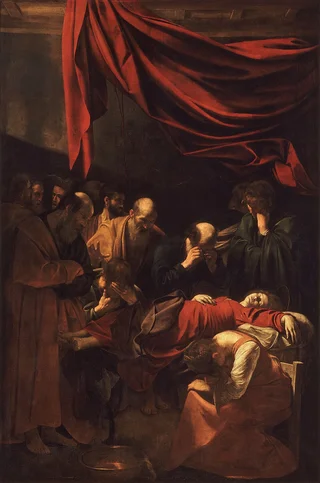
14. Caravaggio. Death of the Virgin
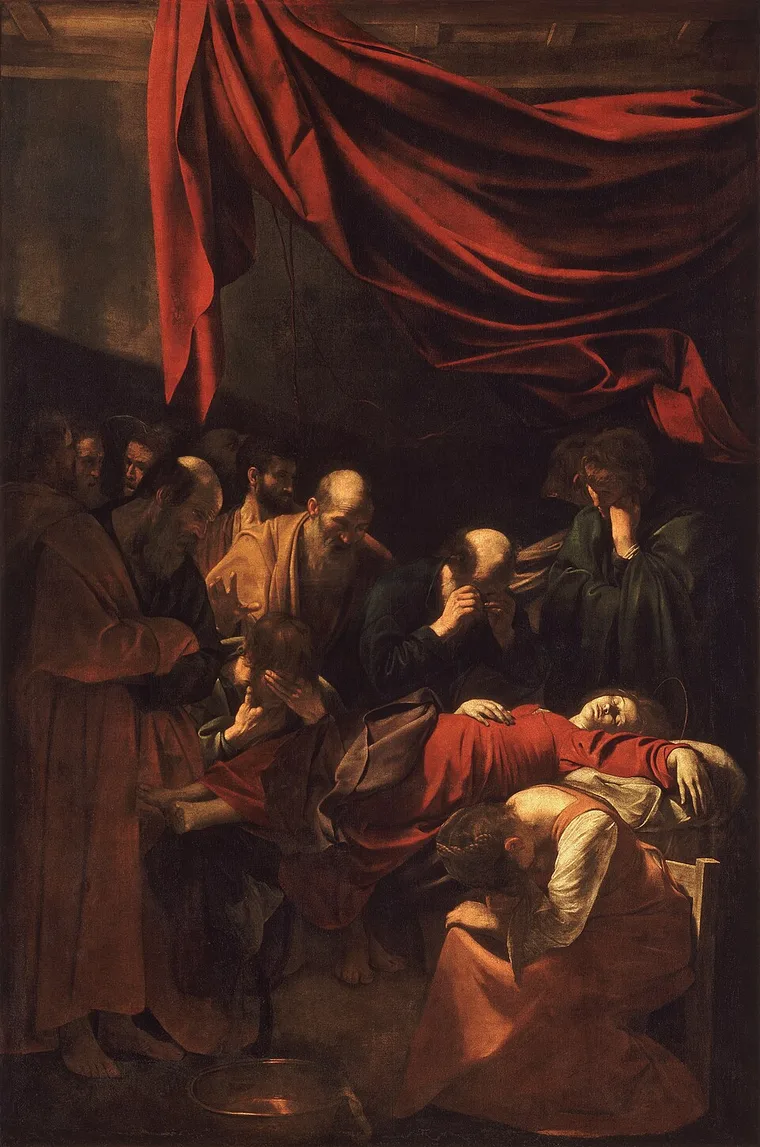
The friars of the church it was painted for refused to accept it, and to this day nobody is sure what put them off.
Caravaggio painted it between 1601 and 1606 for the church of Santa Maria della Scala in Trastevere, in Rome, on a commission from the papal lawyer Laerzio Cherubini. The Virgin lies on a table, barefoot, in a red dress, her body swollen, her head thrown back, her belly distended and one arm hanging down. Around her stand the apostles, old men with heavy faces, one covering his eyes with his hand, another simply looking. In the foreground on the right a young woman sits bent double, weeping. Above it all hangs a huge red drapery that fills the upper third of the canvas.
The Carmelites who served the church would not take the picture. Contemporaries gave various reasons: the Virgin’s indecently bare legs, the swollen body, the absence of any hint of her Assumption. There was also a rumor that the Virgin had been painted from a courtesan. A contemporary of the painter wrote that one down, while the story of a woman drowned in the Tiber appeared later, and there is no way to check either.
Other painters stood up for the picture as soon as it was refused. Rubens, then in Rome working for the Duke of Mantua, advised his employer to buy it, and Vincenzo Gonzaga did. Before it was sent to Mantua, the painters of Rome asked for it to be put on public view for a week, and the whole city went to see it.
From Mantua it went to England, to Charles I. After his execution his collection was sold off, and the picture was bought by Eberhard Jabach, the same banker whose collection Louis XIV acquired in 1671 along with the Pastoral Concert.
05. How to Commission Your Own Past
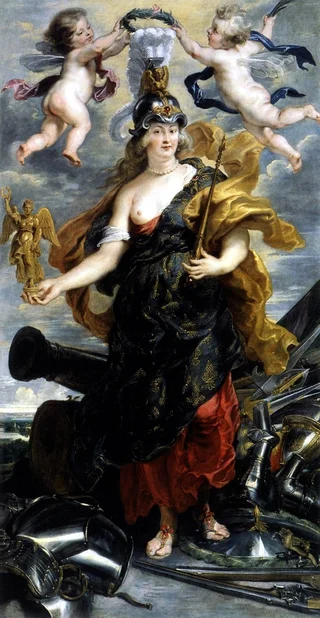
15. Rubens. The Marie de’ Medici Cycle
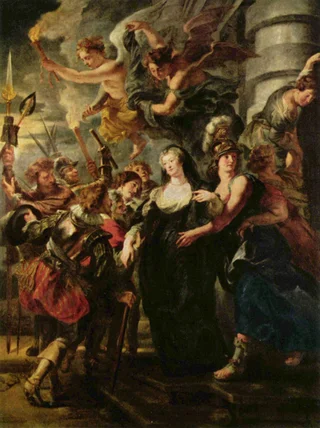
On the night of February 21–22, 1619, Marie de’ Medici, widow of Henry IV and mother of the reigning king of France, was being held under guard in the château of Blois, where her own son’s government had sent her. That night she climbed out of a window and, the story goes, went down a rope ladder to men waiting with horses.
She was just over forty and had never done anything of the kind. The escape succeeded. She raised an army against Louis XIII, lost, negotiated, and made peace with her son on terms that brought her back to court but not to power. Three years later she hired the most expensive painter in Europe.
Between 1622 and 1625 Peter Paul Rubens painted 24 enormous canvases for the gallery of her new Luxembourg Palace. Twenty-one of them tell the story of her own life, and the other three are portraits of Marie herself and of her parents. Ambassadors, courtiers, relatives and rivals were meant to walk the gallery from one end to the other, in order, and learn what her life had been.
One of them is the night scene of the escape from Blois. The queen, in a black dress and a white veil, steps down a wooden ramp, Minerva in a golden helmet steadies her by the shoulder, and above them Night spreads a dark cloak over the scene. Lower left, the Duke of Épernon in half-armor raises his hat and offers the queen his hand. He is the only real participant in the events on the canvas: he organized the escape, although that night he was waiting for the queen near Loches. The rope ladder is in the picture too, though it is a maidservant who uses it, climbing down from the tower in the upper right corner.
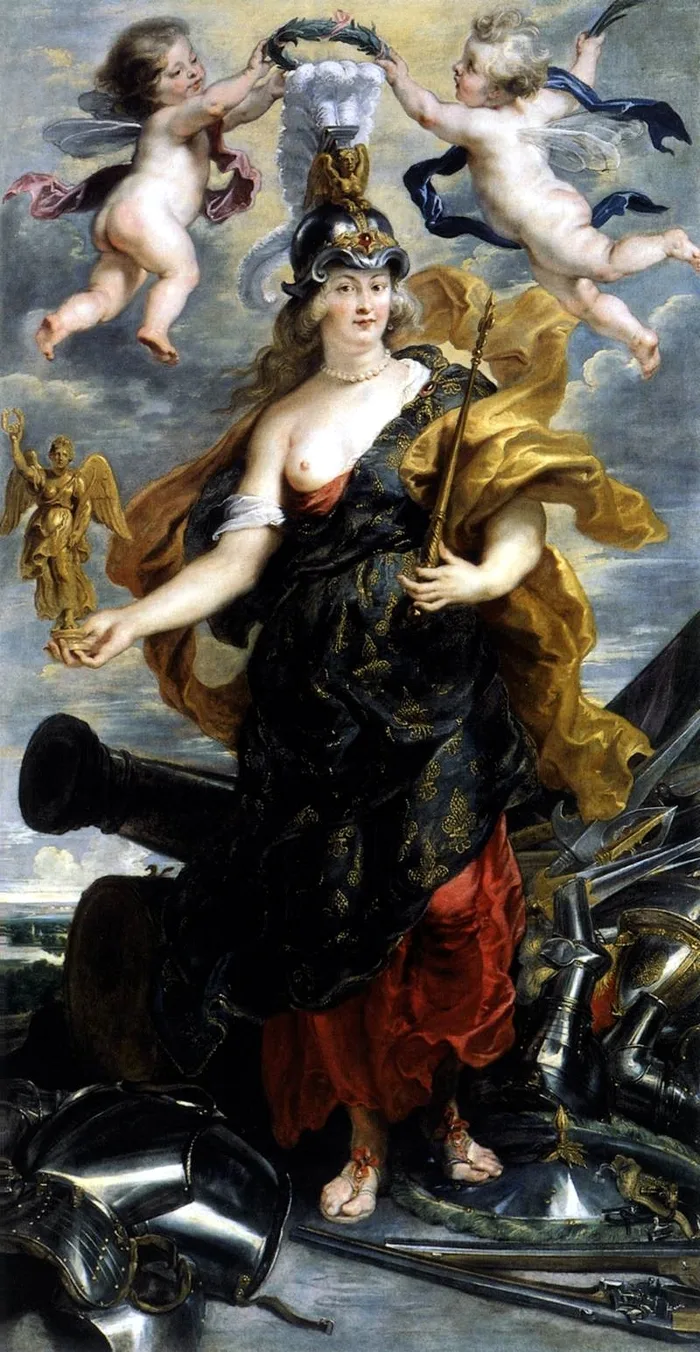
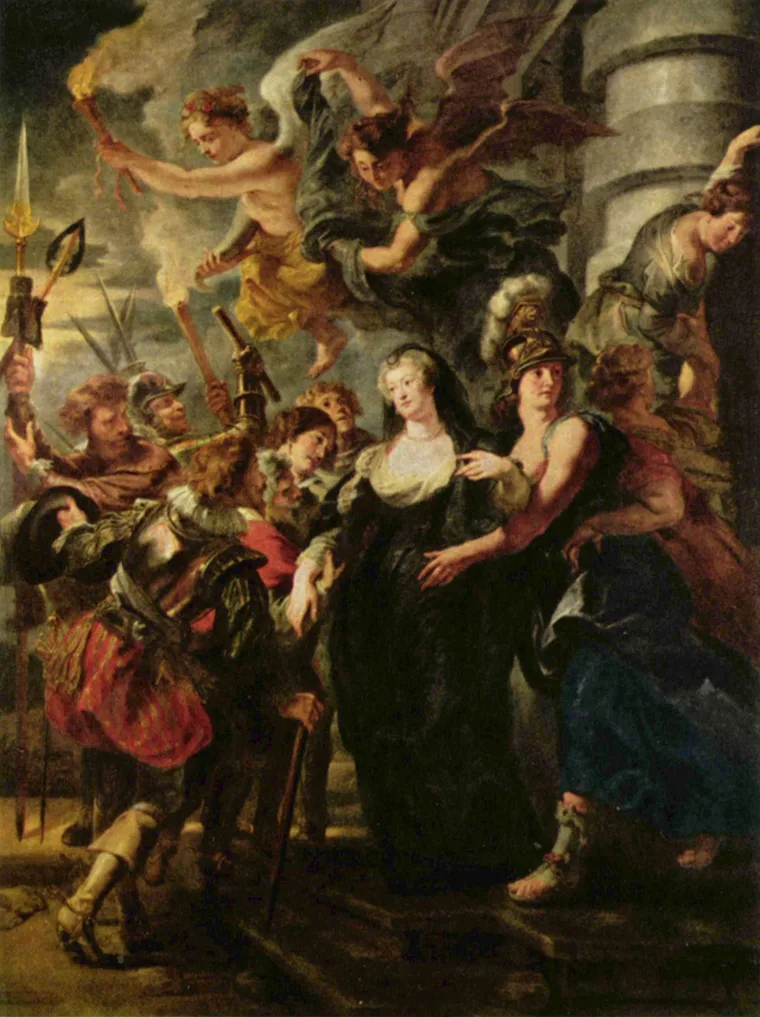
The woman who in fact climbed down a wall in the dark steps calmly down smooth boards, with a goddess steadying her shoulder and a duke offering his hand. Rubens treated the whole cycle the same way, keeping each event and replacing the danger and humiliation with the protection of the gods.
The gallery was finished in 1625. Five years later Marie lost her last struggle with Cardinal Richelieu, and in 1631 she left France for good. She died in Cologne in 1642, owing money to creditors all over Europe. The 24 canvases stayed in Paris. Since May 2026 the Medici Gallery has been closed to the public, because the whole cycle is being restored in the room itself, and the work is expected to take about four years.
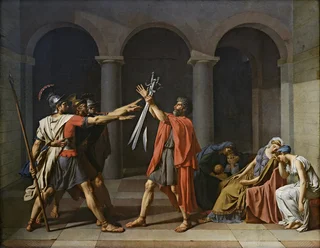
16. Jacques-Louis David. The Oath of the Horatii
Three brothers in Roman armor stretch out their arms toward their father, who holds up three swords. Their feet are planted apart, their backs taut, and the line of their arms runs across the whole picture. On the right, apart from them, sit the women, sisters and mother, bowed and slack. The subject comes from Livy. The three Horatius brothers volunteered to fight for Rome against three brothers from a neighboring city, and one of their sisters was engaged to one of the opponents.
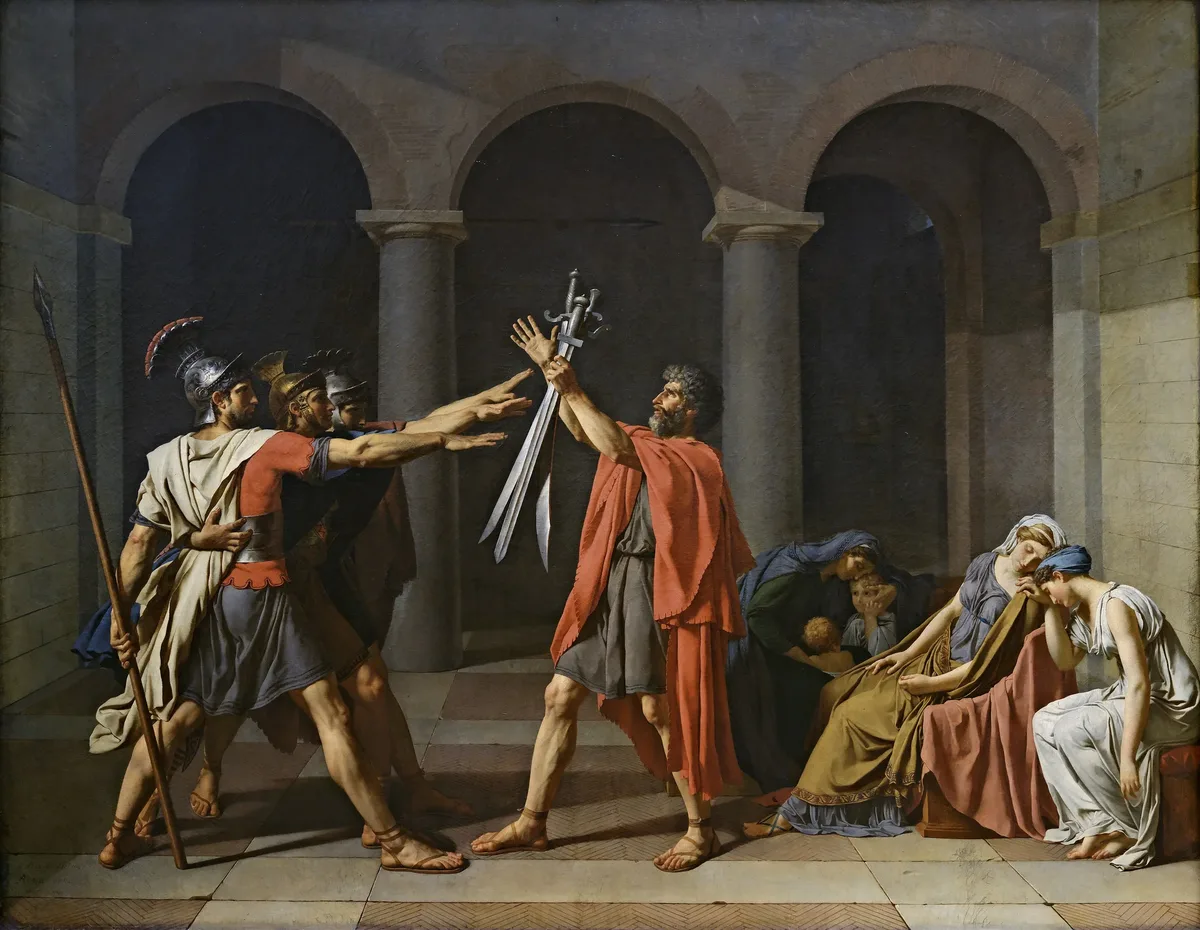
David received the commission from the royal administration in the early 1780s, and in 1784 he went to Rome to paint it. There, on his own authority, he made the canvas larger than the agreed size and delivered it late, and before sending it to Paris he showed it in his Roman studio, where crowds came to see it. At the Salon of 1785, so the story goes, the picture was first hung in a corner and then, at the public’s insistence, moved to a prominent place.
Everything is painted with the greatest possible simplicity: three arches, a stone floor, not one superfluous detail, harsh light, color reduced to red, brown and steel. After the ornamental painting of the previous decades it looked like a slap in the face, and that is how contemporaries took it.
Four years later the Revolution began, and people came to read the Oath of the Horatii as its forerunner, with its vow, its duty to the state and its readiness to die. The picture was commissioned and paid for by a king who would be executed nine years later, and David, as a deputy of the Convention, would vote for his death.
17. Jacques-Louis David. The Coronation of Napoleon
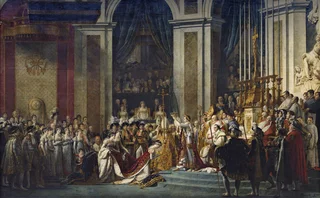
The same painter, and a different power. In September 1804 Napoleon commissioned David to paint his coronation, which took place at Notre-Dame on December 2 of that year. David worked on it with assistants from 1805 to 1807, and the canvas came out 6.21 meters high and 9.79 meters wide, with room for more than a hundred and fifty figures, many of them recognizable.
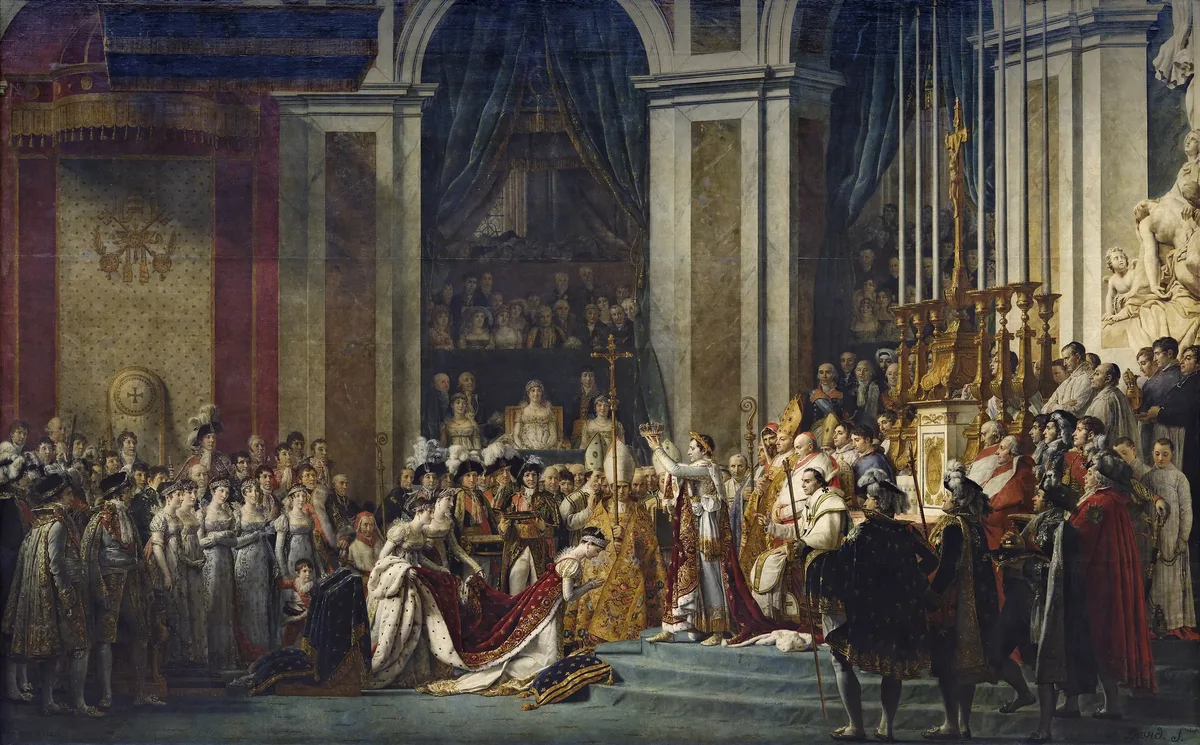
The ceremony followed an order Napoleon had set himself: he took the crown from the altar and placed it on his own head, and straight afterward crowned Josephine. David painted the second act. In the center of the canvas Josephine kneels in white with her hands joined, her long train spread out behind her, and Napoleon, in red and ermine, holds the crown up above her head. The emperor in this picture is the one conferring power.
Farther to the right sits Pope Pius VII in white, raising his right hand in blessing. In the first version of the composition the pope’s hands lay in his lap. Contemporaries report that Napoleon remarked that if the pope had been brought all the way from Rome he might at least do something, and David repainted the hand.
Higher up, above the crowd on the left, there is a tribune, and in the middle of it sits a woman in a pale dress, composed, with her attendants around her. She is Letizia Bonaparte, the emperor’s mother. She did not come to Paris. She had stayed in Rome after quarreling with her son over the way he had treated his brothers. In the picture she sits in the middle of the upper tribune, at just the height from which the head of a family watches over what is happening, in a cathedral she never reached.
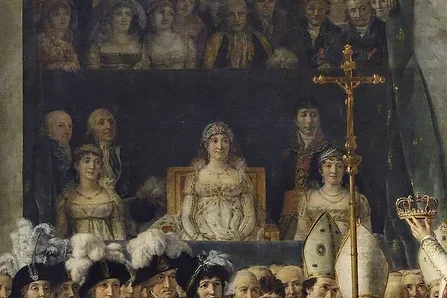
If David could put into the cathedral a person who was not there, then the placing of the other figures cannot be read as a record either. Who stands where was decided by the painter in his studio, three years after the event, while working for Napoleon.
A little farther along the same tribune sits a group of spectators with sketchbooks, and among them David painted himself.
There are, as it happens, two of these pictures. David finished a second full-size version in 1822, and it hangs at Versailles.
06. Pictures for a Single Viewer
18. Georges de La Tour. The Cheat with the Ace of Diamonds
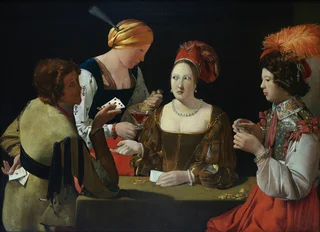
On the right sits a richly dressed young man with his cards and a small pile of gold coins. On the left a man turned with his back to us is pulling a card from his belt, at hip height, where the young man cannot see it. It is the ace of diamonds. Between them a woman in a headdress glances sideways at the maid pouring wine, and the maid glances back.
Three of them are in league, the fourth is looking at his own cards, and the viewer sees both the card behind the belt and the exchange of glances at once.
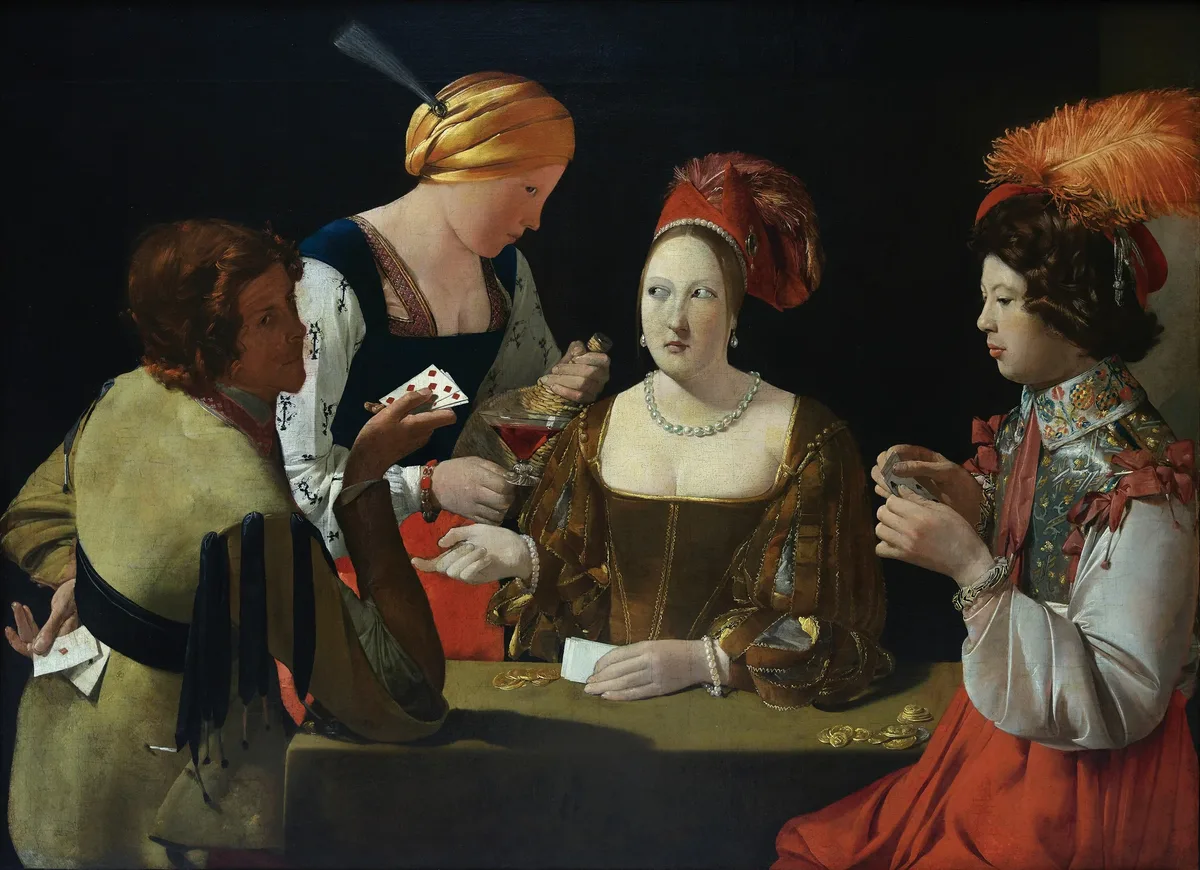
The picture was painted around 1635 in Lorraine, where La Tour worked and was, in his own lifetime, a well-known and wealthy man: he took commissions from the Duke of Lorraine and from the king of France, grew rich and bought land. After his death he was forgotten for three centuries, his pictures went around under the names of Spanish and Dutch painters, and his name dropped out of the literature. He was brought back by the German art historian Hermann Voss, who in 1915 compared several signed works and pieced the painter together again.
The Louvre bought the Cheat in 1972. There is a second version of the same composition, in which the cheat pulls out the ace of clubs. It is in Texas, and the argument over which of the two was painted first goes on.
19. Rembrandt. Bathsheba at Her Bath
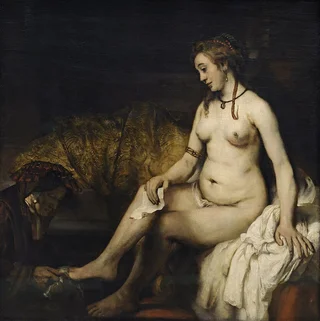
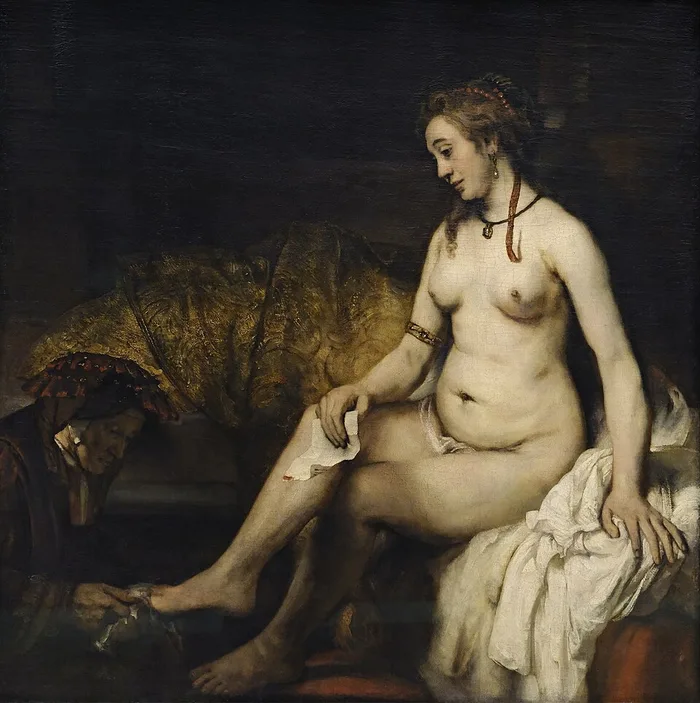
In 1654 the church council in Amsterdam summoned Hendrickje Stoffels, Rembrandt’s servant and companion, three times, demanding that she account for living with the painter. The third time she came, was found guilty of fornication and was barred from communion. A few months later she gave birth to a daughter. That same year Rembrandt painted Bathsheba, and the model, by general agreement, was Hendrickje.
Bathsheba sits holding a letter from King David. In the biblical story David saw her from his roof as she was bathing and sent for her. She came and became pregnant, and the king sent her husband Uriah to the war, to a place where he was sure to be killed. Painters before Rembrandt usually showed the moment of spying, with the woman in the water and the king above. Rembrandt chose the minute after the letter has been read.
She looks down, past everything. Her body is painted heavy and no longer young, with a fold beneath the breast and a thick belly. At her feet sits an old woman drying her foot, intent on that and nothing else.
The picture passed from one private collection to another until 1869, when it was bequeathed to the Louvre by Louis La Caze, a Paris doctor who over forty years had gathered nearly six hundred paintings and gave them to the museum all at once.
Hendrickje died in 1663, probably of plague, and Rembrandt outlived her by six years.
20. Vermeer. The Lacemaker
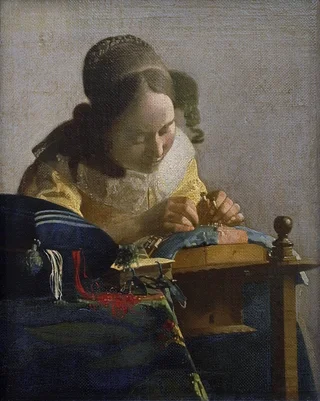
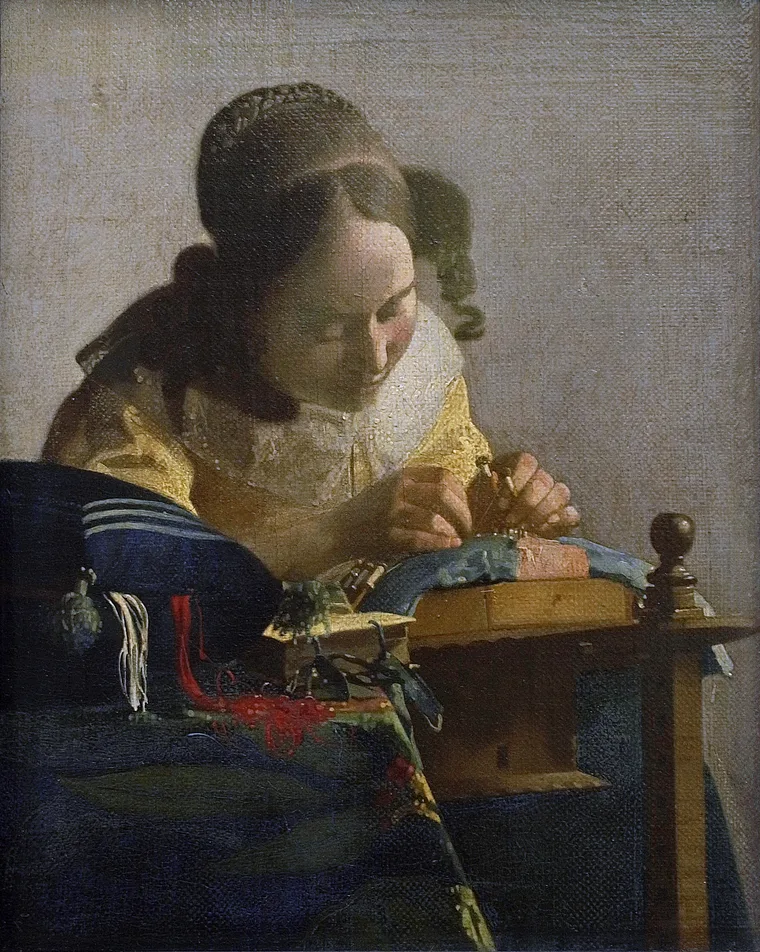
The picture is 24 centimeters high. A girl bends over a small lacemaking frame, bobbins in her fingers, her eyes on the work a few centimeters from her hands.
Everything within that narrow zone is painted with extreme precision: the thread, the pins, the tension. In the foreground, meanwhile, closer to the viewer than she is, red and white threads spill out of a sewing cushion, painted as blurred patches of light with no edges. That is how things look when the eye is focused on another plane.
The light here comes from the right, whereas in almost all of Vermeer’s other pictures the window is on the left.
He worked slowly and left about 35 paintings, and after his death in 1675 his name fell out of use for two hundred years. The Louvre bought the Lacemaker in 1870 for 7,270 francs, shortly after the French critic Théophile Thoré-Bürger had gathered Vermeer’s scattered works under one name in a series of articles and put him back into the history of painting.
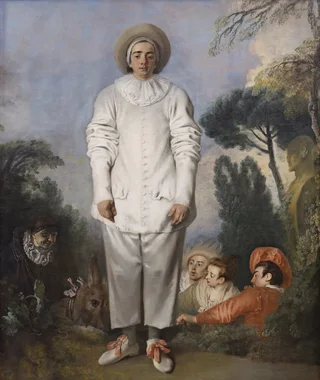
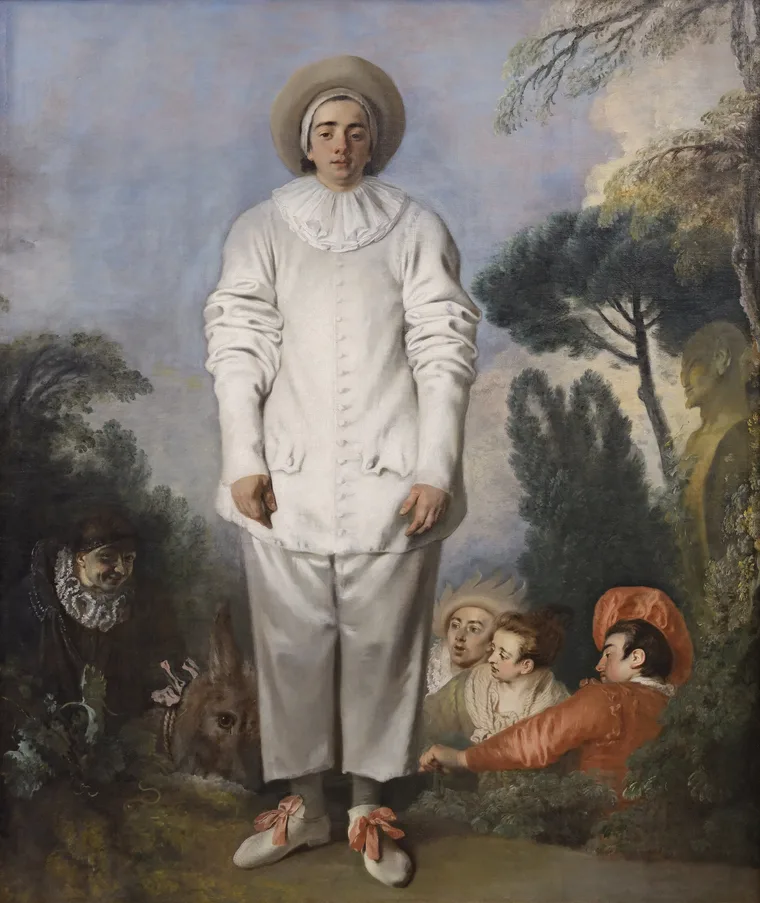
21. Antoine Watteau. Pierrot
Watteau lived 36 years, died of tuberculosis in 1721, and for almost all his life painted the same subject: parties of elegantly dressed people in parks, music, flirtation, faintly melancholy scenes without a story. The Academy had to open a separate category for him, because this kind of painting fitted none of the existing ones, and the name invented for it was the fête galante.
Pierrot has little in common with his other pictures. An actor in a white satin costume stands full length directly facing the viewer, arms hanging, feet together, hat pushed to the back of his head, face motionless. He fills almost the whole canvas and is painted from below, which makes him seem larger than he is. Lower down, behind his legs, four other characters from the Italian comedy are busy with their own affairs.
Historians still argue over what the picture was made for. The most frequent suggestions are a sign for a troupe of fairground players or a portrait of a particular actor who played Pierrot, and both remain guesses.
In the nineteenth century the canvas belonged to Dominique-Vivant Denon, the same Louvre director who had carried off the Italian collections and kept the Wedding at Cana out of the Allies’ hands. After his death the picture changed hands several times, and in 1869 it came to the Louvre together with Bathsheba, as part of Louis La Caze’s bequest.
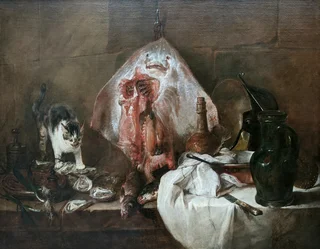
22. Jean-Siméon Chardin. The Ray
In 1728 Chardin, then 28, came to a session of the Royal Academy of Painting with two pictures under his arm, with no introduction, no patron and no academic training. He was admitted that same day as a painter of animals and fruit, the lowest rank in the hierarchy, below history painting and portraiture. One of the two pictures was The Ray.
Over a stone table a gutted ray hangs spread open from a hook. The cut runs from top to bottom, showing the innards and the blood, and the ray’s snout, with its two openings and the slit of its mouth, forms something like a human face. On the left a cat that has crept up to the oysters arches its back, and on the right lie a knife, a jug and a copper pot.
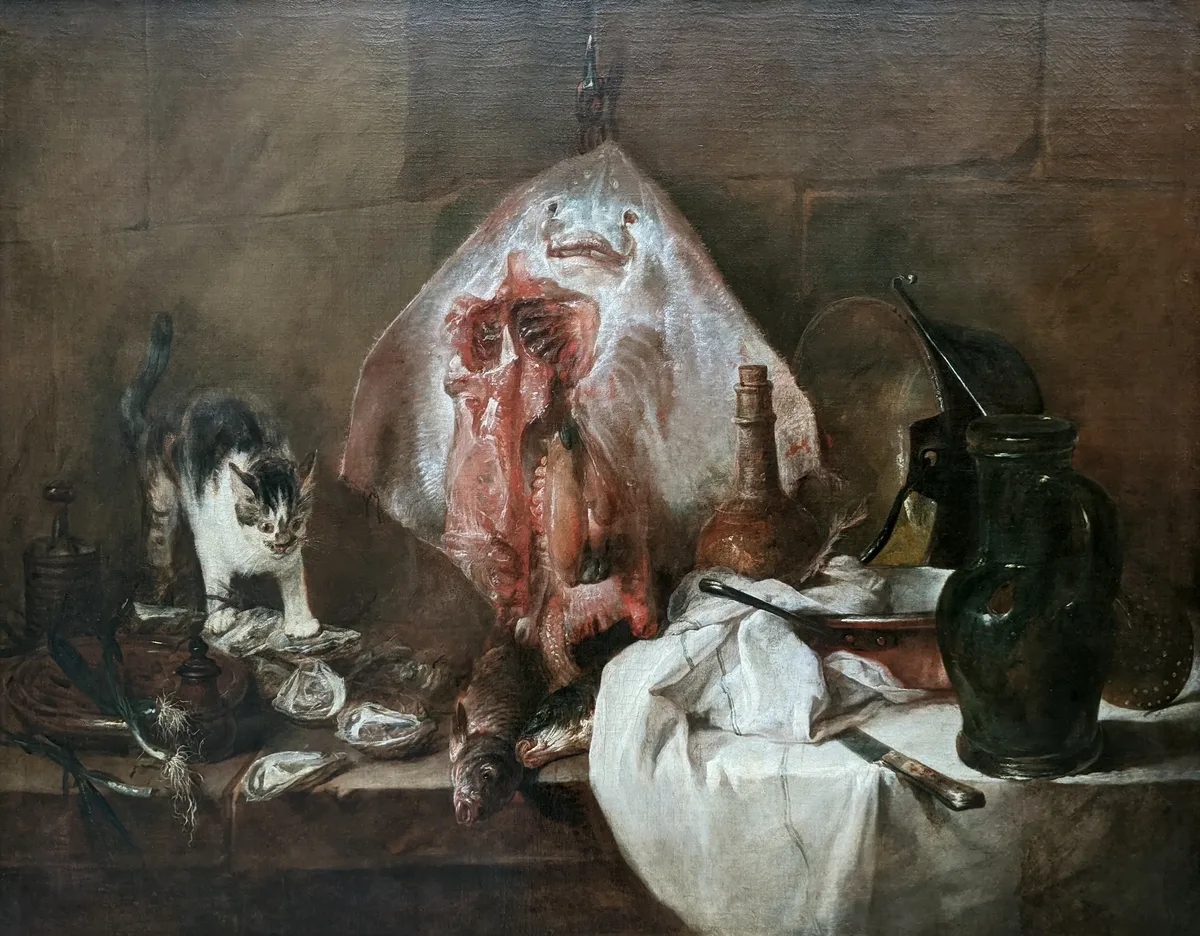
For the rest of his life he painted kitchenware, dead game, bread, glasses of water and children at household tasks, and he was praised by the very people who considered such subjects a low genre. Diderot wrote about him with delight and admitted that he did not understand how it was done. Chardin worked very slowly, laying on paint in small dense touches, and finished only a few pictures a year.
The Ray came to the Louvre along with the rest of the Academy’s collection when the Revolution handed that collection over to the state.
07. The Public Makes Up Its Own Mind
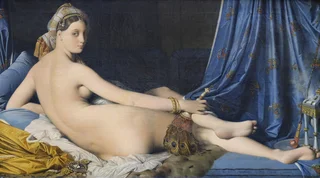
23. Ingres. Grande Odalisque
Caroline Murat, Napoleon’s younger sister and queen of Naples, commissioned this picture in 1814. She never got to pay for it. In 1815 the Murats lost their throne, her husband Joachim was shot by firing squad in Calabria, and the canvas stayed with the painter.
A naked woman lies with her back to the viewer, looking over her shoulder, among peacock feathers, a turban, a heavy curtain and a hookah. The setting is a European idea of an Ottoman interior, pieced together from engravings and travelers’ tales. Ingres never set foot in Turkey.
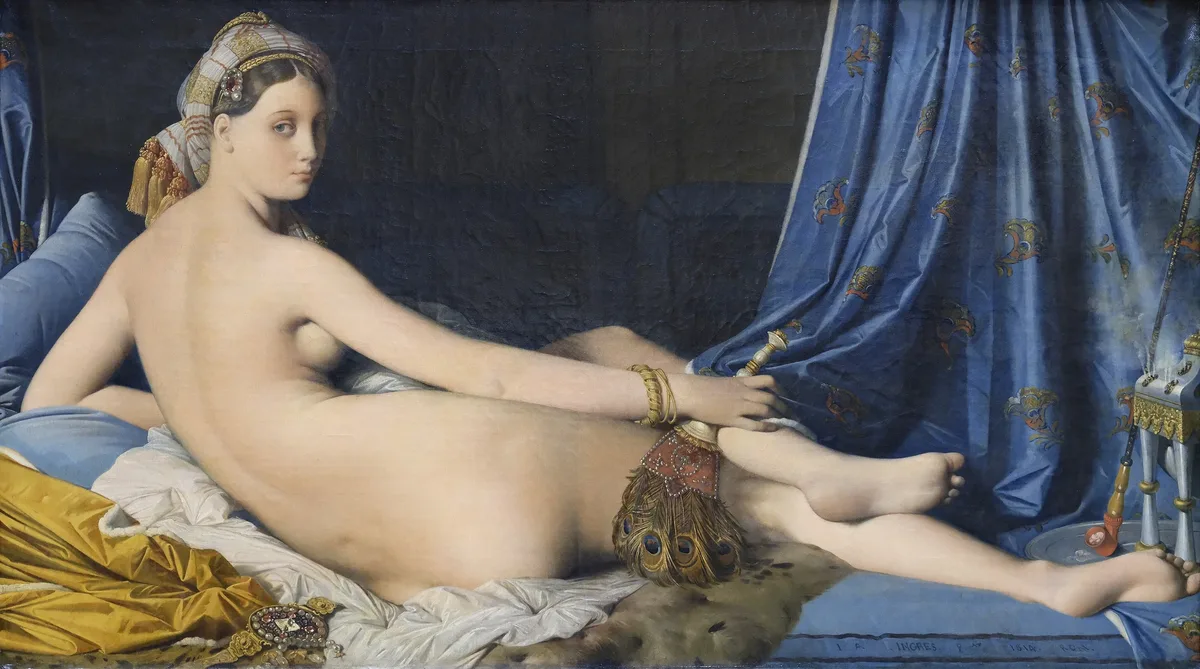
When the picture was shown to the public at the Salon of 1819, people talked about its anatomy. The line of the back from shoulder to hip is longer than any human back. The critic Kératry wrote that she had three vertebrae too many, and in 2004 doctors counted as many as five extra. Ingres did not care, because the line mattered more to him than the skeleton.
He kept painting Eastern subjects to the very end. Ingres finished The Turkish Bath, a round canvas crowded with dozens of naked women, in 1862, when he was 82.
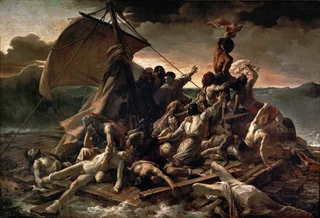
24. Théodore Géricault. The Raft of the Medusa
Géricault was 27 when he took on this picture, and what he did next was nothing anyone expected from the author of a large Salon canvas. He tracked down two survivors and questioned them, had the ship’s carpenter, who had also survived, build him a model of the raft, spent months in hospitals and morgues studying the sick, the dying and the dead, and kept body parts from an anatomy theater in his studio.
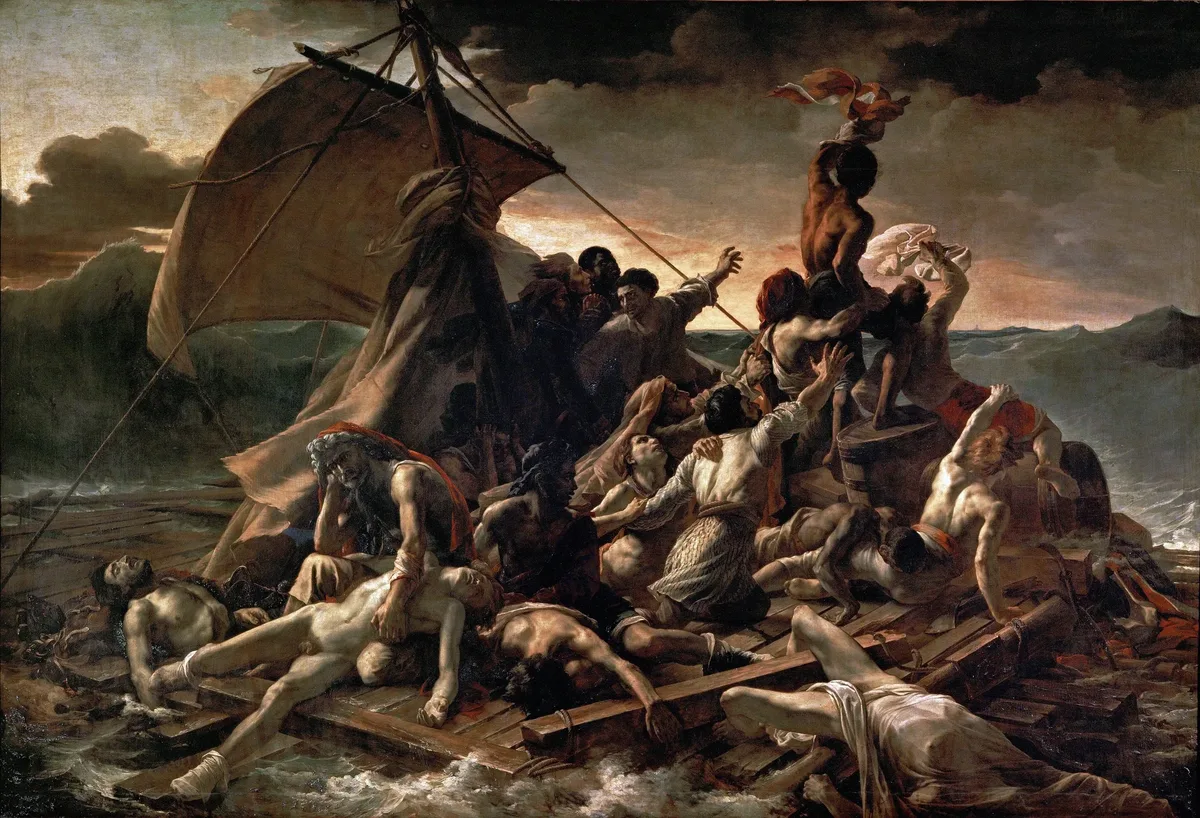
The occasion was a disaster all of France was talking about. On July 2, 1816, the frigate Medusa ran aground off the coast of present-day Mauritania. Her captain, Hugues Duroy de Chaumareys, had hardly been to sea in twenty years and owed his command to connections at court. There were not enough boats for everyone, and about a hundred and fifty people were put on a raft knocked together from the ship’s timbers, which the boats were supposed to tow. The towlines were cast off, and the raft was abandoned. Twelve days later there were fifteen people alive on it, several of whom died soon after the rescue, and in those twelve days there had been thirst, heat, fighting, people falling overboard and, at the end, cannibalism.
Two of the survivors, the engineer Alexandre Corréard and the surgeon Henri Savigny, wrote a book about all of it and published it in 1817. They named both the captain’s incompetence and the circumstances in which the raft was abandoned. The book sold in such numbers that the government could no longer hush the affair up, and it was the government that had put Chaumareys in command of the frigate. Corréard and Savigny were the two survivors Géricault went to see.
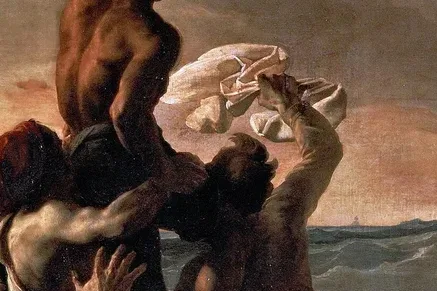
The canvas came out at 4.91 by 7.16 meters. In the lower left corner an old man sits with a dead young man across his knees, a hand to his temple, staring into nothing. From there the composition climbs a rising diagonal: bodies on the wet planks, then men raised on their elbows, then on their knees, then standing and holding each other up. At the top a Black man, braced against a barrel, waves a piece of cloth with both arms toward the horizon. The figure lying face down at the front edge was posed by Géricault’s young friend Eugène Delacroix.
Now find what they are waving at. On the horizon at the right there is a ship, smaller than a fingernail, and it is harder to make out than anything else in the Louvre. It is the Argus, the ship that in the end did pick up the survivors.
The picture went to the Salon of 1819 under the title Scene of a Shipwreck, and everyone understood what it was about. Louis XVIII, as a king was expected to, made his round of the Salon and stopped in front of this canvas. What he said to Géricault exists in several versions and in no document of the time, so it is a legend. In the version most often told, the king said, “Here is a shipwreck that will not sink its painter.”
Géricault died in 1824, at 32, from the effects of a fall from a horse, and that same year the picture was bought for the Louvre at the sale of his studio.
25. Eugène Delacroix. Liberty Leading the People
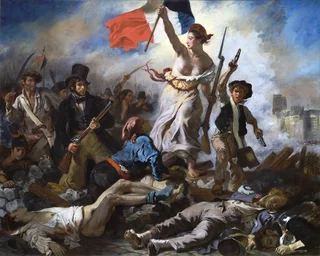
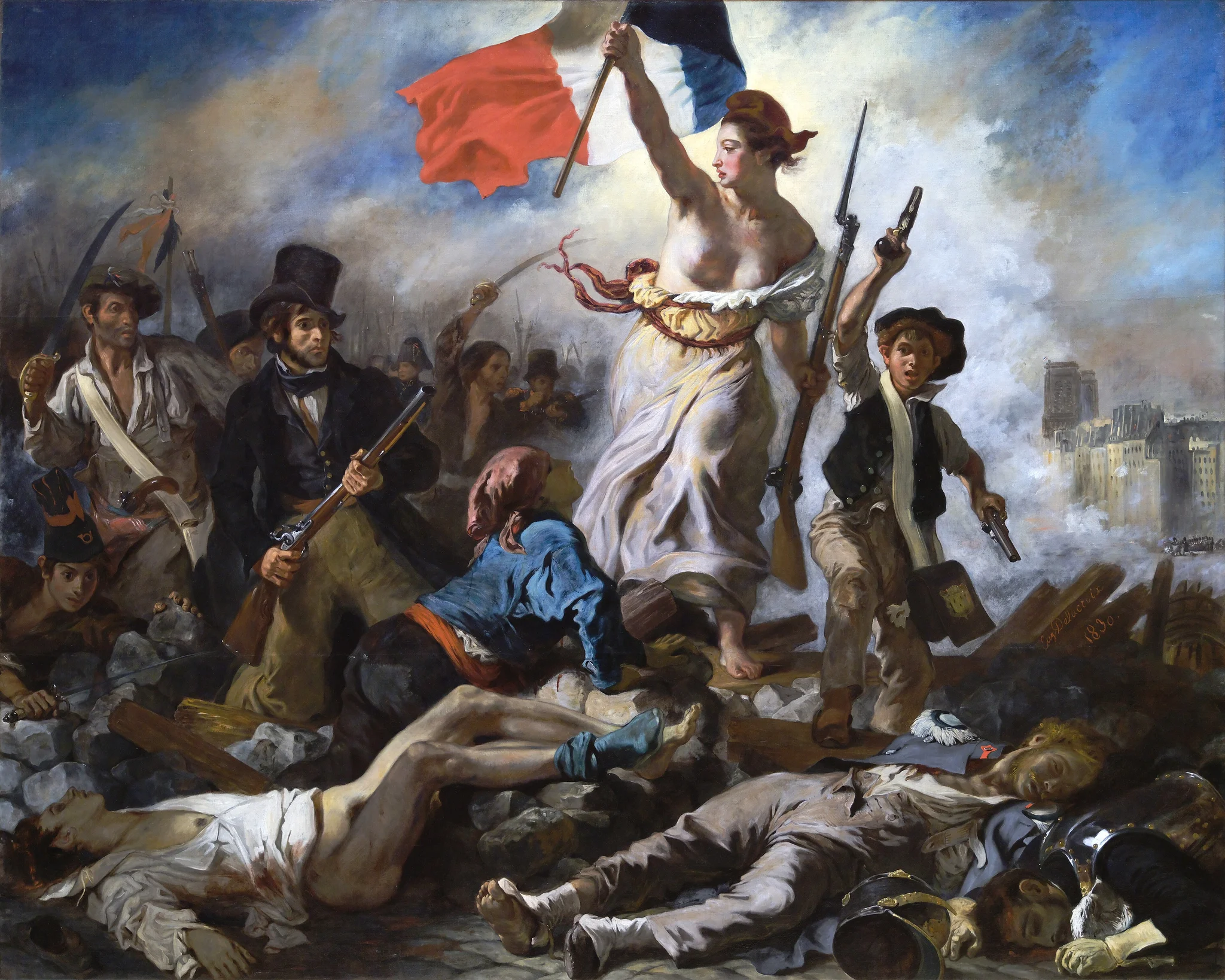
A woman strides forward over a barricade of paving stones and bodies, a musket with fixed bayonet in her left hand and the tricolor raised in her right. She is bare-breasted and barefoot because she is an allegory, walking among people who are not. Around her Delacroix placed people of different classes: a worker in a white shirt with a saber and a craftsman’s belt, a well-off gentleman in a top hat and a well-cut frock coat holding a hunting gun, and a boy, still very small, with a pistol in each hand and a cartridge bag. Putting three classes shoulder to shoulder on one barricade was the picture’s political statement. Farther right, in the smoke, are the towers of Notre-Dame, with a small tricolor flying from one of them.
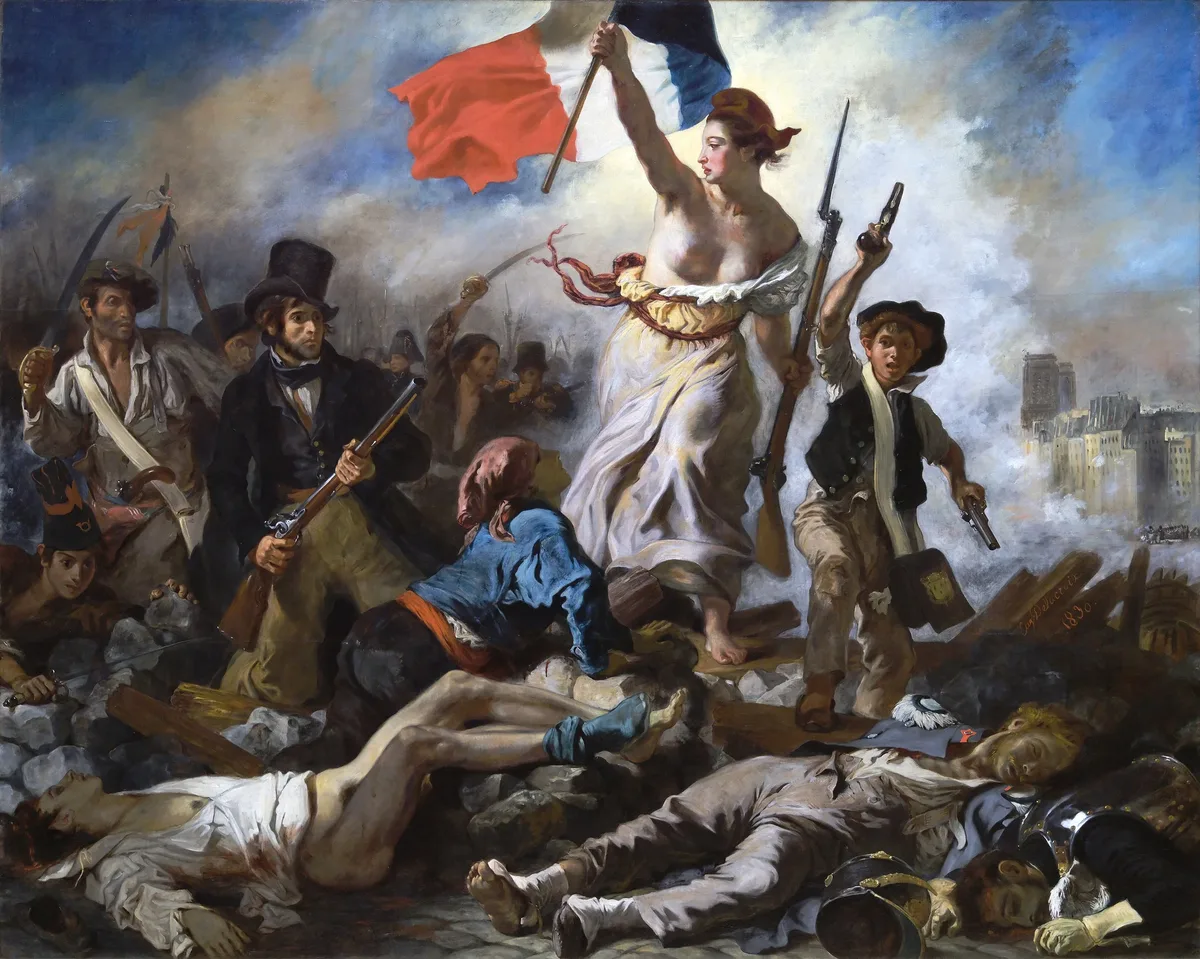
The title under which the Louvre lists the picture includes a date, July 28, 1830. At the end of that July Paris rose against Charles X over censorship and a curtailed right to vote, and after three days of street fighting the king lost his throne. Delacroix was not on the barricades, and he painted the picture that same autumn. The people on the canvas are dressed in the fashions of their own decade, and the event stands four decades after the Revolution of 1789.
In August 1831 the French state bought the picture for three thousand francs. Louis-Philippe’s government owed its existence to those July days and had every reason to show it.
Over the next forty-odd years, however, it was on view only now and then. In 1832 and 1833 the picture hung in the Musée du Luxembourg, and around 1834 it was put into storage. The public saw it again only at the Universal Exposition of 1855, when the regime of Napoleon III wanted to look sure of itself. Then the canvas was put away again, in 1863 it went back to the Musée du Luxembourg, where it hung for eleven years, and in November 1874 it was transferred to the Louvre.
It was bought with public money, hung, taken down, put in storage, brought out for a world’s fair, put away again, and in the end put on show.
What Else to See
The twenty-five works we have told you about are one possible selection. The Louvre holds around half a million objects, with some 30,000 on display, so there is far more worth seeing, and how much of it you manage depends on your time and your taste.
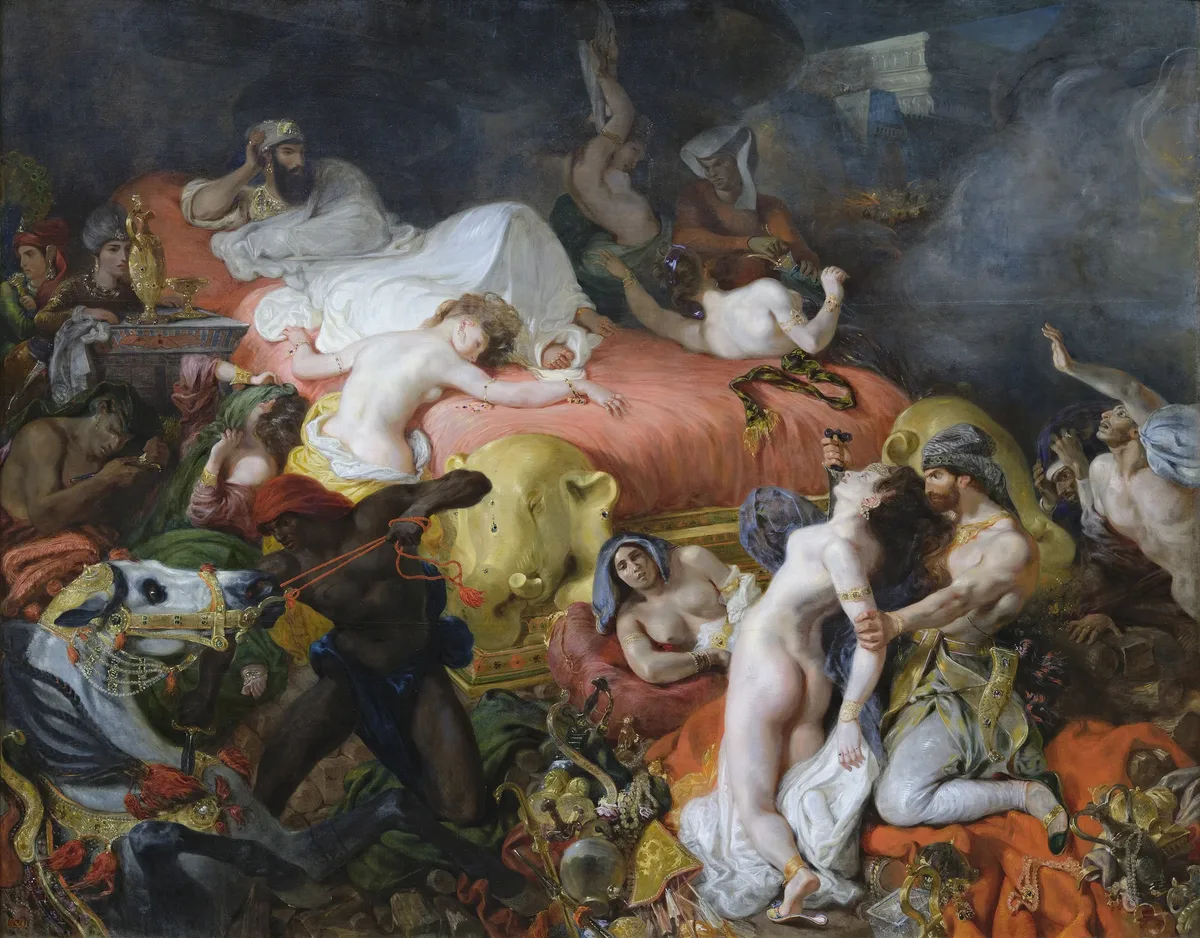
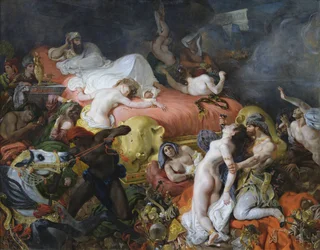
If you have time left, look at Delacroix’s Death of Sardanapalus, a huge canvas of 1827 that in its day was rejected by the public and the officials alike, after which the painter kept it for 18 years, and the Louvre bought it only in 1921. In the Egyptian department stands the Great Sphinx of Tanis, on which several pharaohs in turn carved their names, each over the one before. The Galerie d’Apollon holds what is left of the French crown jewels, including the Regent diamond. The apartments of Napoleon III survive intact, with their furniture and chandeliers. In the basement you can see the foundations and moat of the medieval fortress with which the Louvre began in the twelfth century, as a stronghold against the English. There is also a second Vermeer, The Astronomer, Bosch’s Ship of Fools, and a large department of Islamic art under a glass roof in the Cour Visconti.