Albrecht Dürer · PD
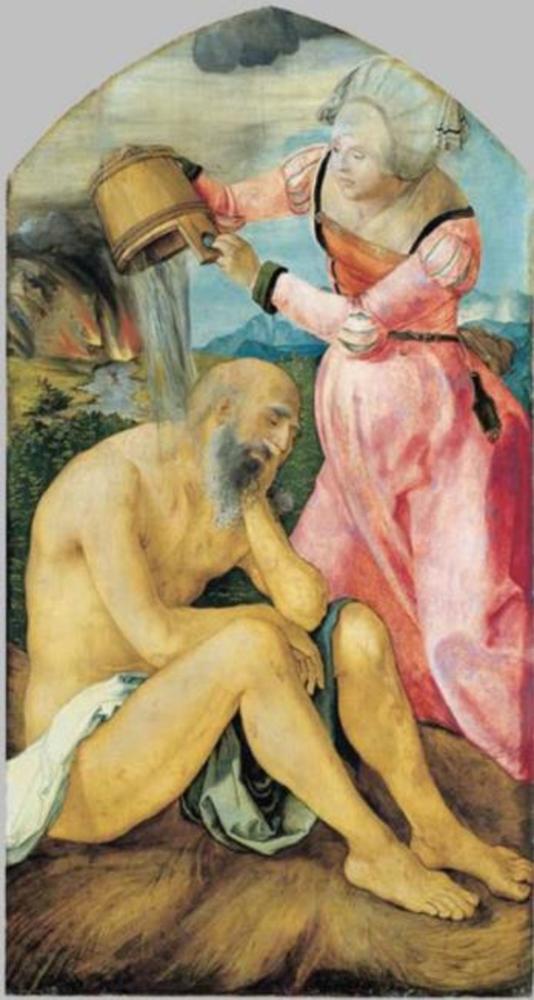
Jabach Altar: Job on the Dungheap
Details
The story
Job sits on a dungheap with his skin broken out in sores, and his wife stands over him tipping a wooden pail of water onto his head. Behind them his house and his fields are burning and his animals are being driven away, his whole ruin fitted into one strip of background. Dürer painted this somewhere between 1503 and 1505, and the panel was the left half of the outside of a folding altarpiece, the half you saw when it was shut. The right half is now in Cologne, in the Wallraf-Richartz-Museum, and it shows a piper and a drummer. Those two belong to the story. Late medieval versions of Job's legend had musicians come and play to him on his heap, and he paid them with scabs from his own body that turned to gold. Job was the figure people prayed to about sores and skin disease, and the water may point somewhere specific. The altar has long been thought to have been made for the chapel at Job's Bath, a healing spring outside Annaberg in Saxony. Nobody has proved it.