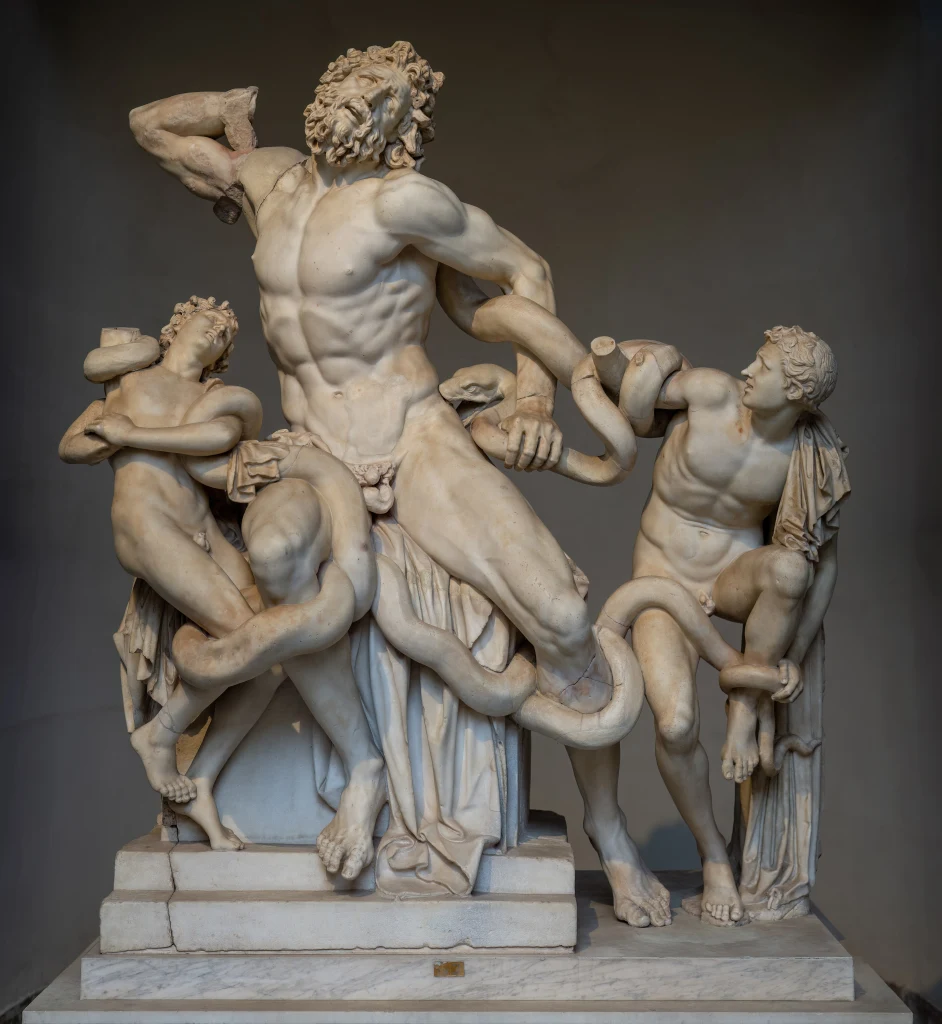
Laocoön and His Sons
Details
The story
Early in 1506 workmen digging in a vineyard on the Esquiline Hill in Rome came upon a buried marble group, a bearded man and two boys caught in the coils of two great snakes. The vineyard belonged to Felice de Fredis, and Pope Julius II sent his architect Giuliano da Sangallo to look. Giuliano's son Francesco, a boy of about 11, went along, and in a letter written in 1567, 60 years later, he recalled that Michelangelo came with them. His father, he wrote, recognised the statue at once as the Laocoön that Pliny mentions, the group the Roman writer had praised above every painting and bronze.
Laocoön was the Trojan priest who warned his city against the wooden horse, and the gods who favoured the Greeks sent serpents to kill him and his sons. In March Julius bought the group, rewarding de Fredis with a share of Rome's customs revenues, and set it up in his statue court in the Belvedere.
The priest's right arm was missing, and in the 1530s he was given a new one stretched straight up. In the early 20th century the archaeologist and dealer Ludwig Pollak spotted a bent marble arm in a stonecutter's shop in Rome. In the 1950s it was confirmed as the original and fitted back, folding toward the priest's head. The museum dates the group to around 40 to 30 BC and notes that the date is much debated.