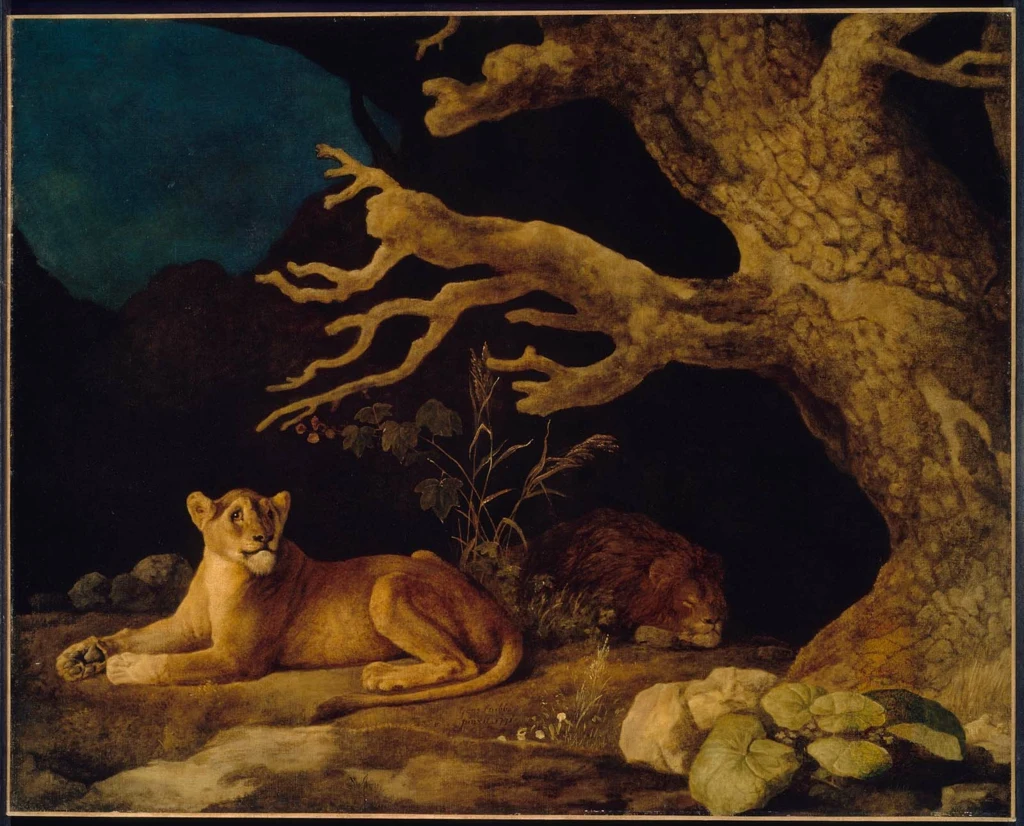
Lion and Lioness
Details
The story
Stubbs signed this canvas at the bottom, Geo Stubbs pinxit 1771. He was then showing his work regularly with the Society of Artists in London, which made him its president the following year, and he had begun experimenting with painting in enamel. In 1770 he made a lion and lioness in enamel on a copper plate barely 28 centimetres across, now at Yale. This canvas is more than a metre wide.
The lioness lies stretched out in the light at the mouth of a cave, head raised and alert, while the lion lies further back, almost swallowed by the shadow. A gnarled, half-bare tree arches over the opening, and broad leaves spread across the foreground. The Museum of Fine Arts singles out the strange, almost fantastic light Stubbs casts over animals and plants that are otherwise painted with a naturalist's accuracy.
Before 1912 the picture belonged to Sir Reginald Proctor-Beauchamp of Langley Park in Norfolk, and it stayed in his family until a sale at Christie's in London in 1946. Three years later the museum bought it from a New York dealer for 3,400 dollars.