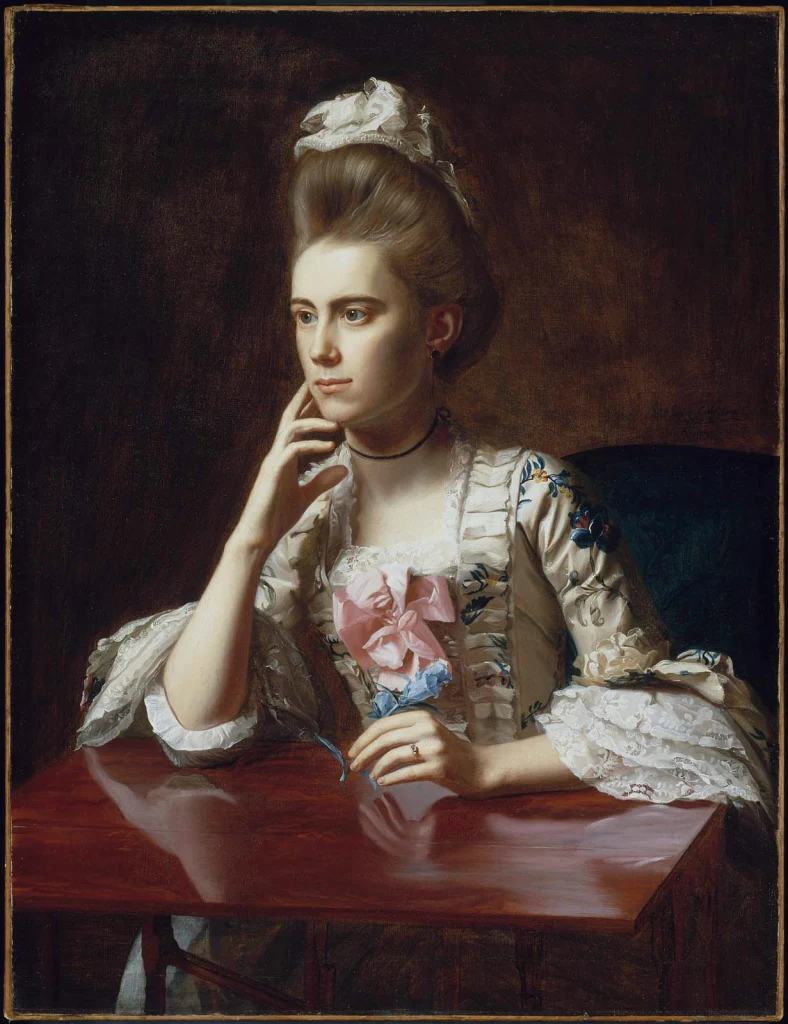
Mrs. Richard Skinner (Dorothy Wendell)
Details
The story
Nobody can say for certain who she is. Copley signed this portrait in 1772 and added the word Boston, yet the picture never went to a sitter's family. For reasons no one knows, he kept it and took it with him to London. After his son's death it was sold at Christie's in 1864 as simply a Portrait of a Lady, and Copley's great-grandson George Henry Timmins bought it and brought it back to Boston. By 1873 it was being called Mrs. Spinner. By 1906, when Timmins's sister Mrs. Martin Brimmer left it to the museum, the name had settled as Mrs. Richard Skinner, born Dorothy Wendell, the wife of a sea captain from Marblehead. The case rests mainly on her resemblance to a portrait of Dorothy Wendell painted in 1755 by the Boston artist Nathaniel Smibert. The doubts are just as concrete. In 1772 Dorothy Skinner was 39, married for 16 years, with four children, while the woman here looks far younger, and her eyes are hazel where Smibert's Dorothy has brown ones. The museum keeps the traditional name. In 1875 the novelist Henry James saw the picture in a Boston gallery and wrote that, her stately clothes apart, she looked as if she might have stepped out of a Boston streetcar. She leans at a polished mahogany table, one hand at her temple, the other holding a sprig of Canterbury bells, and the tabletop gives back a blurred reflection of her long fingers.
More works by John Singleton Copley
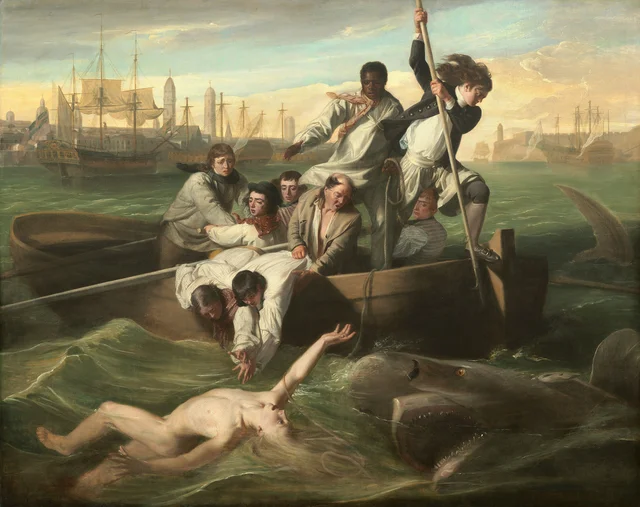 Watson and the SharkJohn Singleton Copley, 1778
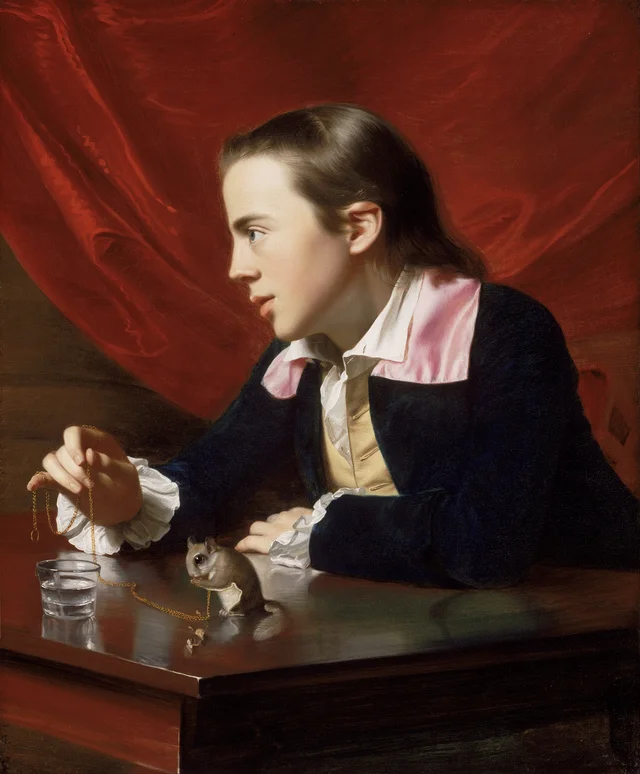 A Boy with a Flying Squirrel (Henry Pelham)John Singleton Copley, 1765
 The Death of Major Peirson, 6 January 1781John Singleton Copley, 1783
 Ann Tyng (Mrs. Thomas Smelt)John Singleton Copley, 1756
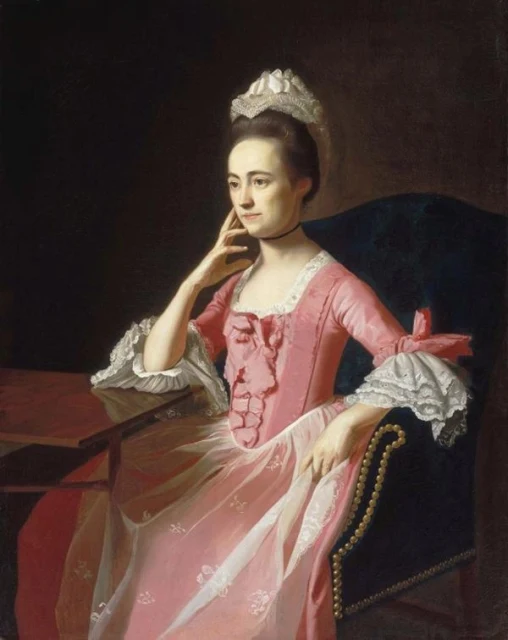 Dorothy Quincy (Mrs. John Hancock)John Singleton Copley, 1772