Alexej von Jawlensky · PD
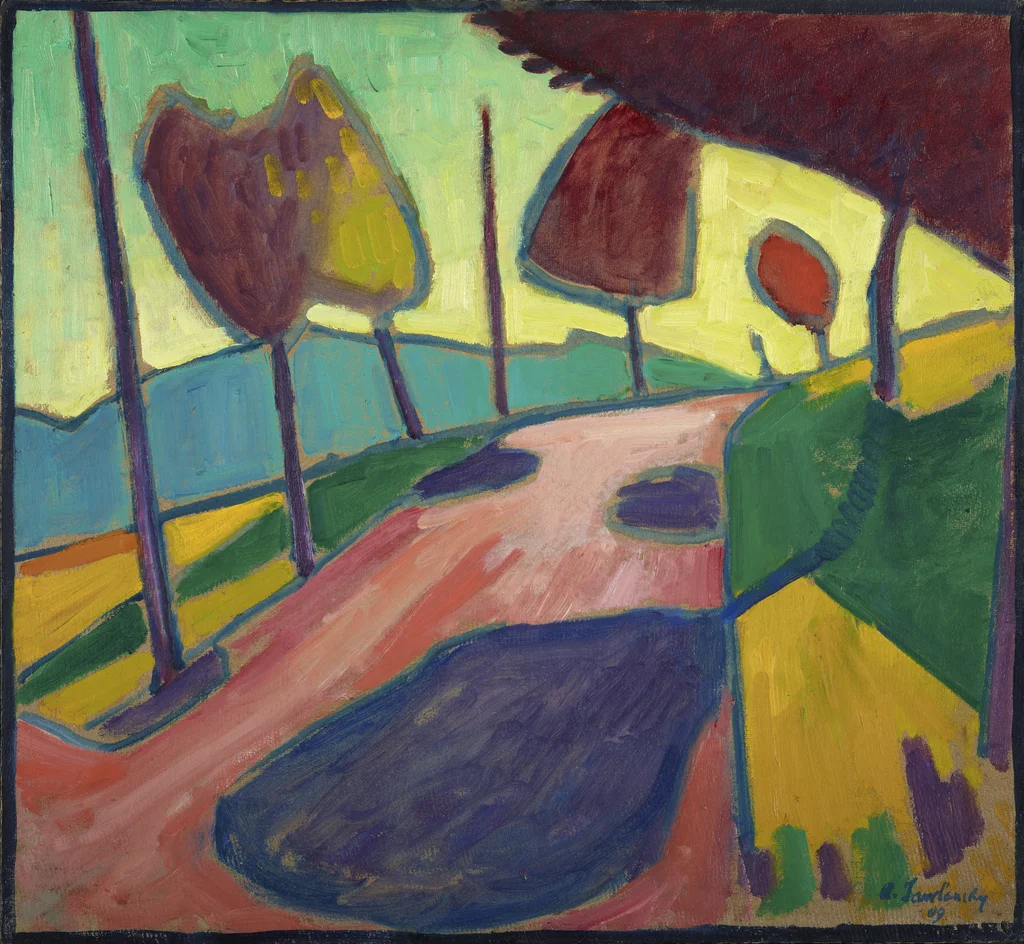
Murnau Landscape
Details
The story
Down in the lower right corner, near the signature and the date 09, Jawlensky left a few dabs of colour that belong to nothing in the scene. The Lenbachhaus reads these colour samples as a sign that the picture keeps its own reality, apart from what the eye met in Murnau that year. The rest of the painting bears that out. Shadows and the things that cast them, sky and ground, all get the same treatment, and the colours are set against each other in hard pairs, an artificial, glowing violet beside yellow, green beside orange, with a vermilion tree at the back and a turquoise ridge of hills. The angular, bent shapes have been traced to French Cubism, in particular to Henri Le Fauconnier, a Paris painter who had built his flat surfaces on the example of Gauguin and Émile Bernard. In 1910 the Munich artists' association Jawlensky belonged to invited Le Fauconnier to show with them at its second exhibition.