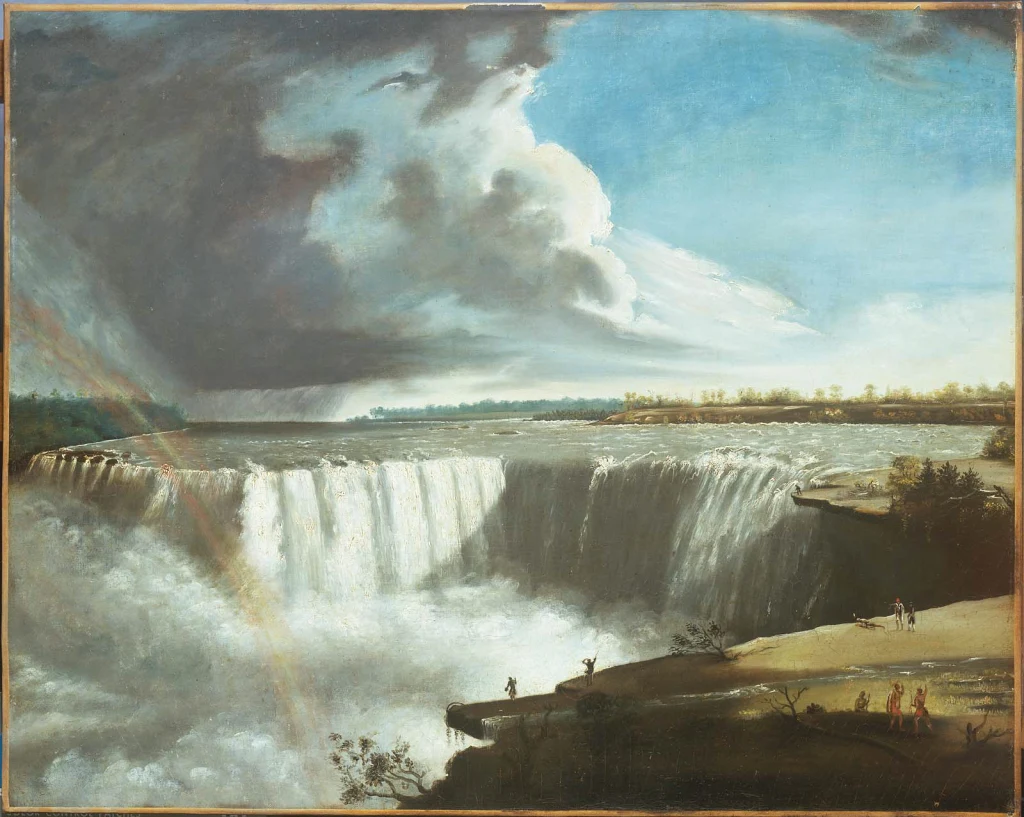
Niagara Falls from Table Rock
Details
The story
On the back of this canvas, before it was relined, Samuel Morse had written a dedication to his friend Nathaniel Jocelyn, a portrait painter and engraver, with his own name, New Haven and the year 1835. The inscription has not ended the argument over who painted it. The picture looks so unlike Morse's other landscapes of the 1830s that several historians decided the words must have been added later. Its composition is close to the Niagara views of John Vanderlyn, who had set out to be the first American to paint the falls and sell prints of them, and for a time it was taken for one of Vanderlyn's lost canvases. It was also given to Benjamin Champney, who copied Vanderlyn's Niagara sketches some 40 years later. Current scholarship has returned it to Morse, and the museum keeps his name on it. We stand on Table Rock, a ledge on the Canadian side that has since been much worn away, with tiny figures for scale and a rainbow arching over the spray. Two years later Morse turned an artist's canvas stretcher into a prototype telegraph receiver.