Passion Flowers and Hummingbirds
Details
The story
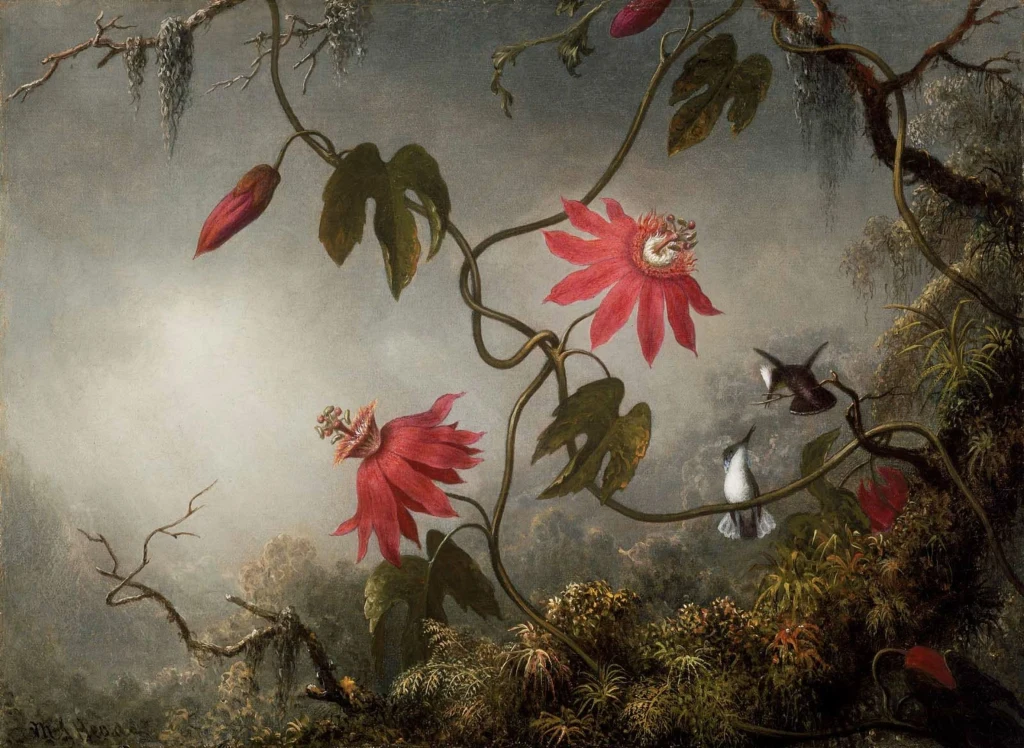
Christian missionaries in the Americas gave this flower its name. They read the Passion of Christ into its parts, the ring of fine filaments as the crown of thorns, the three stigmas as the nails of the cross. Heade's flower is Passiflora racemosa, the most brilliantly coloured of the passion flowers, and with it are two small black-and-white Snowcap hummingbirds, a species the museum places in Panama.
By the 1870s the same flower was being read in quite another way. Charles Darwin, in a book on cross-fertilisation in plants, pointed to the way hummingbirds' beaks are fitted to pollinate passion flowers. Heade was a keen naturalist, and after two trips to Central America, in 1866 and 1870, he began a group of pictures that set the birds beside tropical flowers in close-up, in a steamy jungle. The museum sees in them one of the first reflections of Darwin's ideas in American painting.
The canvas is dated only broadly, to between about 1870 and 1883. Against the cool greens and greys of the jungle, the red of the flowers is the brightest thing in the picture.