Ptolemy
Details
The story
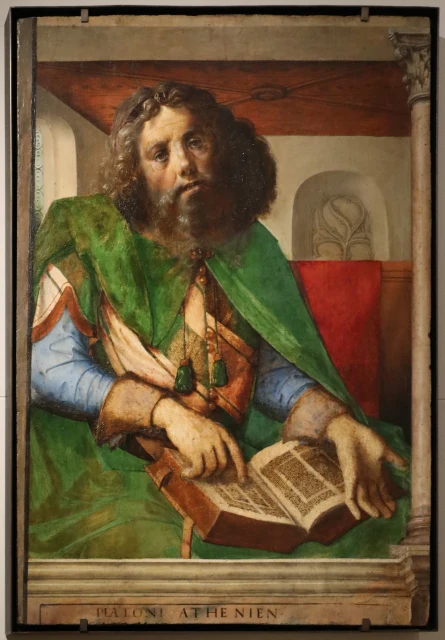
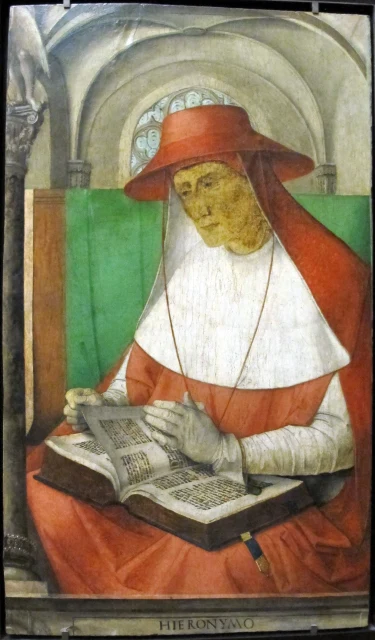
In the 1470s Federico da Montefeltro, the professional soldier who ruled Urbino, fitted out a small study in his palace. The lower walls were lined with inlaid wood that imitates half-open cupboards full of books, instruments and armour. Above them ran 28 portraits of famous men in two rows, painted several to a board, from Plato and Aristotle to Dante and Federico's own schoolmaster, Vittorino da Feltre. Ptolemy was one of them.
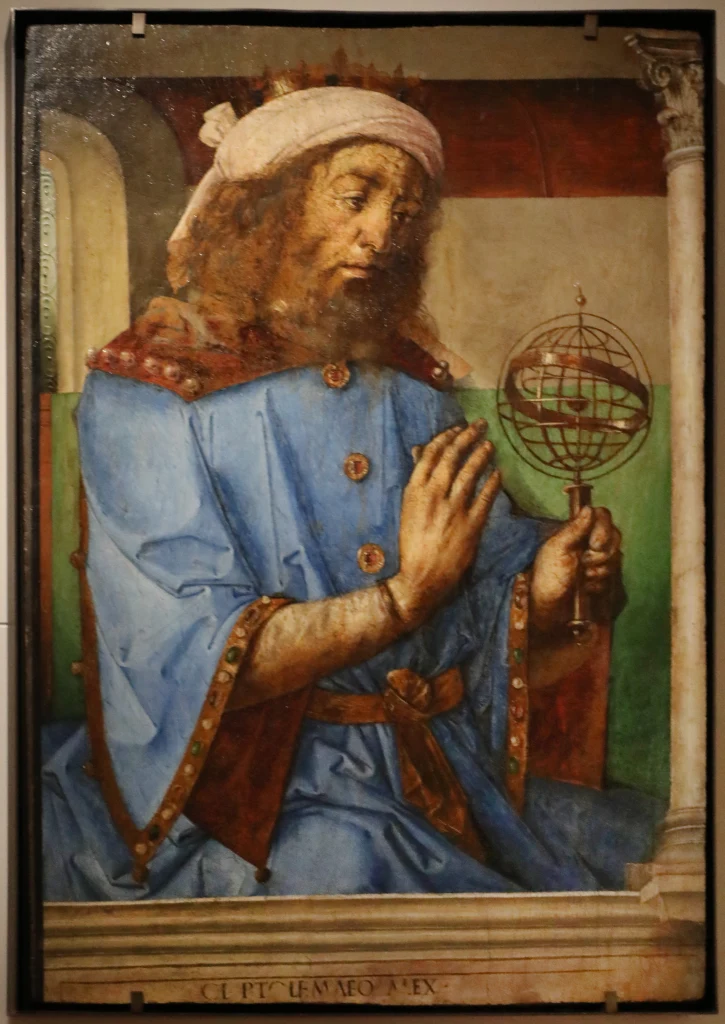
The Latin on the sill below him names him Claudius Ptolemy of Alexandria, the astronomer and geographer of the second century whose system of the heavens and whose maps were still the standard texts in Federico's day. He holds an armillary sphere, a model of the circles of the sky made of metal rings. He also wears a crown over his turban. Medieval writers often mixed him up with the Ptolemies, the Greek kings who ruled Egypt, and painters kept giving him a crown long after.
The Louvre credits the panel to two painters, Justus of Ghent, the Flemish master Federico brought to Urbino, and the Spaniard Pedro Berruguete, and a common reading is that Justus began the figure and Berruguete finished it.
The series later went to the Barberini in Rome, and by 1644 the boards had been sawn into single portraits. An inheritance split them in 1812. The 14 that passed through the Colonna di Sciarra family and the collector Giampietro Campana were bought for the Louvre in 1861. The other 14 returned to Urbino in 1934 and were put back in the study in 1983.