Salvator Mundi
Details
The story
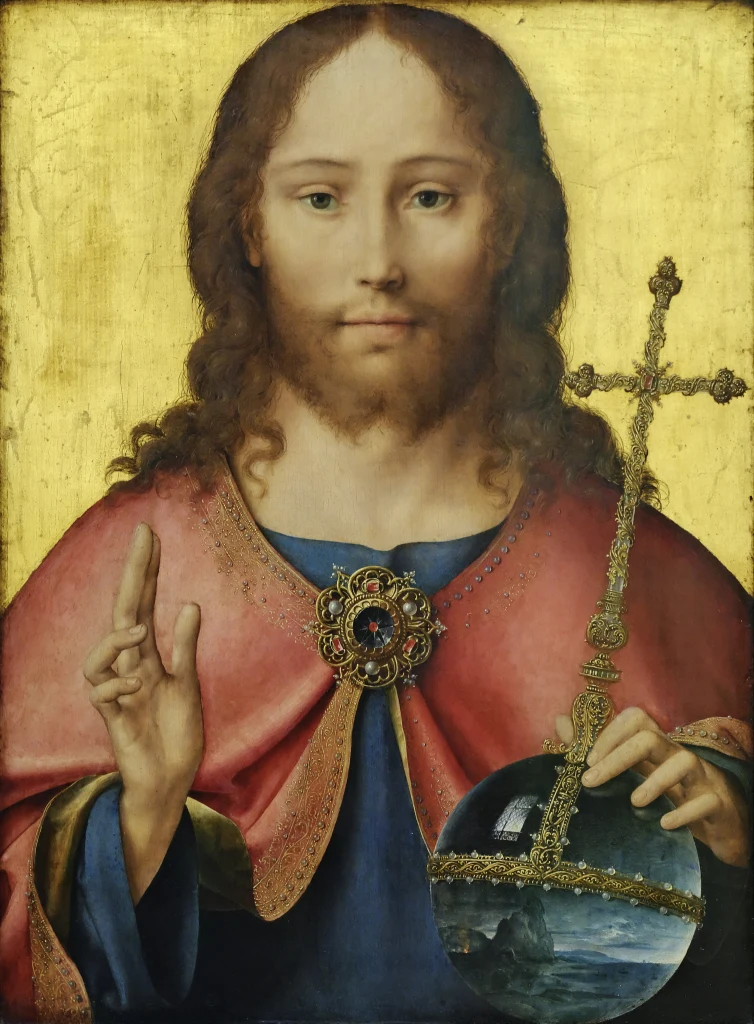
By the 1510s Netherlandish painters had long since traded gold backgrounds for real skies and rooms. Here Joos van Cleve went back to gold. The Louvre calls it an archaic touch in the manner of Jan van Eyck, rare in his work and unknown among the copyists who repeated his pictures, and it suggests this Christ was meant as the centre of something, perhaps a small triptych for private prayer with saints on the wings.
Christ blesses with his right hand and rests his left on the globe of the world, painted as a sphere of clear crystal topped with a jewelled cross. Inside it lies a rocky shore under a dark sky, a landscape the museum links to Bosch and Patinir, and on its upper curve shines the reflection of a window. That window is the detail the Louvre singles out, light from outside falling into the world Christ holds, an opening onto what lies beyond it.
The panel dates from about 1516 to 1518, his mature years in Antwerp. In 2023 it was lent to the Musée de Cluny in Paris for an exhibition devoted to rock crystal.