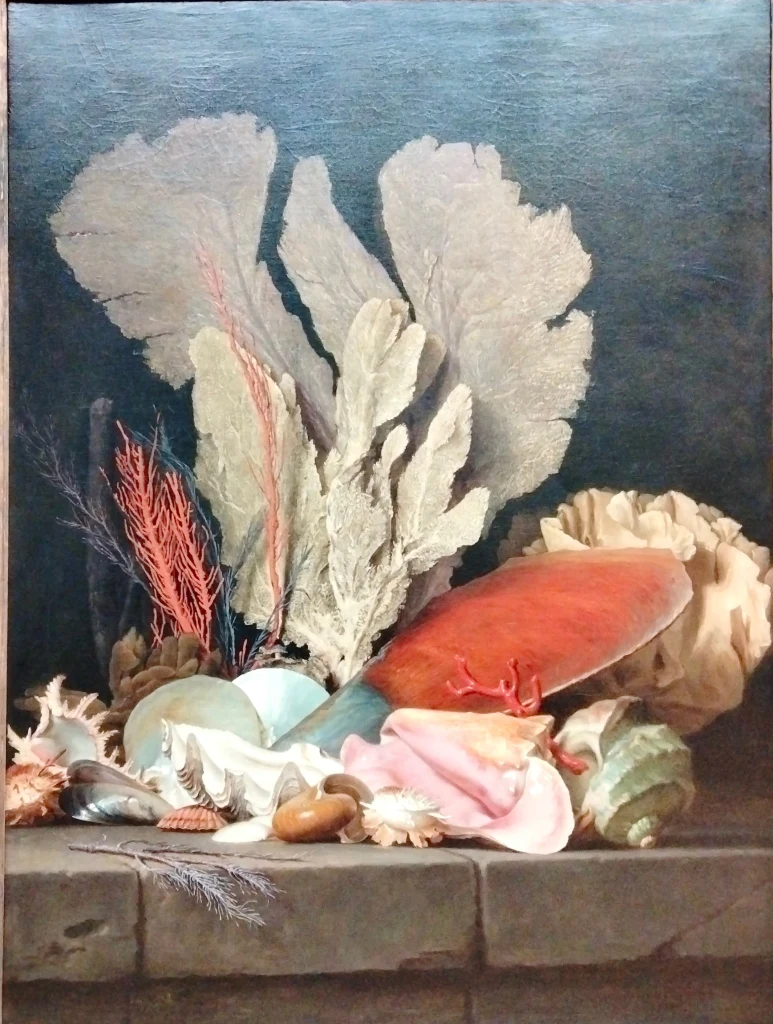
Sea Plumes, Lithophytes and Shells
Details
The story
When this canvas went on show at the Salon of 1771, it was grouped with a companion as pieces of natural history, not among Vallayer's fruit and flowers. Wealthy Parisians of the time kept cabinets of shells, corals and minerals, sorted, labelled and bought at high prices, and she painted the kind of things they collected. Pale sea fans spread like dried leaves against the dark ground, red branches of coral grow among them, and along the stone ledge lie a big pink conch, mother-of-pearl shells, a mussel, a scallop and spiny murex shells.
The title keeps an old word, lithophyte, which means stone plant. For centuries corals were taken for plants that hardened into stone, and only around the middle of the 18th century did naturalists accept that they are built by tiny animals.
Louis-François de Bourbon, prince de Conti, a prince of the royal blood and a great collector, bought the picture from the painter in January 1776, together with its companion, a still life of minerals, crystals and glass jars. Conti died that summer, and both canvases were sold with his collection in 1777. The companion is now lost. This one was bought by the Louvre at auction in Paris in December 1992.