Anthony van Dyck · PD
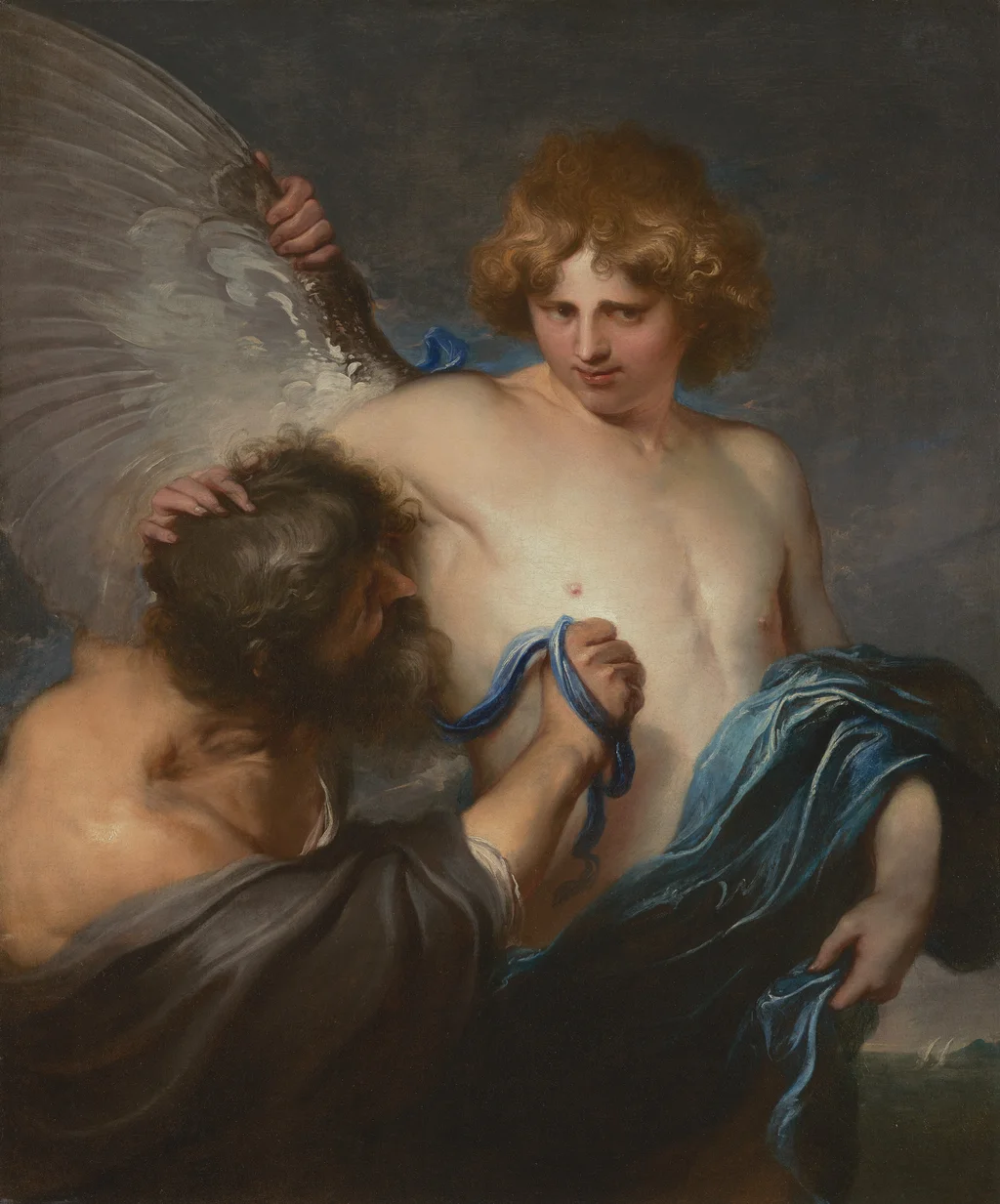
Self-Portrait as Icarus with Daedalus
Details
The story
Van Dyck was about 19 when he painted this, around 1618, still working in Antwerp beside Rubens, the city's dominant painter, and he gave Icarus his own face. Not long before, he had gone through a legal separation from his father. Christopher Atkins, who directs the museum's Center for Netherlandish Art, reads the picture against both men. A son is about to leave his father, and a young painter is working out how to leave his teacher.
In Ovid's telling Daedalus, the inventor held prisoner on Crete by King Minos, makes wings of feathers and wax and warns his son to fly neither too low, where the sea spray would soak them, nor too high, where the sun would melt them. Here the old man is tying a wing to the boy's shoulder. Icarus rests a hand on his father's head and looks away from him.
The Fall of Icarus that hangs in Brussels under Bruegel's name is a wide landscape with a ploughman, and the boy is a pair of legs disappearing into the sea. Van Dyck clears away nearly everything except the two figures. The owners, Rose-Marie and Eijk van Otterloo, lent the canvas to the Yale University Art Gallery for several years before it entered the Boston collection in 2022.