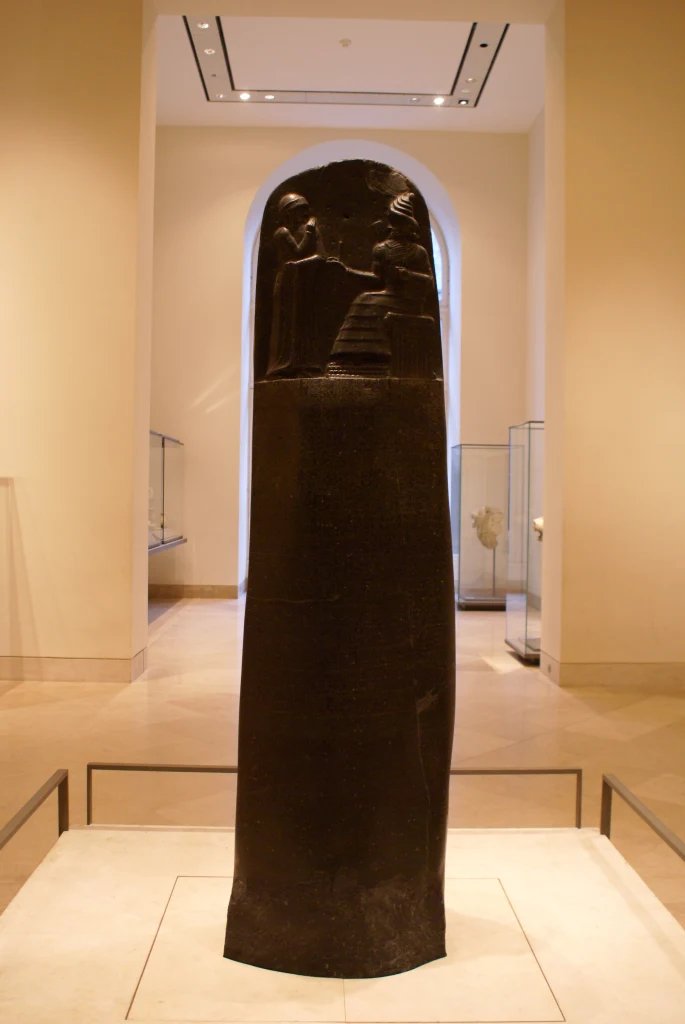
Stele of the Code of Hammurabi
Details
The story
Some six centuries after this stone was set up in Babylonia, an Elamite king named Shutruk-Nahhunte raided the cities of Mesopotamia and brought monuments home to Susa as trophies, this one among them. That is why it was found in south-western Iran, where the French mission of Jacques de Morgan dug it up in the winter of 1901 to 1902, broken into three pieces. It had been made in the later years of Hammurabi of Babylon, after he had brought most of Mesopotamia under his rule. At the top the king stands before the seated sun god Shamash, the god of justice, who holds out a rod and a ring, emblems of kingly power. Below runs the text in cuneiform, a prologue, a long run of rulings in the form "if a man does this, then that follows", and an epilogue telling anyone who has been wronged to come and have the stone read out to him. Near the bottom of the front, a band of columns was polished smooth, probably to make room for an Elamite inscription that was never carved. The stele has been on display in the Louvre since 1904.
