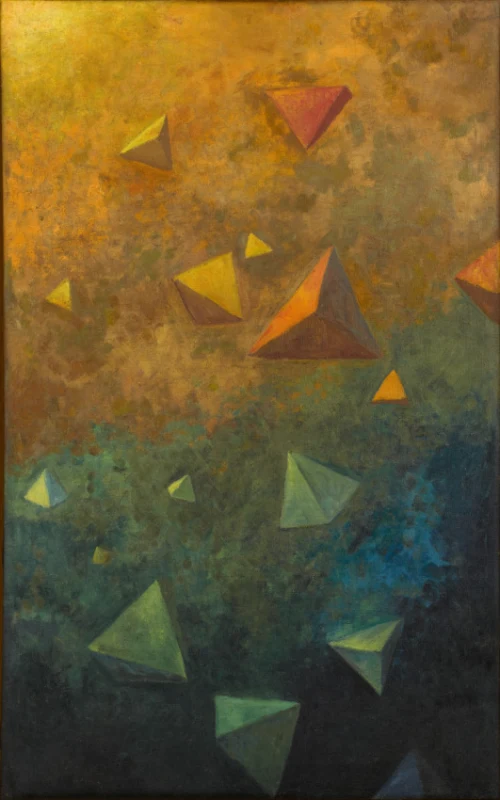
Tetrahedra
Details
The story
Around 1910, Kandinsky in Munich and Kupka in Paris were edging toward pictures with no recognisable subject. Sérusier, settled in the small Breton town of Châteauneuf-du-Faou, came to the same question by way of geometry. This canvas belongs to a series in which he painted only the simplest solid forms, the ones he believed lay beneath every shape in nature. He found the idea in Plato, whose dialogue the Timaeus builds the physical world out of regular solids and puts the pyramid at the root of them. Roughly 15 tetrahedra, pyramids with four triangular faces, drift through a space that turns from gold and orange at the top to green and deep blue below. Each one is shaded as if it had weight. His widow kept the painting for decades, and it passed through sales in Paris in 1984 and London in 1989 before the Musée d'Orsay bought it in 2018.