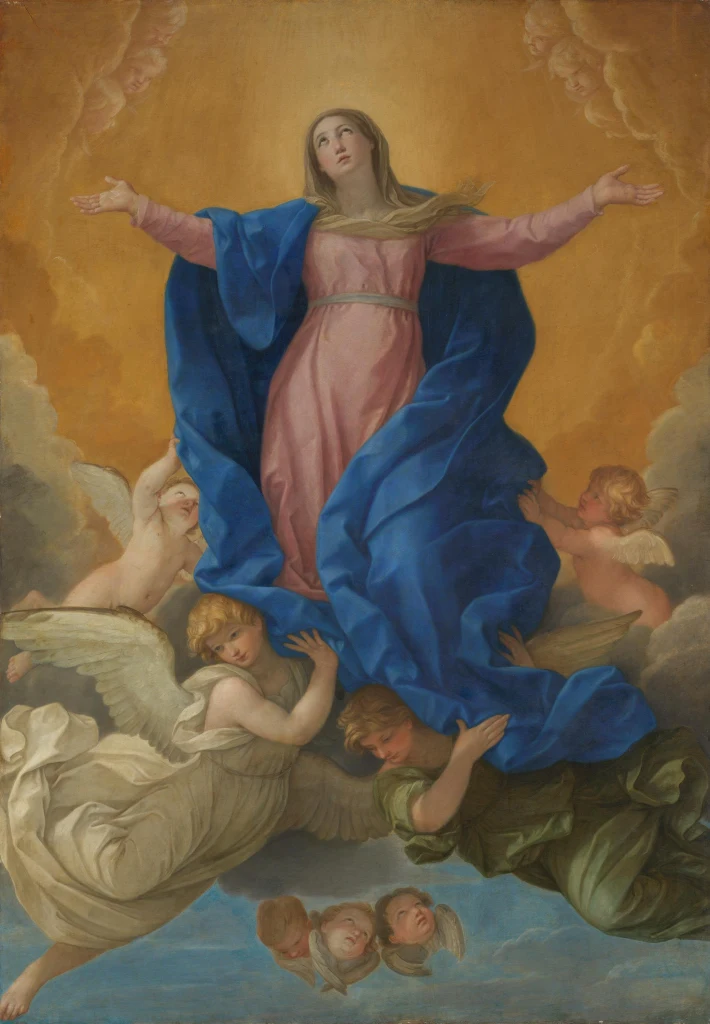
The Assumption of the Virgin Mary
Details
The story
In 1630 plague swept through Bologna, and the city's picture gallery counts some 20,000 dead out of about 70,000 people. When it had passed, the city government ordered a votive banner from Guido Reni, to be carried every year in procession to the church of San Domenico. Processional banners were made of silk, so Reni painted that one on silk, and his biographer Carlo Cesare Malvasia remarked that, apart from such banners, painting on silk was something new. A few years later, around 1638 or 1639, Reni chose the same fabric for a picture that would never be carried anywhere, the high altarpiece of a church in Spilamberto, a small town near Modena. The Munich museum credits the silk with the very fine finish of this late work and with its luminous, almost sculptural effect. Reni's light-filled colour, the museum writes, was meant to give devout viewers a glimpse into paradise as the Virgin is carried up into the sky. The silk that carries her is nearly three metres tall and a little over two metres wide.