see filename or category · PD
The Assumption of the Virgin
Details
The story
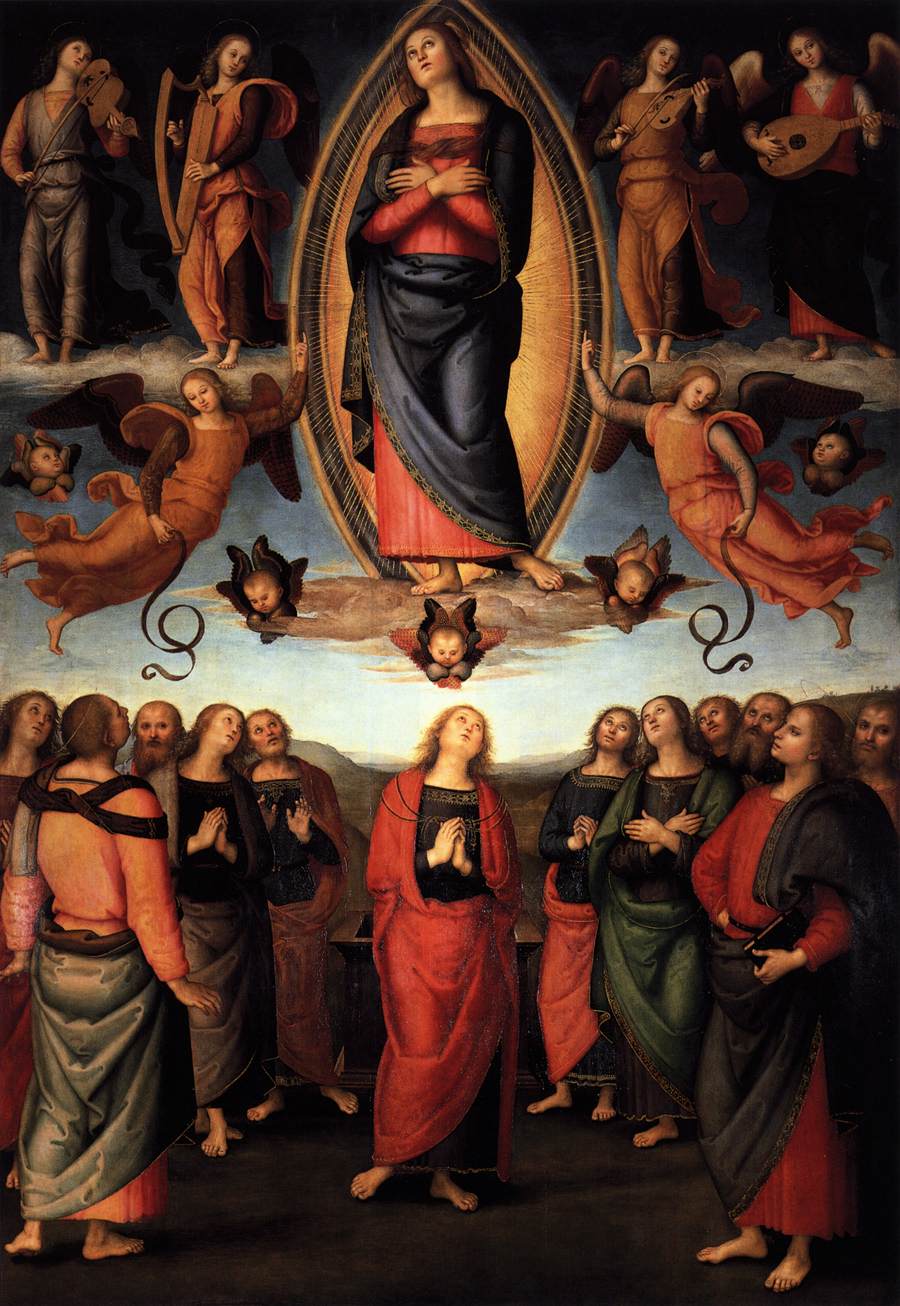
In 1505, when Perugino took over this commission, the talk among young painters in Florence was of two battle scenes being prepared for the council hall of the Palazzo Vecchio, one by Leonardo da Vinci and one by Michelangelo, both full of twisting, straining bodies. Perugino's Assumption is built on a calmer pattern. Mary rises upright inside a golden almond-shaped glory, hands crossed on her chest, with angels playing viols, a harp and a lute around her. Below, the apostles stand around her empty tomb and look up. The commission had first gone to Filippino Lippi, who died in 1504. The panel was the back of a double-sided altarpiece for the high altar of the Santissima Annunziata, the church of the Servite friars, and it faced the friars in their choir while the Deposition faced the nave. According to the biographer Vasari, when the altarpiece was unveiled the newer artists of Florence criticised it because Perugino had reused figures from earlier works. His answer was that these were the very figures they had once praised. After the altarpiece was taken apart in 1546, this side stayed in the church, and it now hangs in the Rabatta chapel.