The Blind Hurdy-Gurdy Player
Details
The story
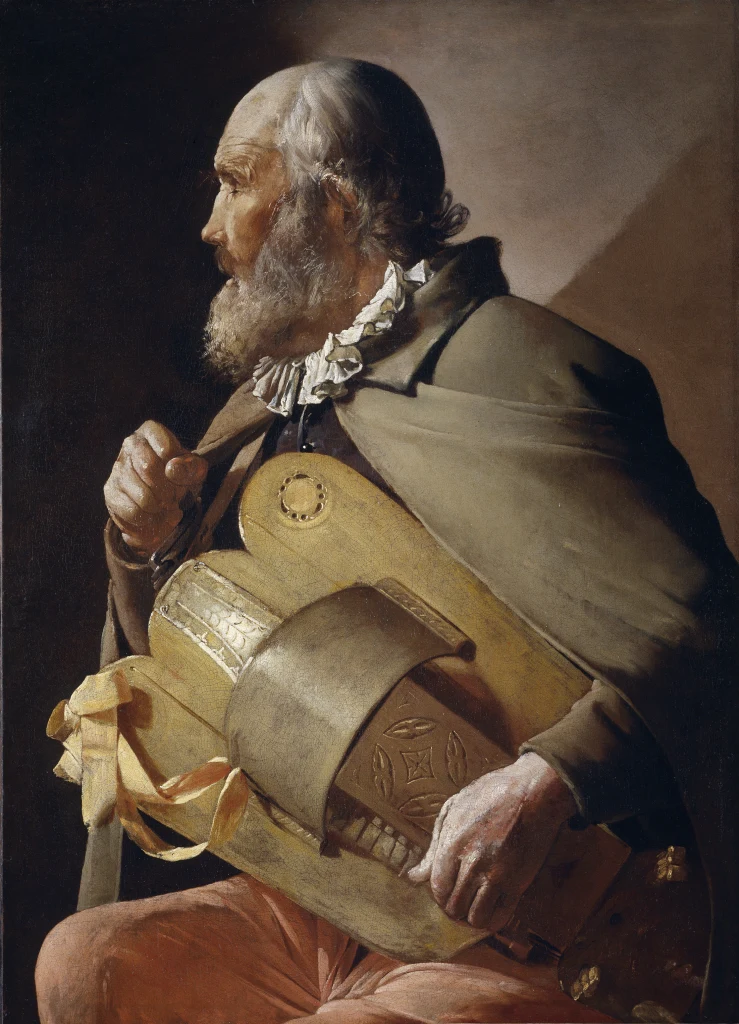
Lorraine, where La Tour worked, was still an independent duchy when this was painted, and the Prado dates it no closer than between 1620 and 1630. For a canvas a little under a metre high he chose a blind beggar at work. Turning the crank of a hurdy-gurdy with one hand while pressing its keys with the other was one of the few trades open to a blind man, and players like this one earned their coins in the street.
La Tour looked at him closely and without flattery. There is the lined face, the neglected beard, the strong hands of a man who did heavy work before he lost his sight, and a small yellow ribbon tied to the cover of the wheel. This is a daylight picture, not one of the candlelit nights.
It is also not all there. A restorer found that the canvas had been cut down from a larger composition, its old edges folded over the stretcher, so the rest of the figure is gone. The Prado bought what survives at auction in London in December 1991, for 1,870,000 pounds, using money a private citizen had left the museum for buying pictures.