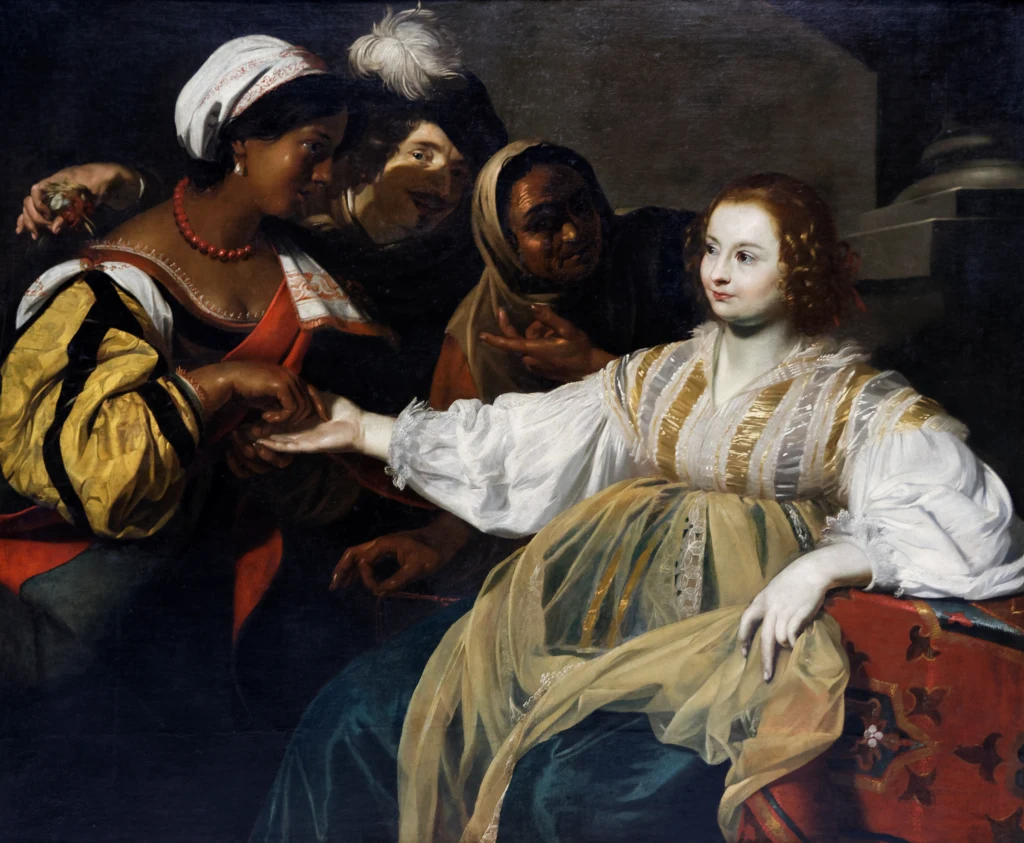
The Fortune Teller
Details
The story
In 1816 the Louvre had gaps on its walls. After Waterloo the allied powers had reclaimed much of what Napoleon's armies had brought to Paris, and the restored king, Louis XVIII, set about buying pictures to fill the rooms again. This canvas was one of those purchases, bought from a Madame Sabonadière, and it arrived under the name of Bartolomeo Manfredi, an Italian follower of Caravaggio whose tavern and street scenes a whole generation of northern painters imitated.
The name held for more than a century. In 1935 the Italian art historian Roberto Longhi gave the picture to Régnier, who had learned Manfredi's manner in Rome and taken it with him to Venice, where he settled in 1626. The Louvre places this palm-reading scene in those first Venetian years, and it singles out what he lavished on it, the care over fabrics, their glints, and the play of light through thin, transparent stuff. In 1968 the paint was transferred to a new canvas and the picture restored.