Anthony van Dyck · PD
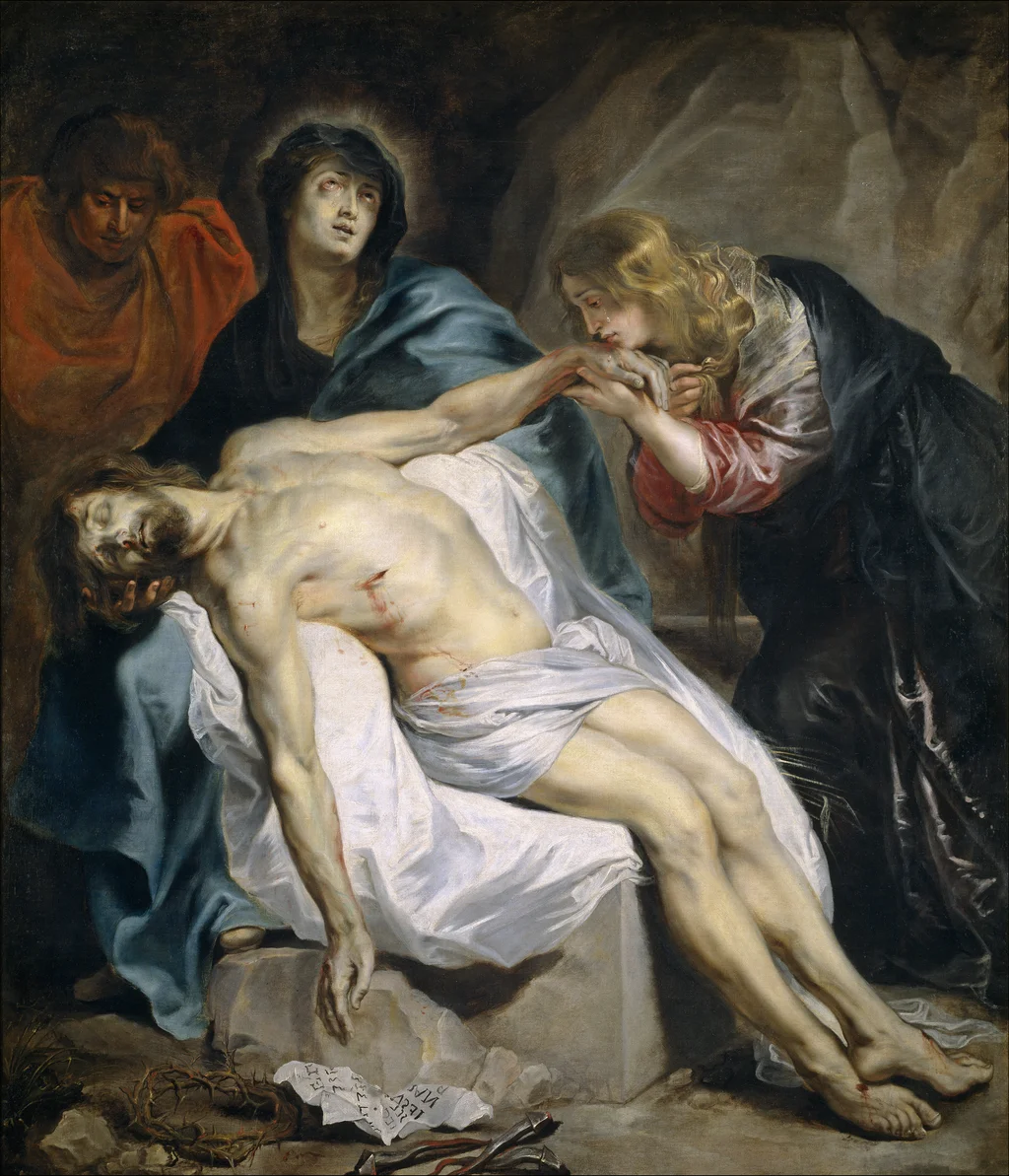
The Lamentation
Details
The story
Van Dyck painted this large Lamentation between 1618 and 1620, and he changed it while he worked. Infrared and X-ray images made at the Prado show that the body he first drew and began to paint was identical to the Christ in his Lamentation in Vienna, the legs drawn up and sharply foreshortened and practically finished. He then laid them out straighter, lengthened the figure slightly and let the weight go slack. The starting point had not been his own invention either. The composition follows an engraving by the Dutch printmaker Hendrick Goltzius, and Christ lying across his mother's knees belongs to an older German tradition of carved mourning groups. In the foreground, in front of the tomb, are the crown of thorns, the nails and the board lettered in Hebrew, Greek and Latin. The canvas stands a little over two metres high. It came to the Prado from the monastery of El Escorial, where it is recorded in the prior's chapter room from 1657.