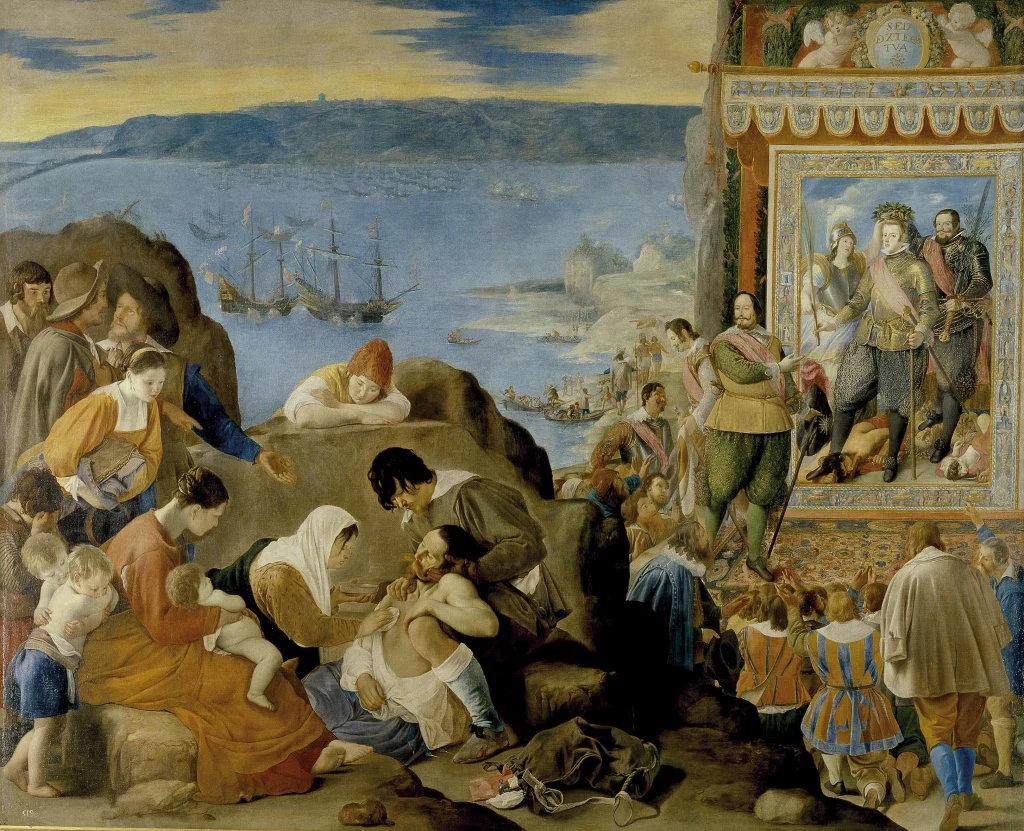
The Recapture of Bahía de Todos los Santos
Details
The story
In 1624 a Dutch fleet sailed into the bay of Todos los Santos and took Salvador, the capital of Portuguese Brazil, which at that time answered to the king of Spain. A combined Spanish and Portuguese armada won it back the following May. Ten years after that, Philip IV was fitting out a new palace on the edge of Madrid, the Buen Retiro, and its throne room was to be hung with 12 canvases of Spanish victories. Velázquez painted the surrender of Breda. Maíno was given Bahía, worked on it from late 1634, and delivered it in June 1635 for 200 ducados.
He left the battle out. The victory is in the picture, but it hangs at the back on a cloth, where Philip IV and his chief minister Olivares are crowned by Minerva and stand on figures of Heresy, Fury and Fraud. In front of that cloth the commander, Don Fadrique de Toledo, pardons kneeling Dutch soldiers, a scene that appears in no account of the campaign and seems to come instead from a play by Lope de Vega. The left side of the foreground is given over to the cost: a soldier shot in the arm, a woman pressing the wound closed, a peasant holding his head, a young woman with a small child watching him, three more figures weeping behind her.
Along the hanging runs half a line from the Psalms, sed dextera tua, your right hand, the fragment that gives the win to God rather than to the men below.