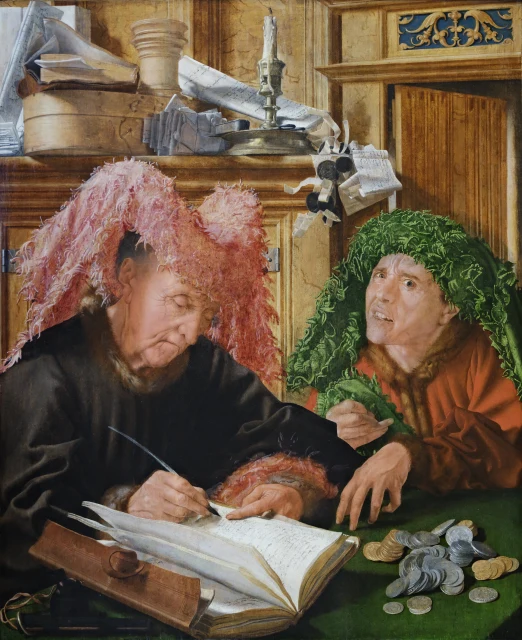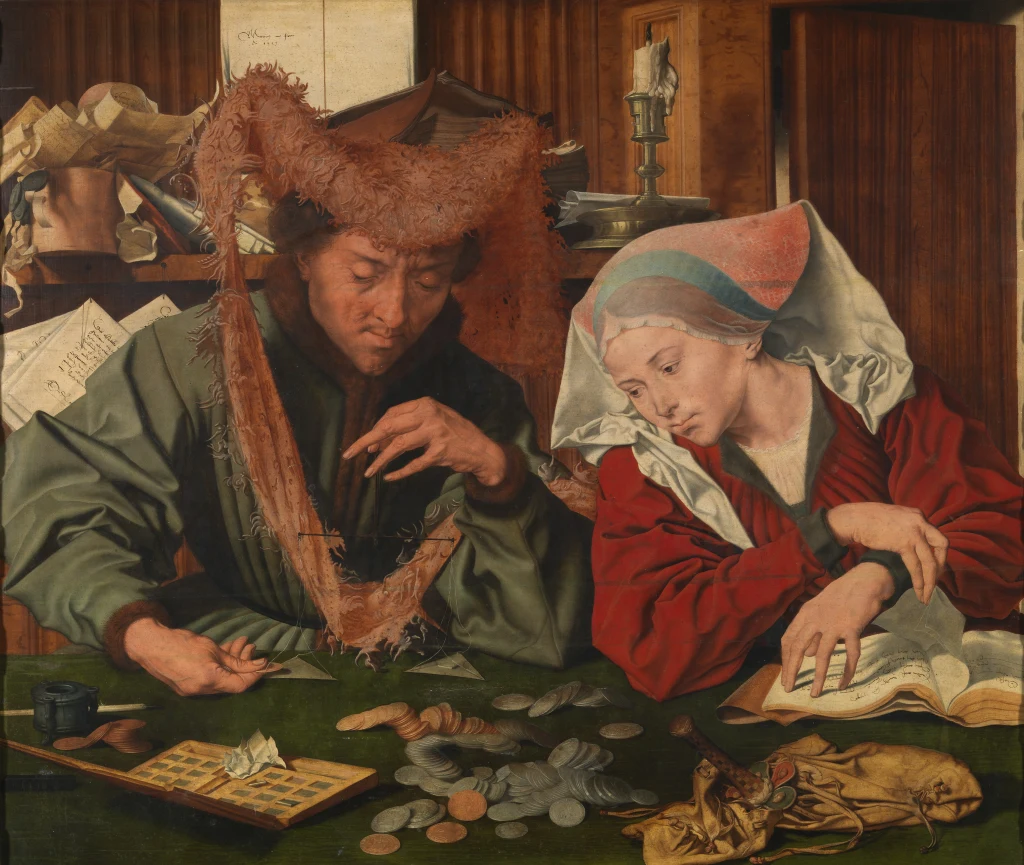
The Tax Collector and His Wife (known as The Money Changer and His Wife)
Details
The story
For centuries this panel was called The Money Changer and His Wife. Then someone read the ledger. The entries the wife is keeping are monthly excise payments on wine and beer, which makes the couple tax farmers, people who bought the right to collect a local duty and were audited on it by the provincial authorities. The Prado now calls the picture The Tax Collector and His Wife and keeps the old name in brackets.
The coins on the table can be named too. There is a gold piece struck at Dordrecht in 1487, and a silver one issued by Charles V in 1536, three years before this panel was painted. The clothes are the odd part. The heavy headgear and gowns were already a generation out of date in 1539, borrowed from older pictures, while the money and the paperwork are strictly current.
Marinus signed the panel at the upper left and dated it 1539. By 1557 it belonged to Pedro Dávila y Zúñiga, a Spanish nobleman who seems to have bought it in Brussels around the time Charles V handed over the Netherlands to his son.