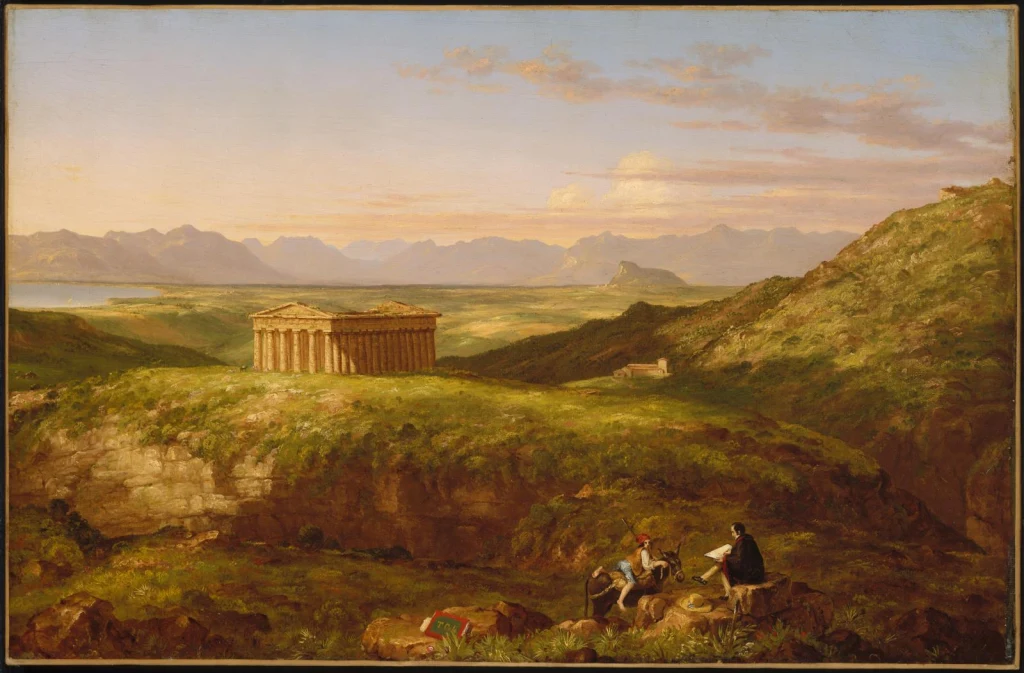
The Temple of Segesta with the Artist Sketching
Details
The story
In 1842, on his second journey to Europe, Thomas Cole crossed to Sicily. At Segesta, in the hills of the island's west, he found a Greek-style temple standing alone in empty country. Its builders were the Elymians, a people of western Sicily who were not Greek themselves, and they put it up probably around 430 to 420 BC. It was never finished. The columns were never fluted, there is no inner chamber and no roof, and the stone knobs left on the blocks for hauling them into place were never cut away.
Cole had painted plenty of ruins. Here was a building abandoned before it was ever complete. He drew it on the spot, and a pen drawing he made of the valley and the temple on that trip is now in the Detroit Institute of Arts.
In this canvas, dated 1842, he put the sketching into the picture. The temple sits on its hill across the valley under a pale evening sky, and in the foreground, among a few small figures, the artist is at work. Cole signed the painting on the portfolio he is holding, T. Cole.