Pierre-Yves Beaudouin · PD
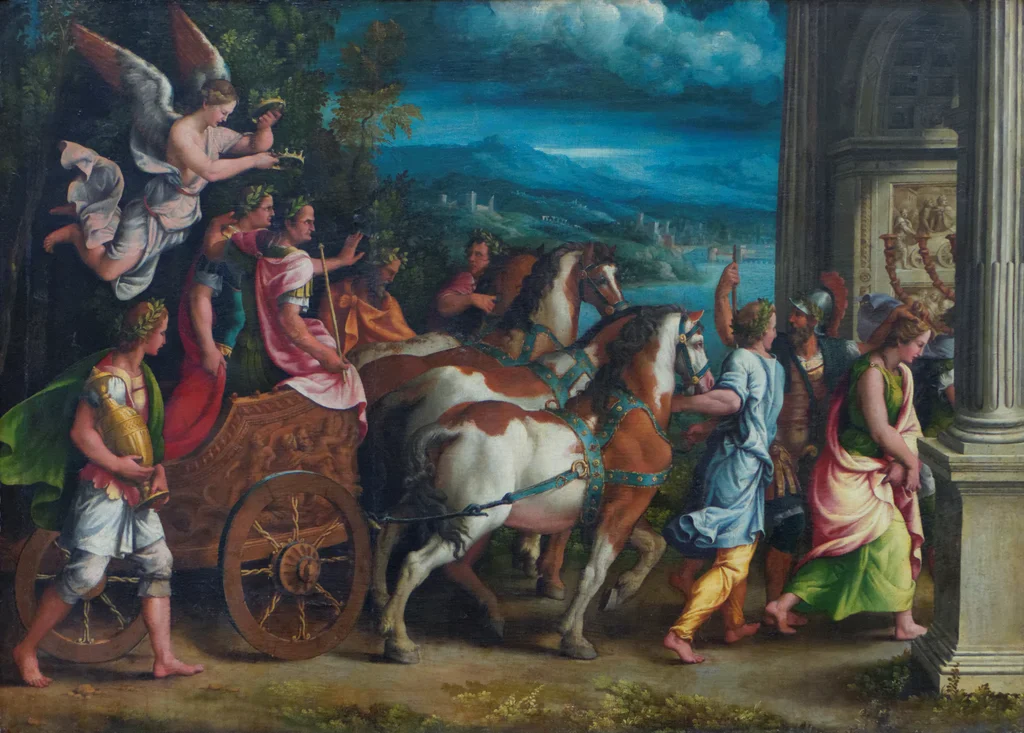
Triumph of Titus and Vespasian
Details
The story
Around 1537 Federico Gonzaga, Duke of Mantua, fitted out a small room in his palace as a gallery of Roman emperors. Titian painted eleven of them, and Giulio Romano, the duke's court artist, added eleven scenes from their lives on wooden panels. This one shows the joint triumph that Vespasian and his son Titus held in Rome in the year 71, after the Jewish War. A winged Victory swoops in from the left, holding out two golden crowns over the men in the chariot, and a boy walks beside the wheel carrying a golden ewer. The pictures stayed together for less than a century. In 1627 and 1628 the Gonzagas sold their collection to Charles I of England. After his execution in 1649 the royal pictures were dispersed, and this panel passed through the Paris banker Everhard Jabach to Louis XIV in 1662. Titian's emperors went to Spain and were lost when the Alcázar in Madrid burned in 1734.