Washerwomen
Details
The story
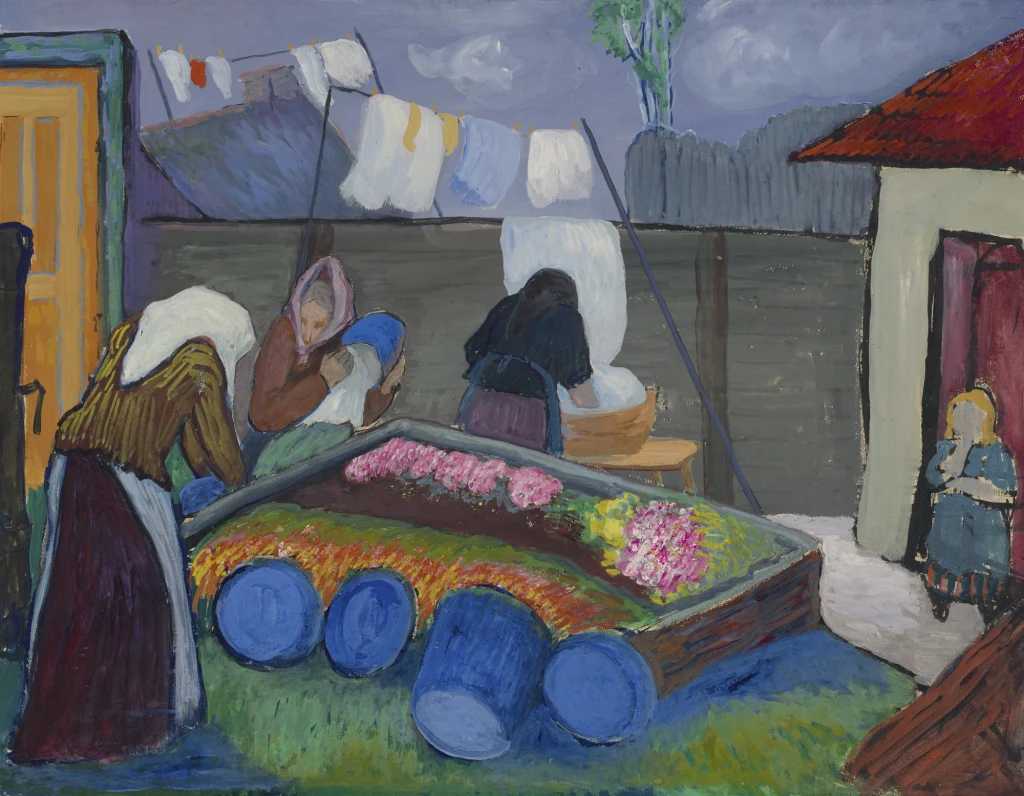
In January 1909 Werefkin helped found the New Artists' Association of Munich, whose founding circular, drafted by Kandinsky, called for art that gave form to inner experience. Unlike her friends Kandinsky, Münter and Jawlensky, she kept to figures through the years of close work that followed, painting in a symbolist manner she had developed since about 1906. This picture from around 1909 shows what she took from the Nabis, the French followers of Gauguin, who built a picture out of simple fields of colour inside dark outlines. The eye goes first to the intense blue of the washtub, propped against a flower bed and held by the two women in front. The blue comes back in their aprons and in the blue-grey sky. Two women turn their backs to us in the identical pose, one in front and one behind, and on the right scarlet and brick red flare against the blue-grey. Like nearly all her paintings, it is in tempera, and it is unsigned.