Didier Descouens · CC-BY-SA-4.0
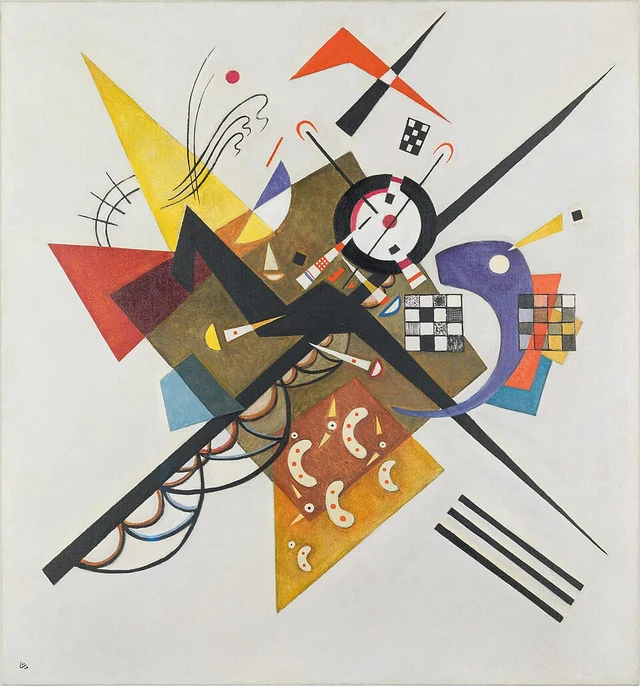
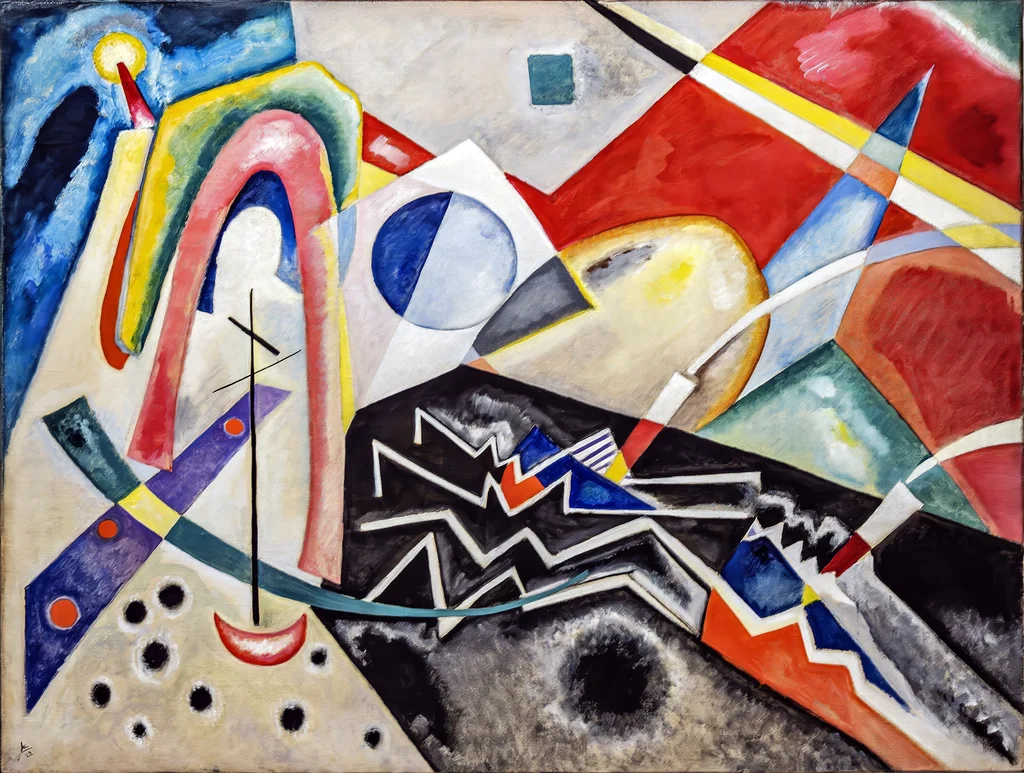
White Zig Zag
Details
The story
In 1950 the Venice Biennale gave Kandinsky a room of his own. He had been dead six years, and the retrospective, put together by the critic Carlo Ludovico Ragghianti, walked Italian visitors from his early figurative landscapes through to the geometry of his last decades. When it closed, the City of Venice bought this canvas for the modern gallery at Ca' Pesaro. Italian public collections held almost no international abstract painting at that point, and the purchase is usually described as the moment abstraction formally got in.
The painting itself is from 1922, the year Kandinsky moved to Weimar to teach, and it sits on the hinge of his work, between the loose floating forms of the years before and the ruled circles and angles that follow. It is oil on canvas, 92 by 125 centimetres, and it has hung in Ca' Pesaro ever since.