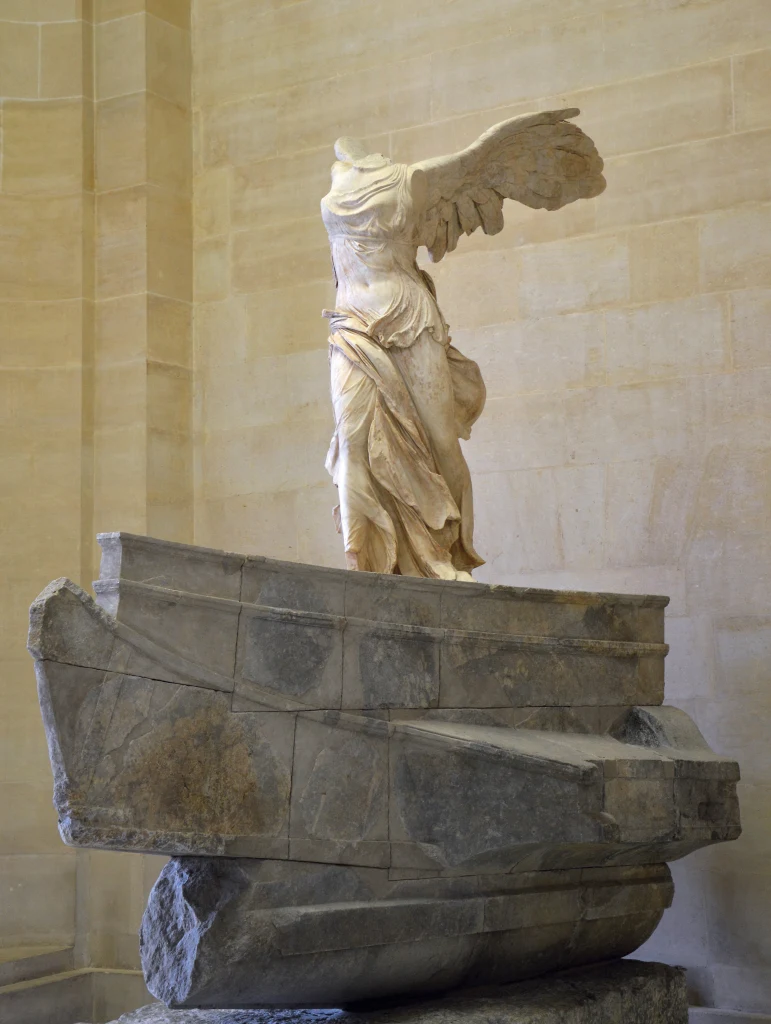
Winged Victory of Samothrace
Details
The story
Around 190 BC the eastern Aegean was fought over at sea. Rome and its ally Rhodes, an island republic famous for its navy, were battling the fleets of Antiochus III, the Seleucid king, and this statue was very probably set up to give thanks for a naval victory, though which battle, and who paid for it, is not recorded. She is Nike, the goddess of victory, alighting on the prow of a warship. She stood in the sanctuary of the Great Gods on the island of Samothrace, gods whom sailors trusted to protect them at sea. One clue points to Rhodes. The ship under her feet is carved from a grey marble quarried at Lartos, on Rhodes, while the figure is white marble from Paros.
She came to light in 1863, when Charles Champoiseau, a French diplomat posted in the region, dug in the sanctuary and sent the broken torso to Paris. The grey blocks were left behind, and only in 1875 did excavators recognise them as the prow of a ship. Figure and ship were reunited at the top of the Louvre's Daru staircase in 1884, with a plaster right wing cast as a mirror of the left. Her head has never been found. In 1950, though, the palm of her right hand turned up on Samothrace, and it is now shown in a case beside her.
