Basilica of Our Lady of the Pillar
Zaragoza, Spain
The story
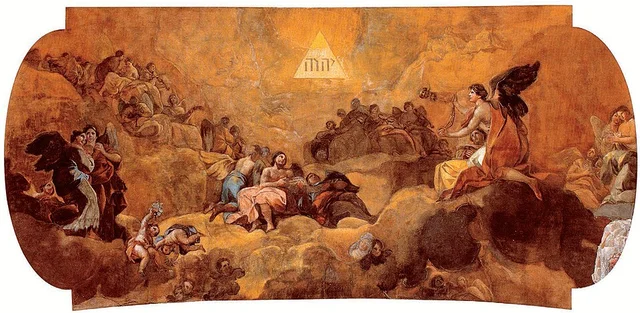
In the spring of 1772, a 26-year-old painter from a village south of Zaragoza, just back from Italy, climbed the scaffolding in the basilica of El Pilar for his first major public commission. Francisco de Goya's Adoration of the Name of God fills the small dome over the coreto, the little choir that faces the chapel of the Virgin. Angels on banks of cloud turn toward a triangle bearing the name of God in Hebrew letters, and Goya painted it between May and early June. He was paid 15,000 reales, against the 25,000 the better-known Antonio González Velázquez had received for his dome over the Virgin's chapel.
The basilica was begun in 1681 on plans by Francisco Herrera the Younger, and it grew around much older things. Pilgrims come for the small jasper pillar on which, by tradition, the Virgin appeared to Saint James in Roman Zaragoza. The high altar keeps the alabaster altarpiece carved by Damián Forment between 1509 and 1518 for the earlier church on the site.
Goya returned in 1780 to paint another dome, the Queen of Martyrs, and quarrelled with the cathedral's building board and with his brother-in-law Francisco Bayeu, who directed the work, when they criticised his designs. On a pillar near the Virgin's chapel hang two bombs that were dropped on the basilica in August 1936, early in the Spanish Civil War, and failed to explode.