The story
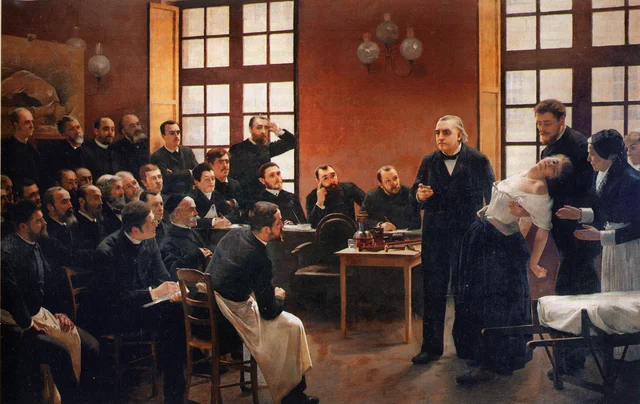
Near the entrance to the museum hangs a crowded painting that many visitors know before they arrive. André Brouillet, a Paris painter, showed it at the Salon of 1887. The neurologist Jean-Martin Charcot is lecturing at the Salpêtrière hospital while his patient Blanche Wittmann sinks backwards into the arms of his assistant Joseph Babinski, watched by a room full of men in dark coats. Sigmund Freud, who had studied with Charcot, later kept a print of it in his consulting room.
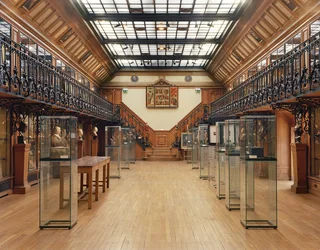
The museum itself is one tall room on the second floor of the old Paris Faculty of Medicine, on the rue de l'École-de-Médecine, fitted out in the early 1900s with wooden display cases and an upper gallery. Its collection, among the oldest of its kind in Europe, grew from instruments gathered in the 18th century, and it follows surgery across the centuries. There are Egyptian embalming tools, rows of amputation saws and long trepanning drills for opening the skull. One case holds the instruments of Francesco Antommarchi, the doctor who performed Napoleon's autopsy on Saint Helena.
The strangest object is a small round table presented to Emperor Napoleon III in 1866 by Efisio Marini, an Italian doctor who experimented with petrifying human tissue. Its top is a mosaic of preserved organs and blood, with a human foot and four ears resting on it.