The story
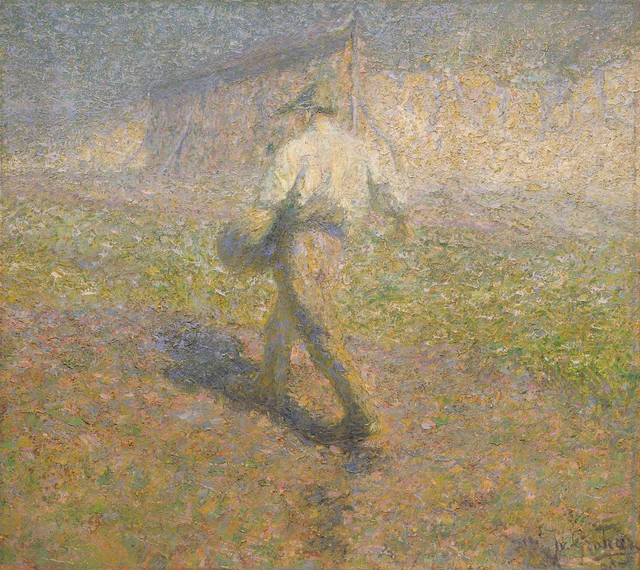
Anyone who has handled a Slovenian five-cent euro coin has already met one painting in this gallery. The coin carries The Sower, painted in 1907 by Ivan Grohar, a peasant scattering seed across a ploughed field in the morning haze. Grohar was one of the Slovene Impressionists, who brought open-air light into Slovene painting around 1900, and his sower has become close to a national emblem.
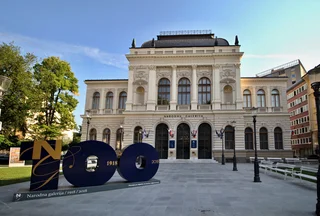
The gallery was founded in 1918, as Austria-Hungary broke apart. It settled in the Narodni dom, or National Hall, built in 1896 by the Czech architect František Škabrout for Slovene cultural societies. Edvard Ravnikar, the leading Slovene architect of his generation, added a wing in the early 1990s, and in 2001 a glass hall was built to join old and new.
That hall now shelters the original Robba Fountain, the baroque Fountain of the Three Carniolan Rivers by the Venetian-born sculptor Francesco Robba, brought indoors after its restoration in 2008. The collection runs from medieval sculpture to the early twentieth century, with Slovene painters such as Ivana Kobilca beside European ones. A still life by the Russian expressionist Alexej von Jawlensky arrived by train just before the Second World War, the gift of a Jewish doctor from Zagreb. And a small oval portrait of a Polish noble girl, Elisabeth Mniszech, holding a white spitz, was painted in Saint Petersburg in 1797 by Élisabeth Vigée Le Brun, Marie Antoinette's portraitist.