The story
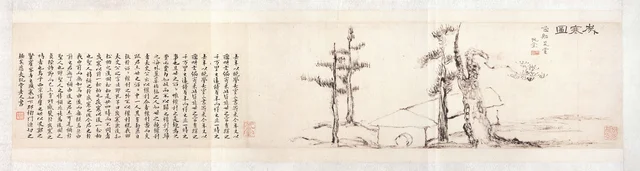
In December 2020 a collector named Sohn Chang-keun gave the National Museum of Korea one of the country's best-loved paintings. Sehando, A Winter Scene, shows a plain hut between pine and cypress trees. Kim Jeong-hui, the scholar and calligrapher better known as Chusa, painted it in ink in 1844, in his fourth year of exile on Jeju Island.
He made it for his former student Yi Sang-jeok, an interpreter who stayed loyal and kept bringing him books from China. The inscription borrows a saying of Confucius, that only when the year turns cold do we see that the pine and cypress are the last to fade. Yi carried the painting to Beijing, where 16 Chinese scholars added poems of praise, and with these colophons it grew into a scroll almost 15 metres long.
In the 20th century it belonged to Fujitsuka Chikashi, a Japanese scholar of Kim's work living in Tokyo. In 1944 the calligrapher Sohn Jae-hyeong, the donor's father, visited him again and again until Fujitsuka let it go. Most of Fujitsuka's remaining collection was destroyed in air raids the following year.
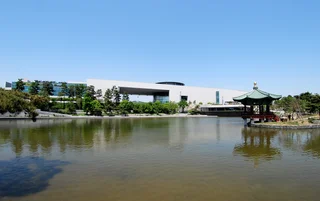
The museum itself moved in 2005 into a large new building in Yongsan, in central Seoul. One gallery there, the Room of Quiet Contemplation, holds two gilt-bronze pensive bodhisattvas from the 6th and 7th centuries, Buddhist figures seated with one leg crossed over the knee, shown side by side in a darkened space.