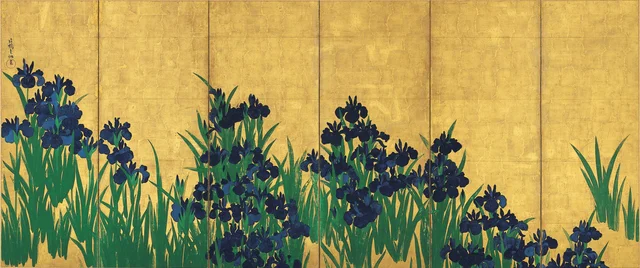
The story
Every spring, for a few weeks between April and May, the Nezu Museum in Tokyo's Aoyama district brings out its most famous possession while real irises flower in the garden outside. The Irises screens are a pair of six-panel folding screens by Ogata Kōrin, the Kyoto painter of the early 18th century. Clumps of irises in deep blue and green run across a ground of gold leaf. The motif comes from The Tales of Ise, a classical Japanese poem-tale in which a traveller stops at a marsh full of irises, yet Kōrin left out the bridge and the travellers and painted only the flowers. The screens are a National Treasure, and for the rest of the year they are kept out of sight.
The collection behind them was assembled by Nezu Kaichirō, a railway industrialist of the Meiji era and a devoted follower of the tea ceremony. He died in 1940, and the museum opened to the public on his estate the following year. Its holdings now number more than 7,400 objects of Japanese and East Asian art, from tea utensils and Buddhist painting to Chinese ritual bronzes of the Shang and Zhou dynasties.
The present building, by the architect Kengo Kuma, opened in 2009. Visitors reach it along a long path lined with bamboo, and behind the galleries the garden runs down a slope, with ponds, stone lanterns and several tea houses.