Santa Maria Formosa
Venice, Italy
The story
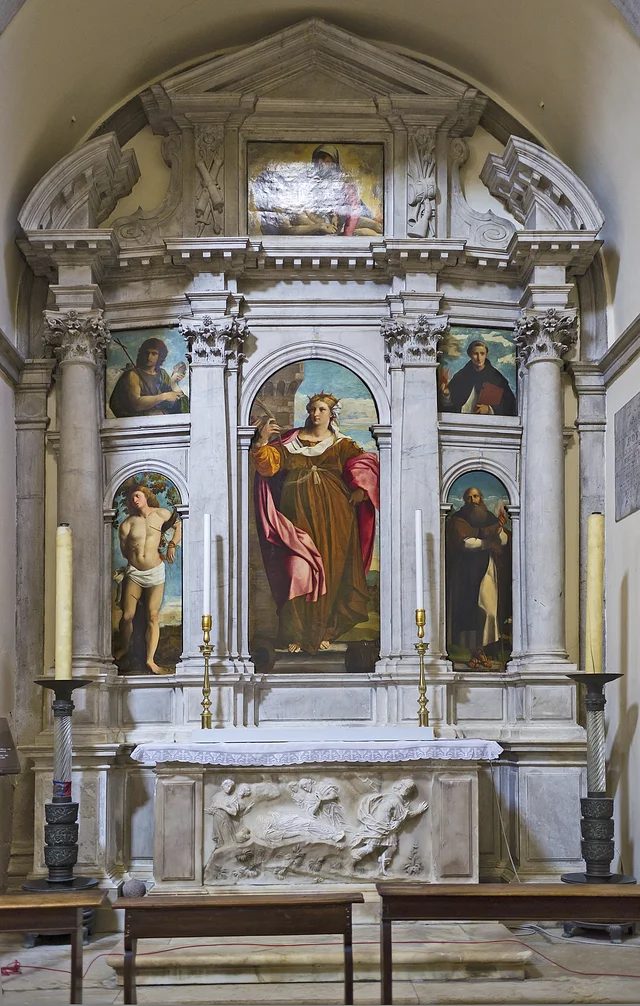
At the feet of Saint Barbara, in the altarpiece on the gunners' altar of Santa Maria Formosa, sits a small cannon. The chapel belonged to Venice's bombardiers, a confraternity of artillerymen who took the martyr Barbara as their patron, and around 1523 they asked Palma Vecchio, a painter from the Bergamo hills working in Venice, for a polyptych in her honour. She stands tall and calm in the centre, holding the palm of martyrdom beneath a dead Christ, with Saint Sebastian, John the Baptist, Anthony Abbot and a Dominican saint in the panels around her.
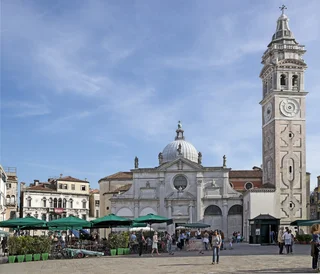
The church is Mauro Codussi's work, rebuilt from 1492 on the plan of an older one. Venetian tradition traces the first church here to the 7th century, when the Virgin is said to have appeared to Saint Magnus, bishop of Oderzo, as a shapely woman, formosa in Latin. It has two facades, a Renaissance one of 1542 on the canal and a Baroque one of 1604 facing the campo.
Inside, the chapel of the Conception keeps a triptych of the Madonna of Mercy by Bartolomeo Vivarini, dated 1473. Outside, a carved grotesque head leers from the arch at the foot of the bell tower. The English critic John Ruskin wrote that it was leering in bestial degradation, too foul to be either pictured or described.