The story
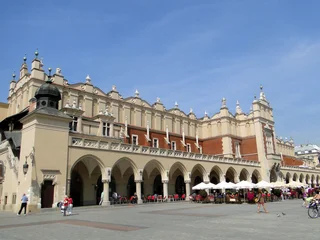
Climb the stairs inside the Cloth Hall, the long trading hall in the middle of Kraków's Main Market Square, and the upper floor opens into four rooms of 19th-century Polish painting. This is where the National Museum in Kraków began. In October 1879, at a ball held in the freshly renovated hall, the painter Henryk Siemiradzki announced that his huge canvas Nero's Torches, showing early Christians set alight in the emperor's gardens, would go to a new national museum. The museum was founded days later, at a time when Poland had been divided among three neighbouring empires for more than 80 years.
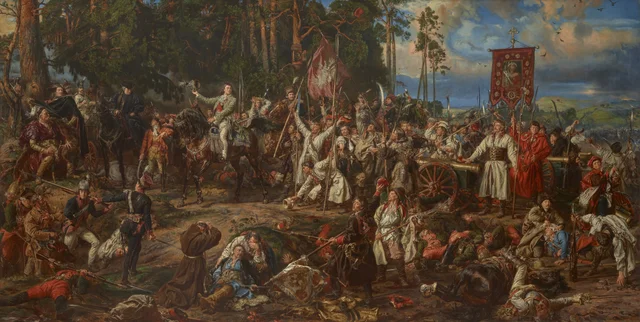
That missing state shapes much of what hangs here. Jan Matejko, Kraków's own history painter, is present with the Prussian Homage, where the Duke of Prussia kneels before the Polish king in 1525, and with Kościuszko at Racławice, painted in 1888. It shows Tadeusz Kościuszko's peasant scythemen in their battle against Russian troops in 1794, on a canvas close to nine metres wide.
The rooms are named after four painters, Bacciarelli, Michałowski, Siemiradzki and Chełmoński, and move from the Enlightenment to early Symbolism. In the last of them, Józef Chełmoński's Four-in-Hand sends four horses galloping straight at the viewer. The gallery closed for renovation in 2006, its paintings stored at Niepołomice Castle outside the city, and reopened in 2010.