Pârvu Mutu
1657–1735 · Principality of Wallachia · Brâncovenesc style, Post-Byzantine art
The story
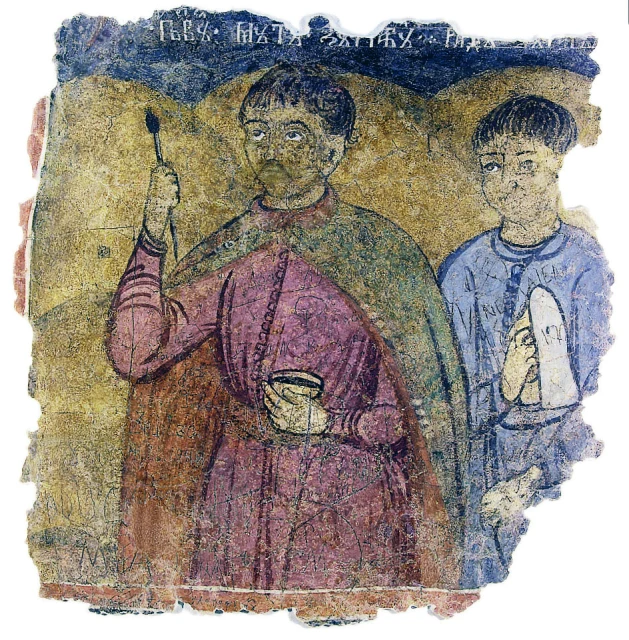
In the church of the Three Hierarchs at Filipeștii de Pădure, a village in the Prahova hills, a long wall of donor portraits shows dozens of members of the Cantacuzino family, a leading boyar clan of Wallachia, standing in their court robes. The painter who finished that church in 1692 put his own portrait in it too. His name was Pârvu, the son of a priest from Câmpulung, and he is remembered as Pârvu Mutu, Pârvu the Mute. Church tradition says the name came from the way he worked, silent, fasting and praying while he painted.
For decades the Cantacuzinos kept him busy, and so did Constantin Brâncoveanu, the prince of Wallachia who was a Cantacuzino on his mother's side. Pârvu painted churches and monasteries they founded, among them the monastery at Sinaia in the Carpathians and the Colțea church in Bucharest. His rows of founders are more than a list of patrons, since he gave them individual faces, and historians of Romanian art single out that interest in likeness as his real strength. A self-portrait from the church at Bordești, brush in hand, is now in the National Museum of Art of Romania.
Late in life, after his wife died, he became a monk and took the name Pafnutie. He died in 1735, and in 2017 the Romanian Orthodox Church canonised him as the Venerable Paphnutius the Iconographer.