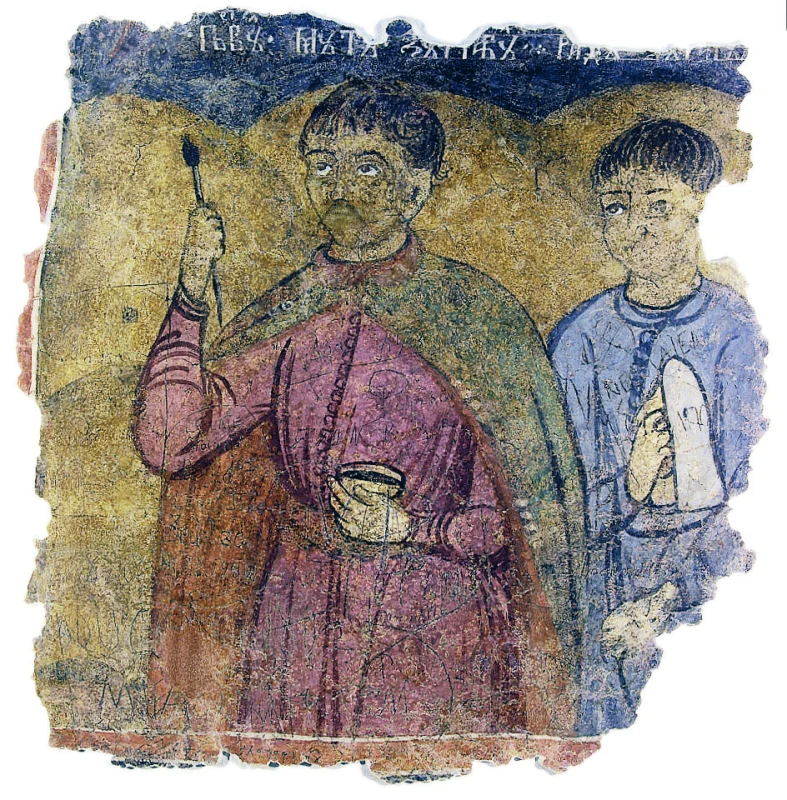
Self-portrait of Pârvu Mutu
Details
The story
In the late 1690s a boyar named Mănăilă built a small hermitage church at Bordești, close to what was then Wallachia's border with Moldavia, and Pârvu Mutu painted it. Among the figures on its walls he put himself. In the Orthodox tradition he worked in, church painters had long stayed anonymous, and the museum reads this portrait as a sign that some masters were starting to step out of that, at a time when craftsmen's guilds were growing and a skilled painter could claim a respectable place in society.
He shows the whole job. In his raised right hand is a brush, and in his left a small vessel, described in the sources as a shell for mixing colours. Just behind him stands his apprentice Radu, younger and shorter, holding against his chest a pale, pointed float, the tool used to smooth fresh plaster before the painting begins. The master wears a long violet kaftan buttoned down the front and a green cloak, the dress of a respectable layman.
The church was later abandoned and stood open for decades, and visitors scratched letters into the paint. Those marks run across the kaftan, the ochre background and Radu's blue robe, and they came with the fragment when it was cut from the wall in the mid-20th century.