Allegory of the brevity of life
Details
The story
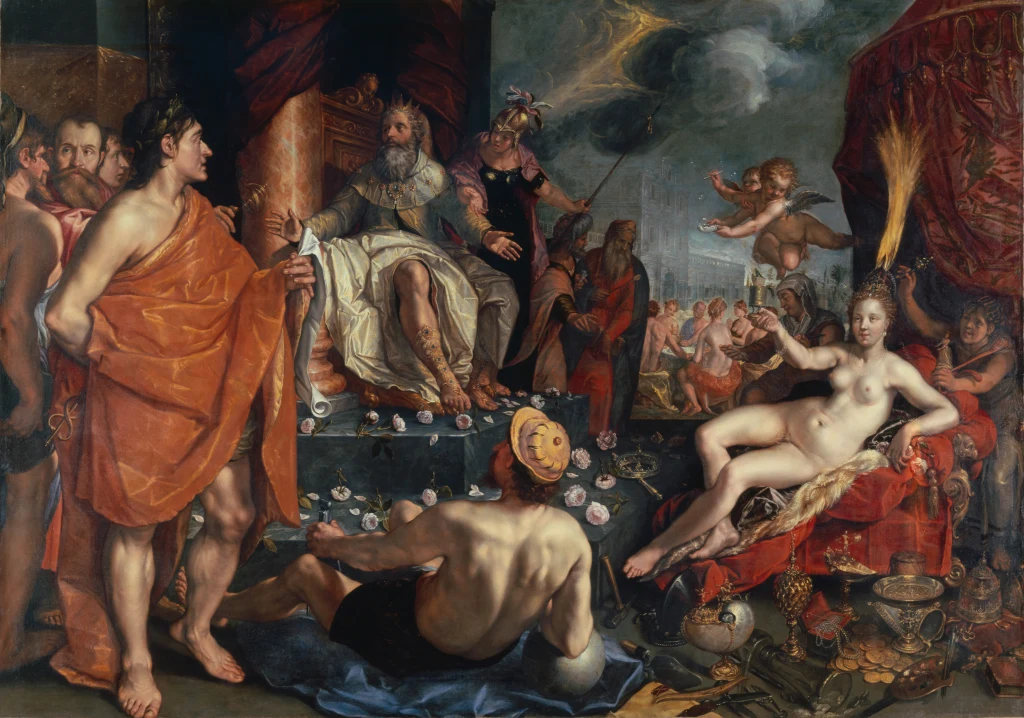
By 1611 Hendrick Goltzius, famous across Europe for his engravings, had spent a decade doing something unexpected: painting in oil. This canvas, over two and a half metres wide, is the largest picture he ever made, and the only one into which he worked his own face, off to one side beside the god Hermes.
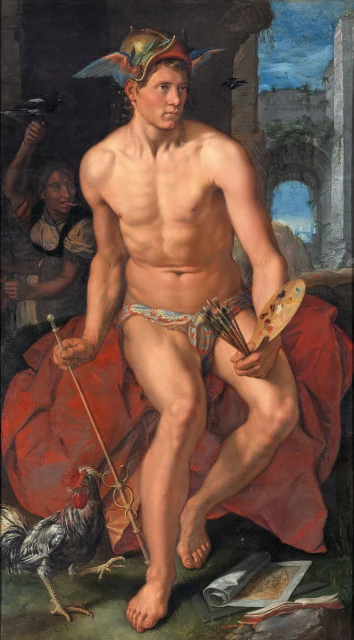
The scene is drawn from the Pandora myth. Hermes presents her to the king Epimetheus. Around the figures Goltzius laid out the equipment of a working alchemist, a furnace, a broken glass alembic, and the metals and residues of distillation. Hermes was the god alchemists claimed as their patron, and the painting keeps sliding between a Greek story and a laboratory.
What it means has never been settled. Read as the brevity of life, as alchemy, or as a riddle about the making of art itself, it has drawn flatly contradictory interpretations for 400 years. The date 1611 appears twice, once on the throne and again on a tool lying on the ground.