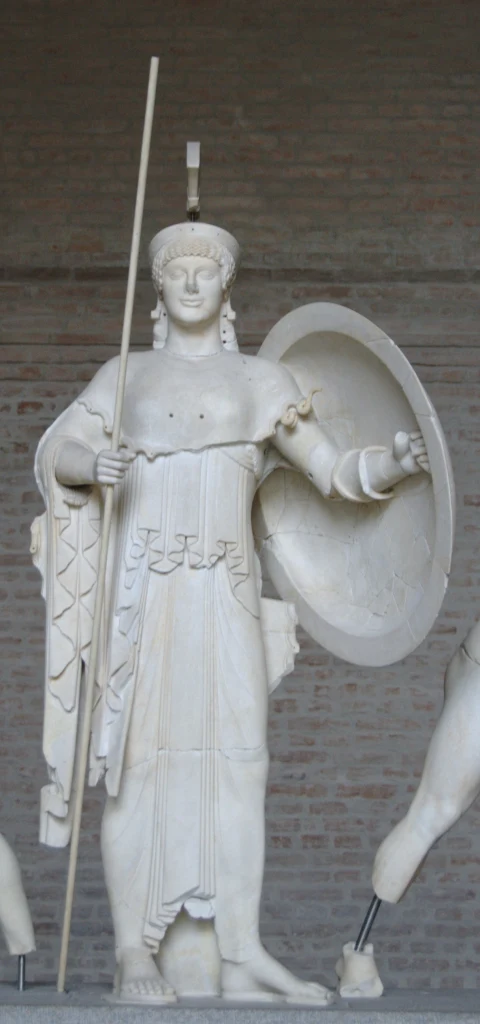
Athena from the West Pediment of the Temple of Aphaia
Details
The story
Through most of the 19th century, nobody knew whose temple these figures had come from. It was called the temple of Zeus Panhellenios, and because Athena stands at the centre of both gables, some scholars thought it must be hers. In 1901 the Munich archaeologist Adolf Furtwängler excavated the sanctuary on Aegina and found inscriptions that settled the question. The temple belonged to Aphaia, an old local goddess of the island, almost forgotten in later antiquity. The Glyptothek's guide of 1922 still took care to point out that the temple had once been wrongly given to Zeus or to Athena.
So the goddess at the middle of this gable stands in a house that belonged to someone else. Here she is the Athena of the Trojan War, who in Homer takes the side of the Greeks. She wears a helmet, the aegis, her protective goatskin cape, and carries a shield. While the fighting runs on to either side, she faces straight out, and she is usually understood as present in the battle yet unseen by the warriors around her.
More works by Unknown Greek sculptor (Archaic)
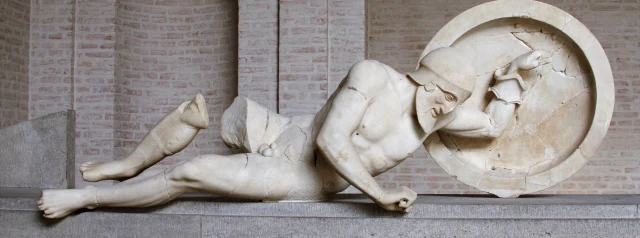 Dying Warrior ("Laomedon") from the East Pediment of the Temple of AphaiaUnknown Greek sculptor (Archaic), -490
 East Pediment of the Temple of Aphaia, AeginaUnknown Greek sculptor (Archaic), -490
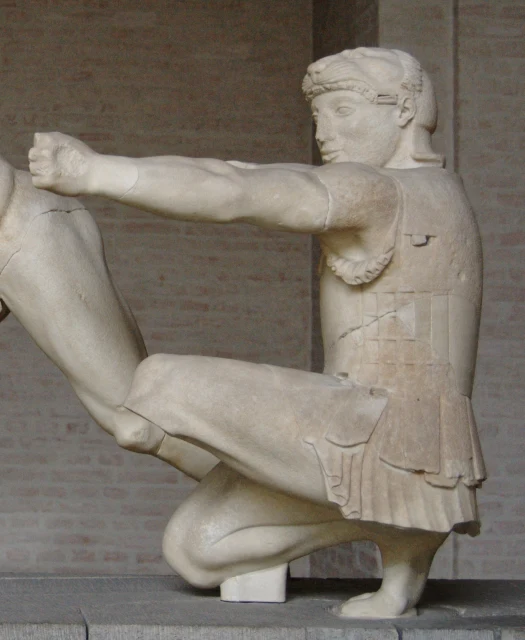 Herakles the Archer from the East Pediment of the Temple of AphaiaUnknown Greek sculptor (Archaic), -490
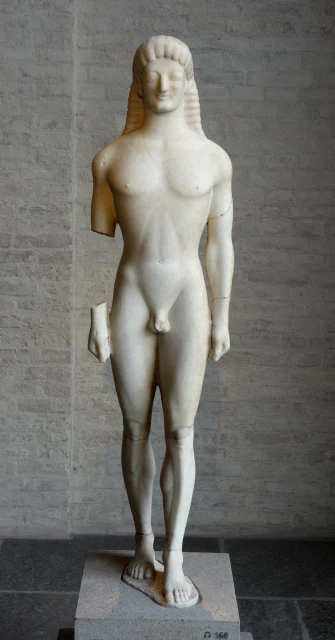 Kouros of TeneaUnknown Greek sculptor (Archaic), -560
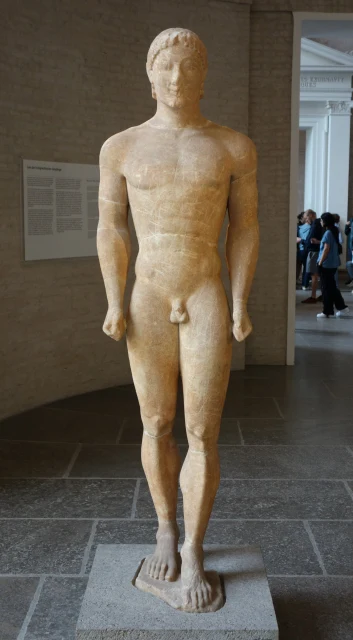 Munich KourosUnknown Greek sculptor (Archaic)