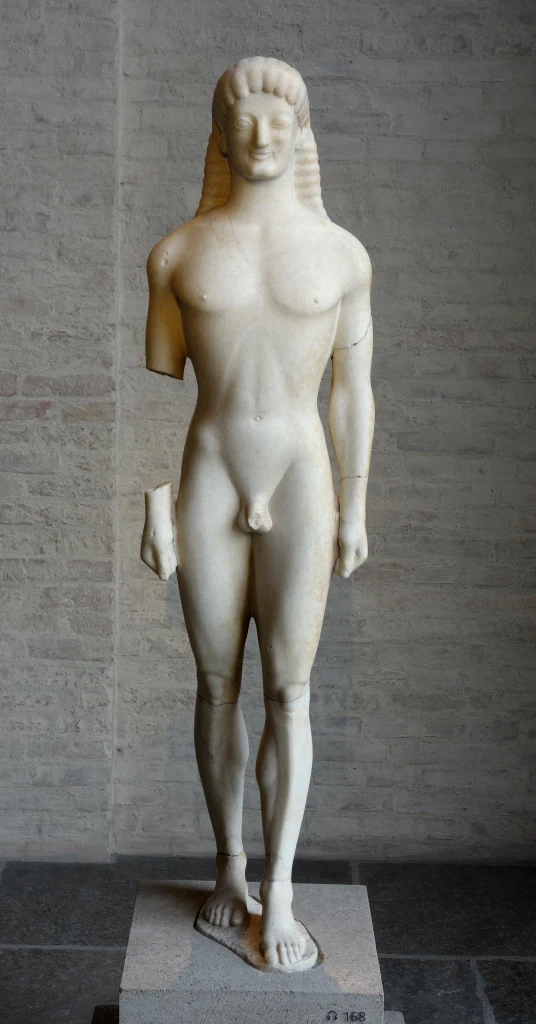
Kouros of Tenea
Details
The story
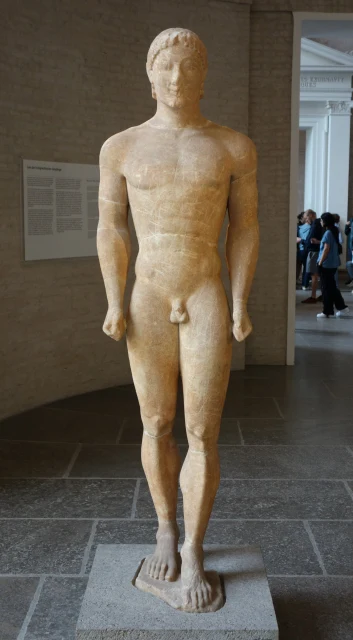
Around 560 BC this marble youth was set over a grave at Tenea, a small settlement in the hills south of Corinth, then one of the richest trading cities in Greece. The museum thinks it probably stood for the dead man himself, so that his memory would outlast him. It came out of the ground there in 1846 and reached Munich in the 1850s.
The 19th century knew it as the Apollo of Tenea, because scholars took naked youths like this for the god. Today such figures are called kouroi, which simply means young men. Greek sculptors had begun carving large marble youths and maidens around 650 BC, and the youths always keep the same stance. The left foot is set forward, but the weight rests evenly on both legs, so the figure is ready to move without moving. The arms stay close to the body and the eyes look straight ahead. The face wears what is called the Archaic smile.
The museum points out that the body is carefully observed, with some details close to life and others stylised. What Greek sculptors wanted, the museum says, was an ideal image of the human body. He stands 153 centimetres tall.
More works by Unknown Greek sculptor (Archaic)
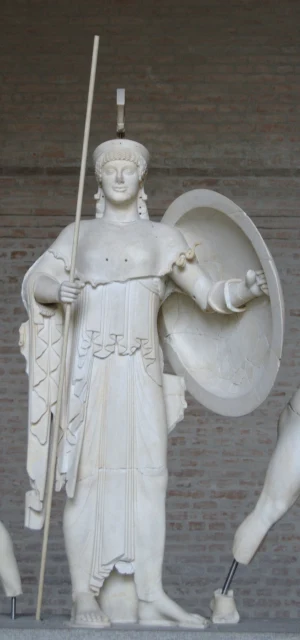 Athena from the West Pediment of the Temple of AphaiaUnknown Greek sculptor (Archaic), -500
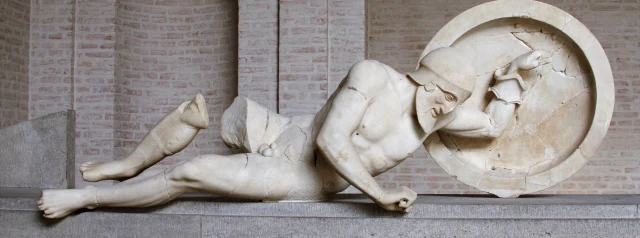 Dying Warrior ("Laomedon") from the East Pediment of the Temple of AphaiaUnknown Greek sculptor (Archaic), -490
 East Pediment of the Temple of Aphaia, AeginaUnknown Greek sculptor (Archaic), -490
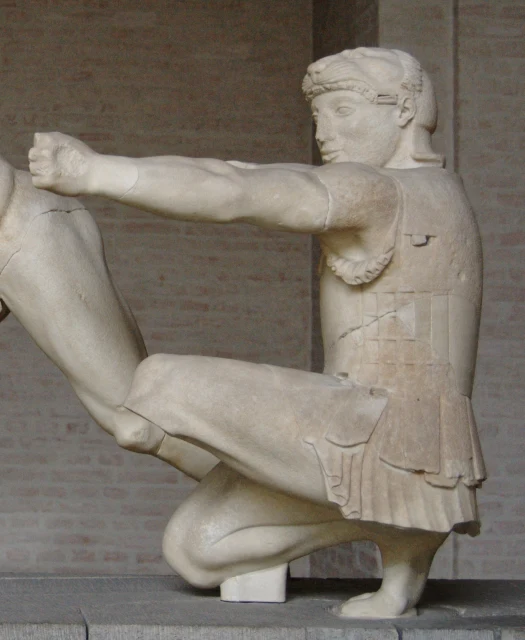 Herakles the Archer from the East Pediment of the Temple of AphaiaUnknown Greek sculptor (Archaic), -490
 Munich KourosUnknown Greek sculptor (Archaic)