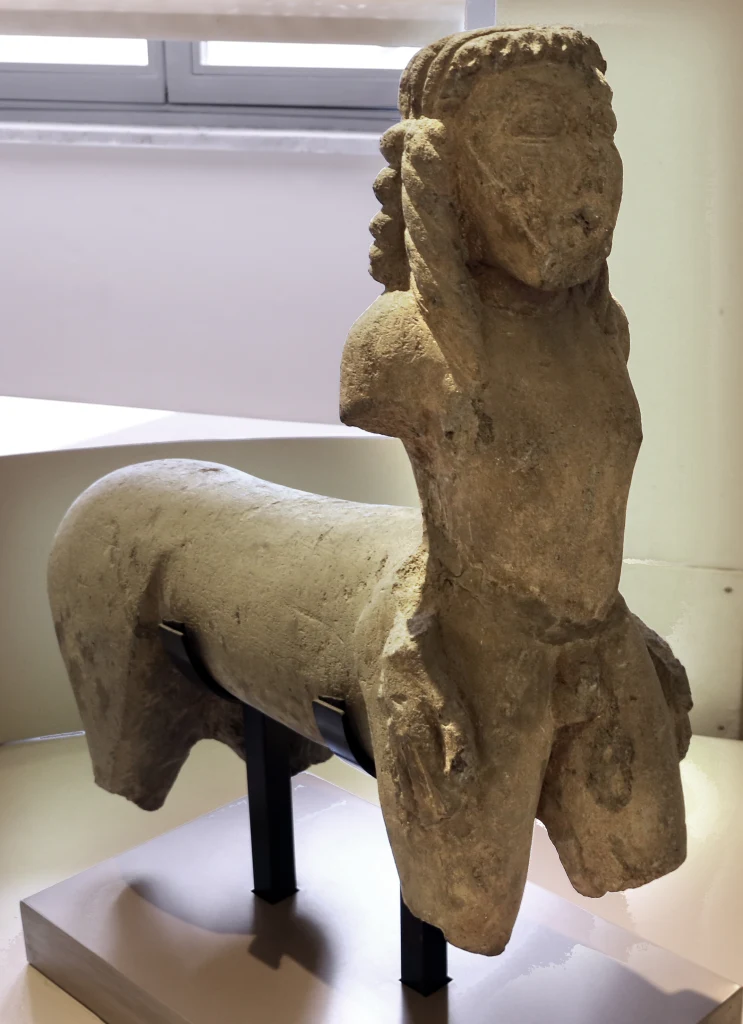
Centaur of Vulci
Details
The story
From the front this is a bearded young man walking slowly forward, arms at his sides, his long hair carefully dressed, with a row of curls along the forehead. Seen from the side, a horse's body joins his back. Centaurs with fully human front legs like these are less common than the familiar horse with a man's torso, though Greek and Etruscan artists used both.
He was carved in Vulci around 590 to 580 BC to guard a tomb, and he did not fare well. When the archaeologist Goffredo Bendinelli found him in 1919, the tomb had been looted and the statue lay broken in two, thrown out of the entrance corridor with the rubble, its base and lower legs missing. Trying to understand why a centaur would stand at a tomb, Bendinelli turned to Virgil's Aeneid and to Dante's Inferno, both of which place centaurs in the underworld.