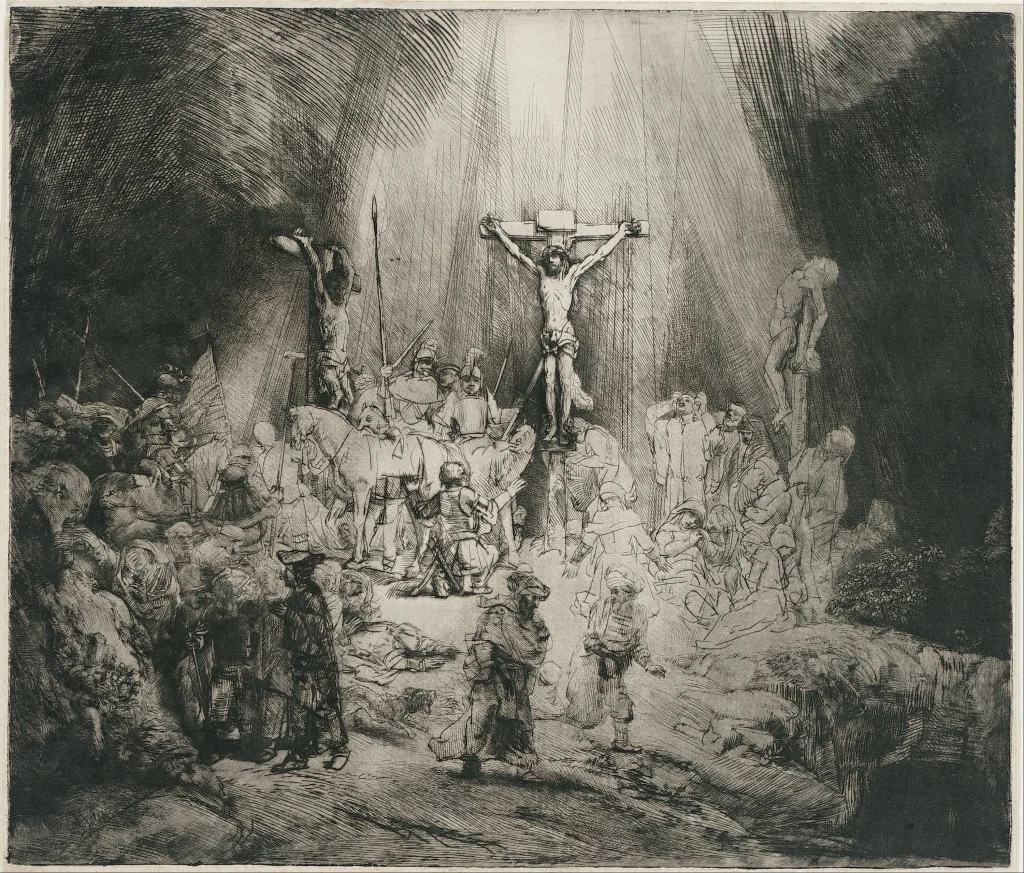
Christ Crucified Between the Two Thieves ("The Three Crosses")
Details
The story
Rembrandt scratched this crucifixion straight into the copper with a needle, a technique called drypoint, and that choice limited how many good impressions could ever exist. A drypoint line throws up a little ridge of metal along its edge, the burr, which holds ink and prints as a soft, velvety black. It also flattens with every pass through the press, and after a few dozen sheets the richest darks were gone. This sheet comes from the second of the stages Rembrandt worked the plate through, which print specialists call states. He had not yet signed it. His name and the date 1653 went in at the next state, when he cleared the plate for sale, and a few years later he scraped much of the scene away and redrew it in heavier darkness. Here the light still pours down broadly over Christ and the crowd. The impression once belonged to the Dukes of Arenberg, whose prints were auctioned in Stuttgart in 1902. It then passed to Albert Blum, a collector who lived between Switzerland and New Jersey, and reached Boston from a Zurich dealer in 1977.