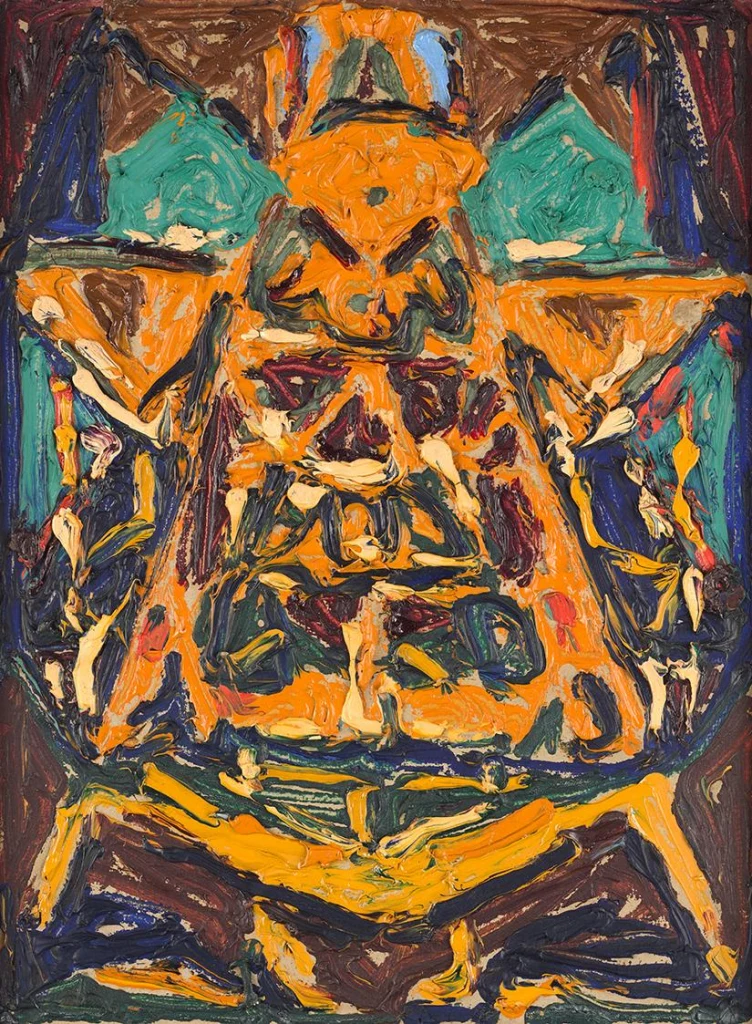
Crucifixion
Details
The story
In the middle of the First World War, Hölzel was working on his first large stained-glass commission, windows for the boardroom of the Bahlsen biscuit factory in Hanover. He had received the job in 1914, and the war delayed the installation until 1918. In 1916 he had also painted a Fugue on a Resurrection Theme, borrowing a musical form for a Christian subject.
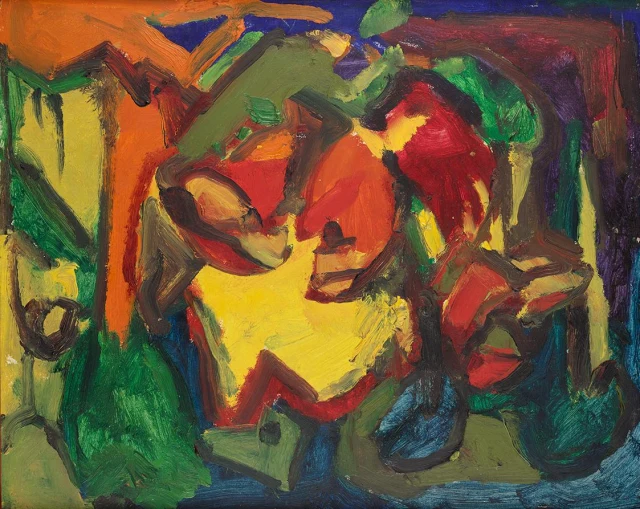
In this Crucifixion, dated to about 1917, the subject is almost buried under paint. The colour sits on the cardboard so thickly that it stands up in ridges, orange and yellow at the centre, turquoise and deep blue at the edges, everything held together by dark, heavy strokes. The picture is built symmetrically on a central orange form that widens toward the top. Small strokes of pale cream, set in near-mirror image on both halves, are the brightest notes on the panel.