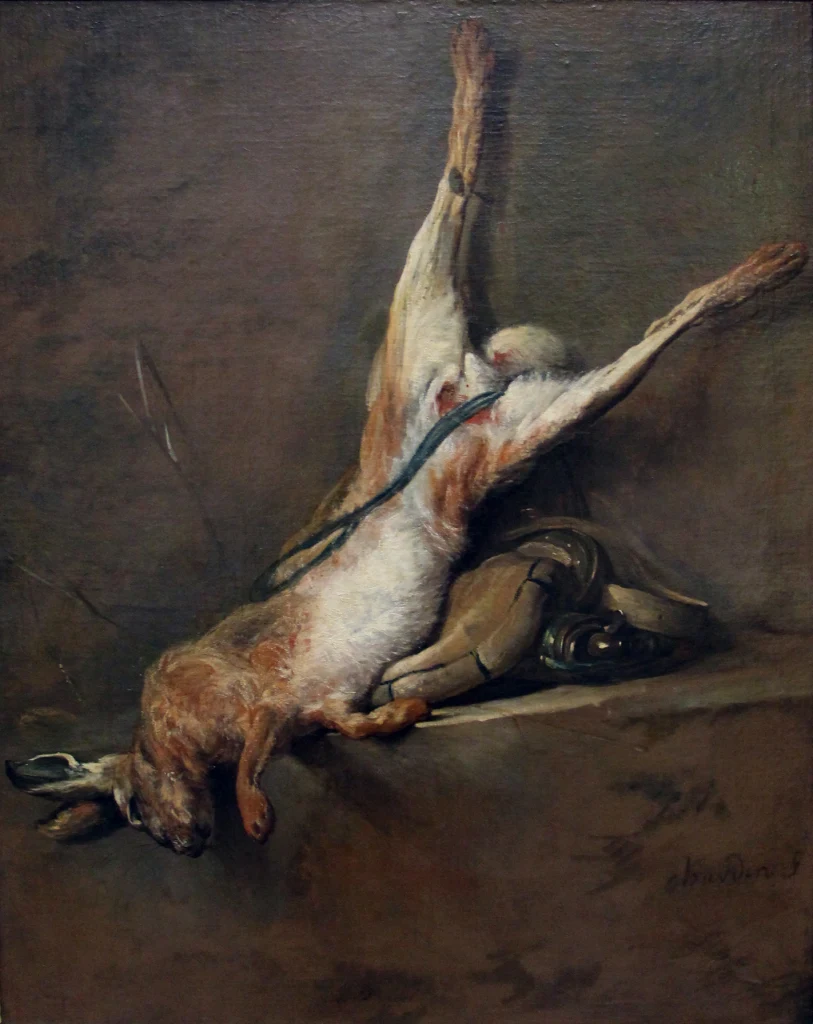
Dead Hare with Powder Flask and Game Bag
Details
The story
Nobody knows who owned this hare in the 18th century. The canvas first surfaces in 1925 on the Paris art market, and later belonged to Paul Cailleux, a Paris dealer in French 18th-century painting. It reached the Louvre in 1979 by dation, an arrangement created by a French law of 1968 that lets heirs pay inheritance tax with works of art instead of money, and it was restored the following year.
Chardin painted it around 1730, on a canvas nearly a metre high. The hare hangs by one hind leg against a bare wall, its body twisted across a game bag and a powder flask, and he signed at the lower right, Chardin f., short for fecit, made it. In 2017 the Louvre lent it to the Pushkin Museum in Moscow for an exhibition of Chaïm Soutine, the 20th-century painter of dead game and carcasses.