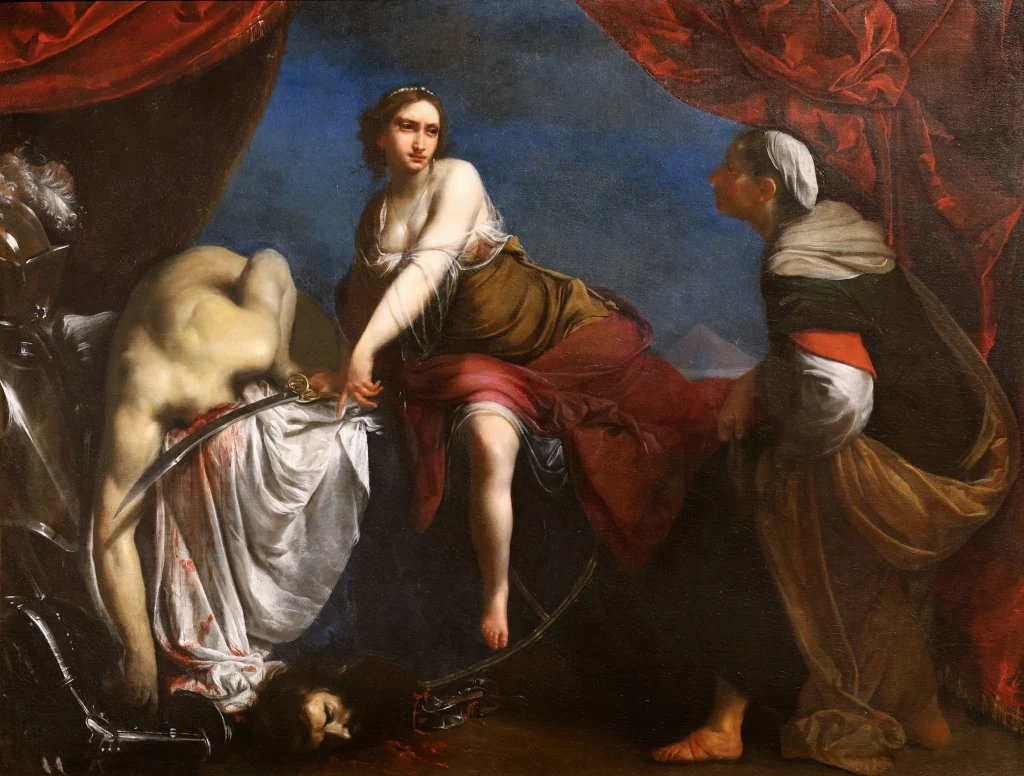
Judith and Holofernes
Details
The story
Florence had long counted Judith among its own heroes. In 1495, after the Medici were driven out, Donatello's bronze of her beheading Holofernes was set up on the Piazza della Signoria, the city's political heart, as a sign of the weak defeating a tyrant, and Michelangelo's David soon joined her there. Francesco Furini, a Florentine, painted his Judith between 1630 and 1635, and the museum finds something of that David in her proud look. Yet he sets her, half undressed, on the enemy's bed. The scene is the night in the tent from the Book of Judith. The Assyrian general already lies headless on the bloodied sheets, and Judith, the sword still in her fist, points out the trophy to her maid Abra, who will carry it away. Her foot points too, down at a pair of elegant unlaced shoes. The museum traces the detail to the song of Judith in the Bible, which says that her sandals ravished the eyes of Holofernes. The canvas came to the state in 1948 as a gift from the Dusmet collection.