Plate with a Wolf-Man Demon and the Abduction of Deianira
Details
The story
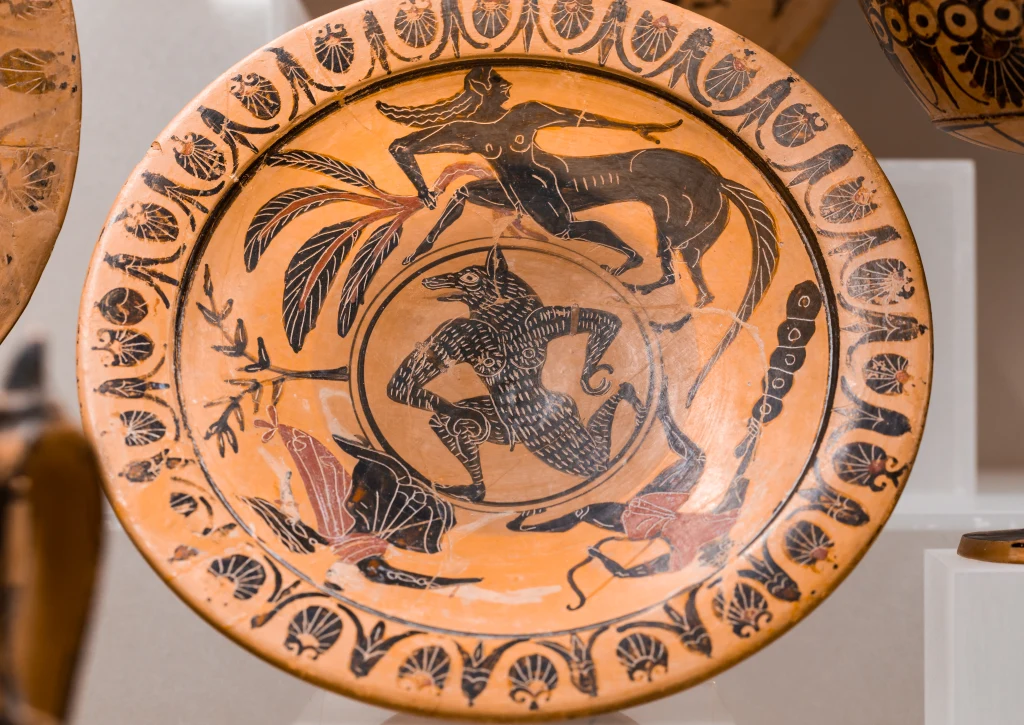
In the middle of this plate a hairy creature with the head of a dog or a wolf runs, legs bent in the kneeling stride that archaic painters used for speed. No Greek myth accounts for him, and the vases of this Etruscan group never carry inscriptions, so nothing on the plate gives his name. The museum's label calls him a deity of the wolf-man. Later Etruscan art keeps the same link between wolves and the dead. In the Tomb of Orcus at Tarquinia, painted in the 4th century BC, Aita, the lord of the underworld, wears a wolf's head as his cap.
Around the demon runs a story the Greeks did tell. The centaur Nessos carries off Deianira, the wife of Herakles, and Herakles, here holding his bow, comes after them past a tree. In the version later staged by Sophocles, Herakles shot Nessos with an arrow, and the dying centaur gave Deianira his blood as a love charm that would one day kill her husband. The plate was painted at Vulci in the late 6th century BC and found in tomb 177 of the city's Osteria cemetery.