Porcelain Cabinet of Queen Maria Amalia
Details
The story
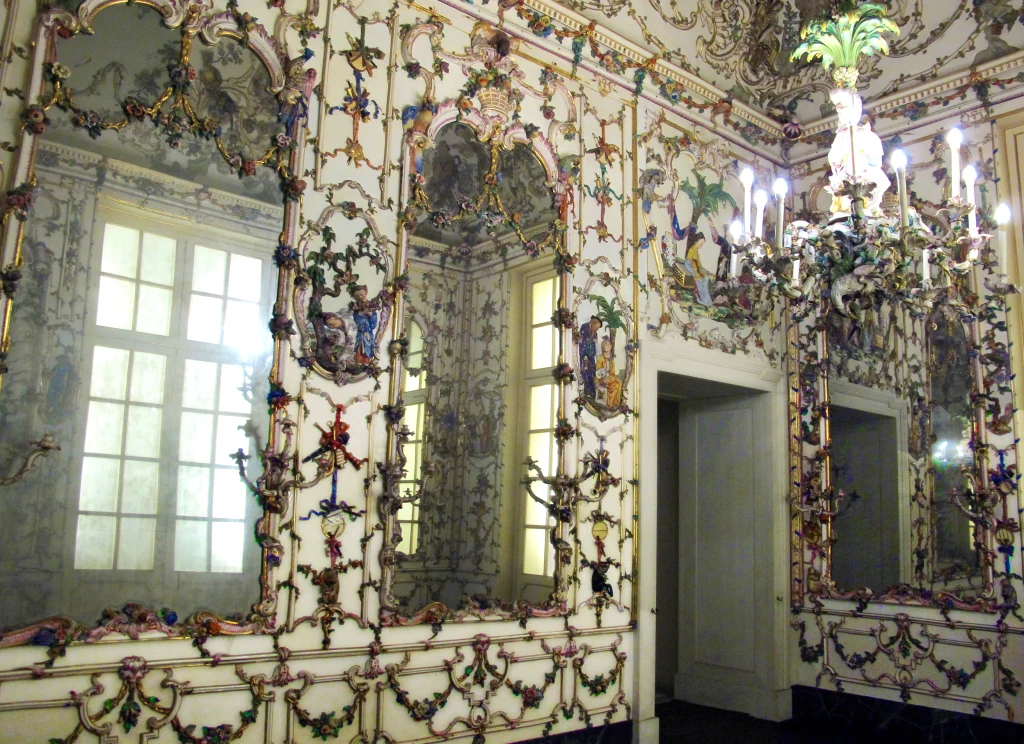
Queen Maria Amalia grew up at the Saxon court, where her grandfather Augustus the Strong had founded Meissen, the first works in Europe to make true hard-paste porcelain. In 1743 she and her husband, Charles of Bourbon, King of Naples, started their own manufactory in the park of Capodimonte, and in 1757 it set about lining a whole room for her palace at Portici, below Vesuvius, with about 3,000 porcelain pieces. The walls show a China invented in Europe: figures in long yellow and blue robes, small dark monkeys on the gilded lattice, and cartouches in Chinese characters praising the king. The room was finished in 1759. Within months Charles inherited the Spanish throne and left for Madrid with the best craftsmen, the moulds and the materials. In 1866 the room was taken apart and rebuilt here, on the hill where its porcelain had been made. Its stucco ceiling, painted to look like porcelain, stayed behind at Portici until 1957, when it was sawn into 18 pieces and carried up to rejoin the walls.