Relief of Rahotep
Details
The story
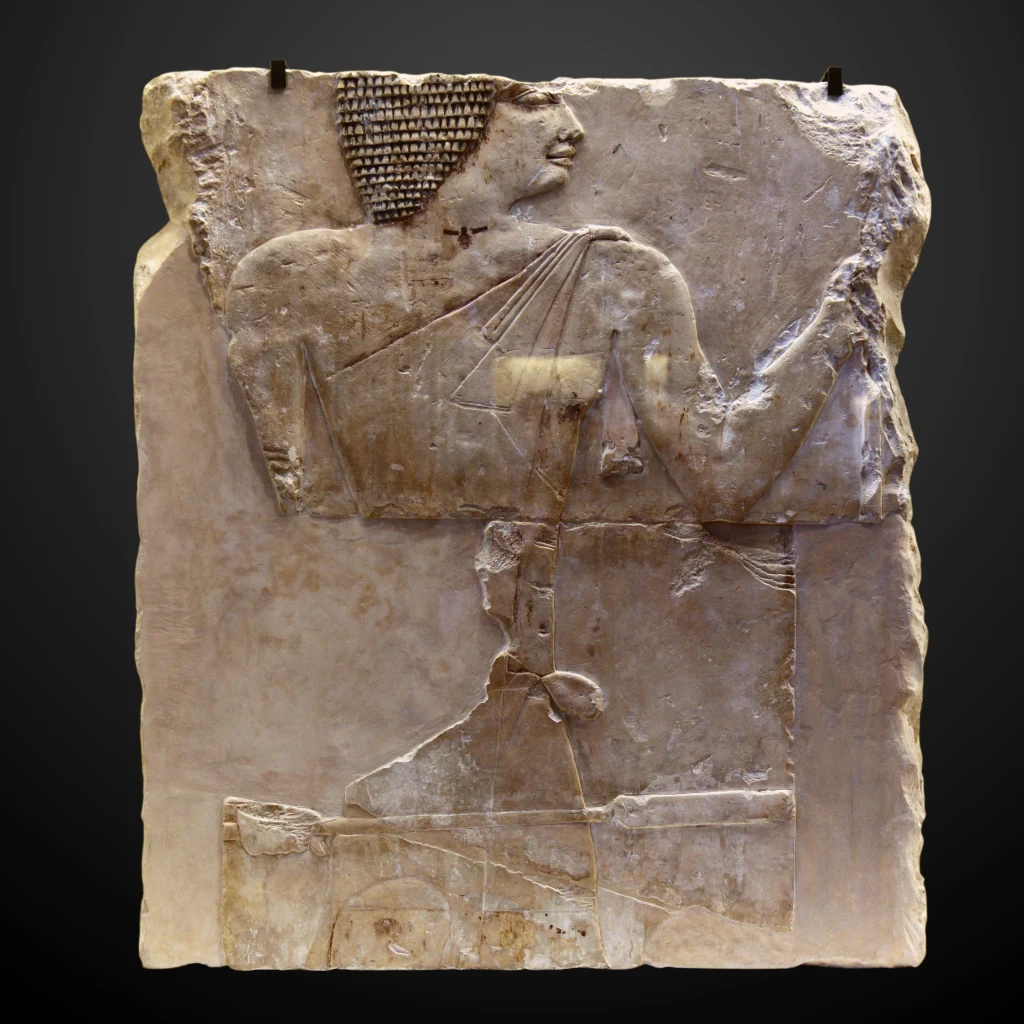
Most people who know the name Rahotep know it from a pair of painted statues found in 1871, the prince and his wife Nofret seated side by side, with eyes inlaid in stone. Those statues stayed in Egypt. This relief comes from the same man. The Louvre records its findspot as the mastaba of Rahotep at Meidum, the cemetery beside the pyramid of King Sneferu, who was probably his father, and dates it to the reigns of Sneferu or his son Khufu, more than 4,600 years ago.
Among Rahotep's titles was high priest of Ra at Heliopolis. Here he stands carved in raised relief, left arm forward, in a short curled wig, a collar, a bracelet and a panther skin, holding a long staff and a kherep sceptre, an emblem of command. Traces of red and black paint survive. The block reached the museum in two fragments, now rejoined, and other pieces of his tomb chapel are in the British Museum. The Duke of Trévise bought it from the collector Max Herz, an architect working in Cairo, and gave it to the Louvre through its friends' society in 1913.