Stele of Nefertiabet
Details
The story
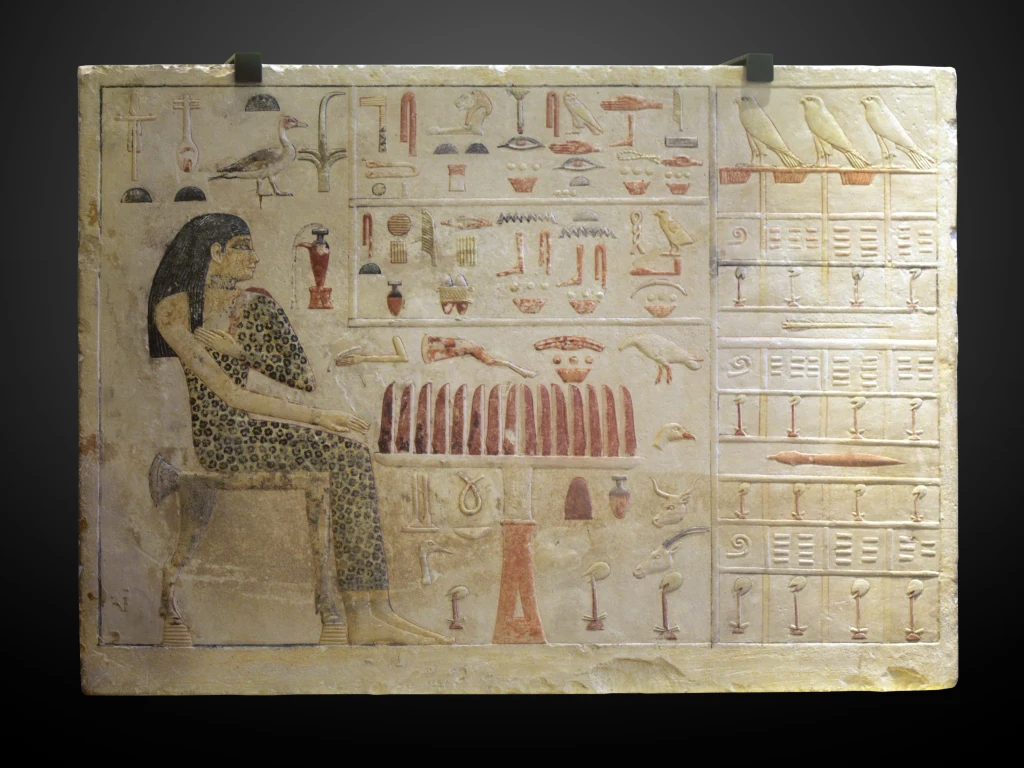
In the reign of Khufu, the king who built the Great Pyramid, or under one of his two successors, a princess named Nefertiabet was buried in a mastaba in the cemetery west of the pyramid at Giza. Her name means beautiful one of the east, and on this slab her title is king's daughter. Whose daughter is not stated.
The slab was set into the outer face of her tomb, and it belongs to a small group of such stelae from Giza, about 15 slabs and fragments in all. Nefertiabet sits on a stool with bull's legs, wearing a leopard skin over her dress, and reaches towards a table of bread loaves. Around her the hieroglyphs list what she was to receive for eternity, ointments, bread and beer, oryx and beef, and on the right a grid of linens counted by type and quantity. The colours are still bright. Some of these slabs were found walled over by later building, which helps explain how well they have survived.
It was found in 1902 by Montague Ballard, an Englishman digging at Giza. The American collector Atherton Curtis bought it in 1912 from the dealers Jules Sambon and Jacob Hirsch, and he and his wife gave it to the Louvre. The gift was accepted in 1938.