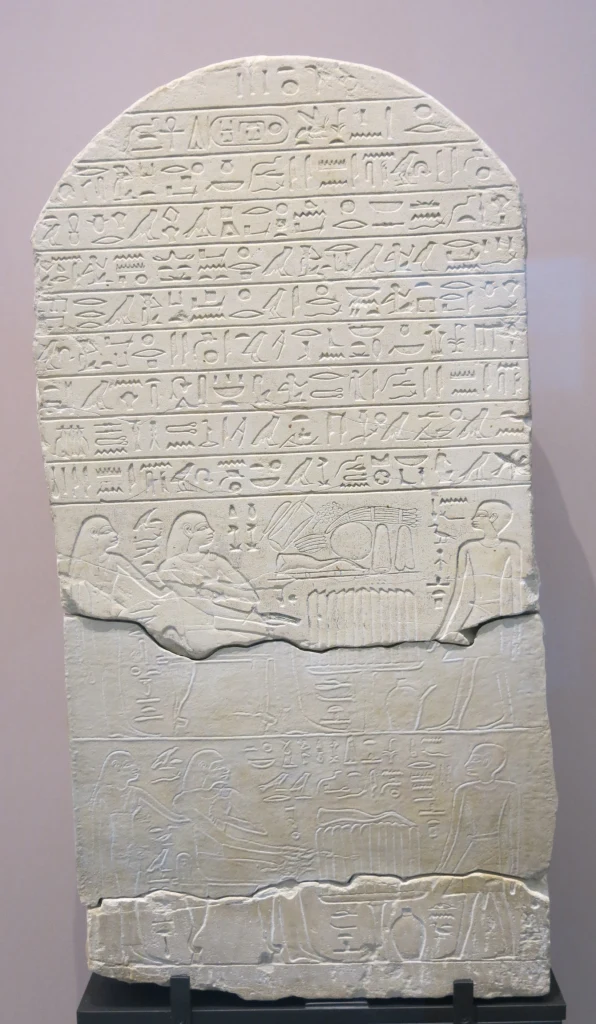
Stela of Imeny
Details
The story
Until 1870 this stone was whole. It had once stood at Abydos, the town of Osiris, god of the dead, where officials set up stelae in small chapels close to the god's processional way, and it came to the Louvre intact in 1857, bought at the sale of Giovanni Anastasi, a diplomat who had collected in Egypt. In October 1870, during the war with Prussia, with troops quartered in the Louvre, the curators' minutes record that a stela had been broken in the gallery of Henri IV. It was probably this one, which lost its centre.
What saved the missing part was a sheet of paper. Before the damage the Egyptologist Théodule Devéria had taken a squeeze, a paper impression of the carved surface. In 2025 the Louvre scanned that sheet in 3D, cast a replica of the lost fragment and fitted it, toned so that it can still be told apart from the ancient stone. The text is dated to the third year of the reign of Amenemhat II. It names Imeny, an official in charge of works, calls on the living to recite offerings for him and lists his family, and below, a seated man faces a table of offerings at a funerary meal.
More works by Unknown Egyptian artist (Middle Kingdom)
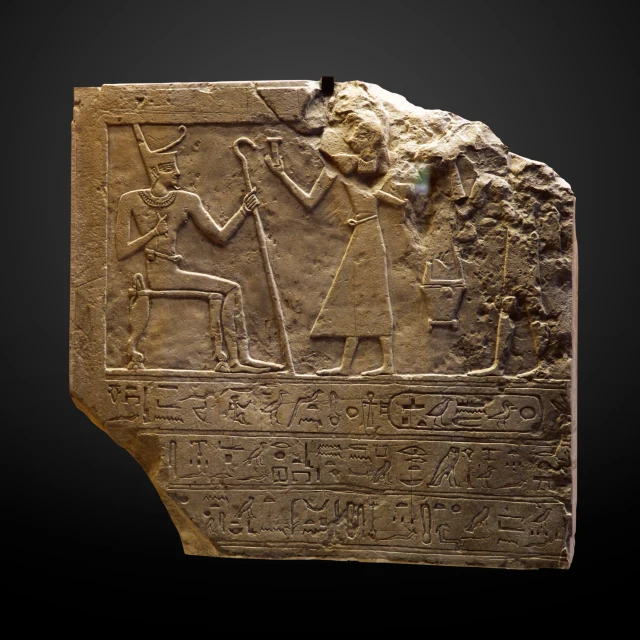 Fragmentary Stela with an Offering Scene before King Mentuhotep IIUnknown Egyptian artist (Middle Kingdom), -2019
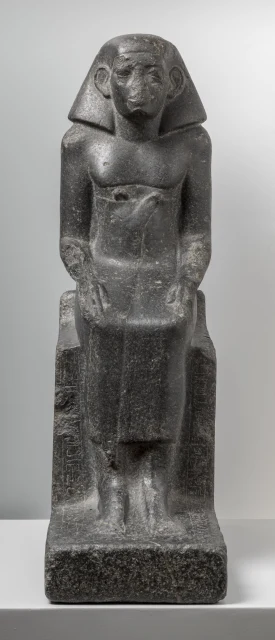 Statue of Kheperka, Overseer of FieldsUnknown Egyptian artist (Middle Kingdom), -1754
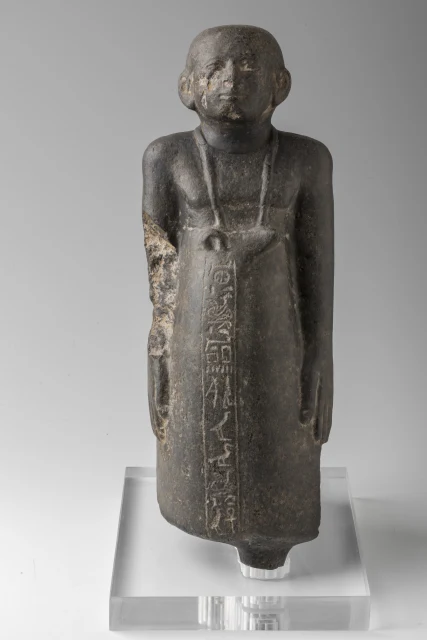 Statue of the Vizier IymeruUnknown Egyptian artist (Middle Kingdom), -1725
 Stela of Iri Receiving an OfferingUnknown Egyptian artist (Middle Kingdom), -1882
 Stela of Sakherty, Overseer of the TreasuryUnknown Egyptian artist (Middle Kingdom), -1915